377810582266825


Ngalng, Yawkyawk, Djanbokkon – Major Work

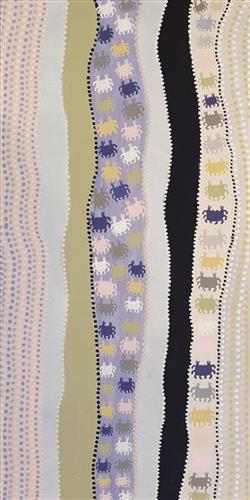
Ngalng (fresh water yabby)

‘This is a story from Mankorlod. This is a djang story. This is the creation story about the fresh water yabby. Starting with the stone, that’s the raw one and the cooked one. The stone rock suddenly turned to ngalng, in a flash. Ngalng started growing and turned into a body. It’s a magic one and it can change from rock to ngalng to human and back to ngalng. Now it’s a ngalng. 

The country is near Mankorlod and Korlobididah. The ngalng is stuck there forever on the rock at Korlobididah,’ 

‘There is also duruk (camp dog) called ‘Djanbokkon’. This is a duruk that comes from water and no one has seen it. This is a true duruk, he goes everywhere in the country. His body is striped. He is a secret dog and he has a secret story.’ 

Janet Marawarr 2022

Textile sourced in India during Janet’s trip in 2023. 100% Handloom Cotton/ Silk blend.

Photograph pending


116482267062


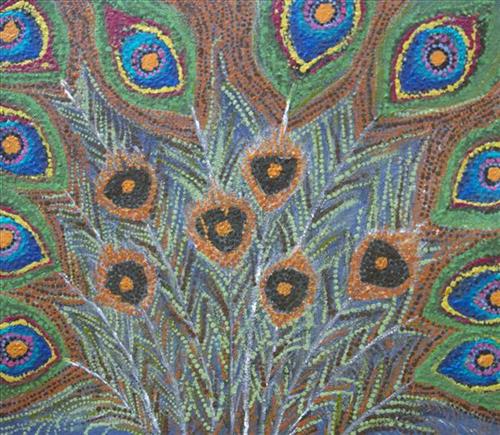
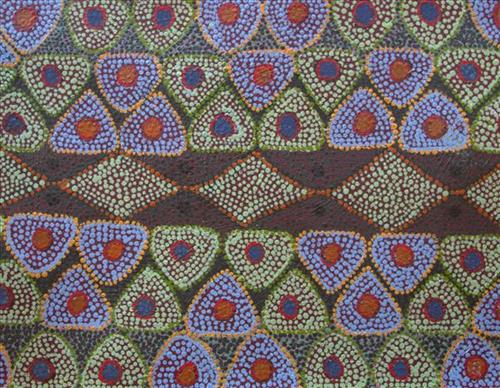
Peacock Feathers

This artwork is inspired by the beautiful and intricate peacock feather. They are such stunning colours.

116482267095


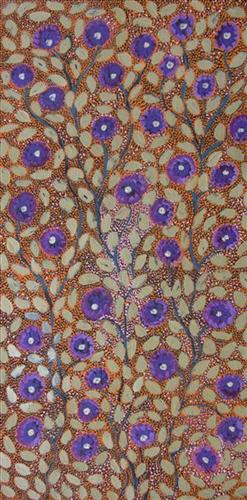
Mulla Mulla Around the Waterholes

The mulla mulla flower is very prominent in the Pilbara during wildflower season. They’re beautiful, resilient flowers that spring up and carpet the country.

116482267076


Bush Tomato Plants

The Bush Tomato, which grows in the Pilbara area, is like the tomato we get in the shop. It’s a small, very prickly bush. The tomato is usually green, but when it turns a yellowy colour you can eat it. You just clean the black seeds out from the inside because they’re very bitter, then you eat the rest of the inside part, and throw the skin away.

116482267068


Emu Seeds

In this painting I have depicted the pods of a shrub which is common in the Pilbara area. It is a smallish bush which comes into seed in September, when the Emu is visible in the Milky Way. This is the time the emu chicks hatch and it is one of their main sources of food. When the pod opens the parent emus feed the little black seeds to their chicks. The seed pod, which is about the size and the shape of a cockroach, turns from orange to yellow, so when all the bushes are in pod at different stages, there is a brilliant display of orange and yellow colours throughout the country. The official name of this annual shrub is Senna notabilis, but, due to the oblong, flat shape and the glossy golden brown colour of its pods, it is known commonly as Cockroach Bush. It has a little round fruit, a berry, that starts of green and turns red when it is ripe, but it’s poisonous. The shrub starts off as a light green colour and then, as it matures, it gets darker. The flowers are a yellowy orange and they, too, get darker with a bit of black as they are fading away.

116482267065


Olive Python Skin

This painting is the artists interpretation of snake skin and patterns of the scales. The olive python is one of Australia’s largest snakes.

116482267059


Pilbara Rocks

This painting I did is of the Pilbara rocks. These Pilbara rocks are coloured ochre, red and oranges, which glow bright across the rock face as the sun gets lower in the sky. They were used as building bricks to make houses when I was young.

225682267046


Baḻgurr Bathi

I learnt how to make baḻgurr bathi (string bags) from my mum when I lived in Milingimbi (Northern Territory) and worked with the Crocodile Islands Junior Rangers. We would go and collect baḻgurr (Kurrajong – Brachychiton Populneus).  We would cut good sized branches from the tree and then smash them with a rock on a hard surface to break up the fibres. Sometimes we dyed the fibres by boiling it with natural dyes.   Once smashed up, we would then strip and separate the fibres from the bark and let them dry in the sun.  Once dried we’d start twisting and rolling the fibres on our thigh to make a few meters of string and then weave it into a bag using the looping technique. This is a very time-consuming process.

Traditionally string bags are used by women and mothers to carry bush foods such as maypal (oysters).  These days people use the bags for their shopping and carrying items like mobile phones!

I am Garawirrtja on my mother’s side and Kuku-Yalanji on my father’s side. Doreen Collins

225682267044


Kubal

Kubal is the Kuku-Yalanji word for Brolga.

This painting is about the dancing kubal, she likes to dance around the waterways. The dancing brolga has a long tapering beak and long, slender legs. I love the way how the brolga dances around in circles.

225682267043


Kiju

Kiju (mud crab) is very good eating. I have been hunting kiju with my family all my life. We make a fire on the beach and wait for it to die down and then cook the kiju on the coals.  In my culture, we leave the shell where we catch the kiju so next time there will be plenty more to hunt and eat. This was what my elders taught me, and I am showing the young ones how to look after their Country and to do things the right way.

The best time to go hunting for mud crab is when the mangkurru (mangroves) are flowering.  That’s when we know the kiju is nice and fat.

Us Bama (people), use plants to tell us when to hunt or collect certain foods. It’s our culture and lore.