111576230126


Untitled

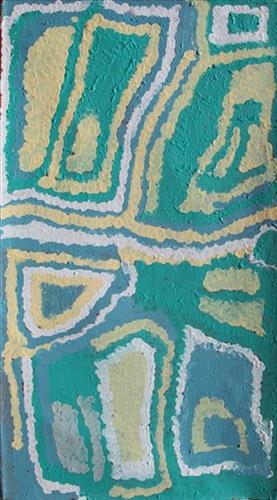
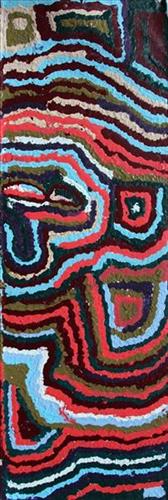
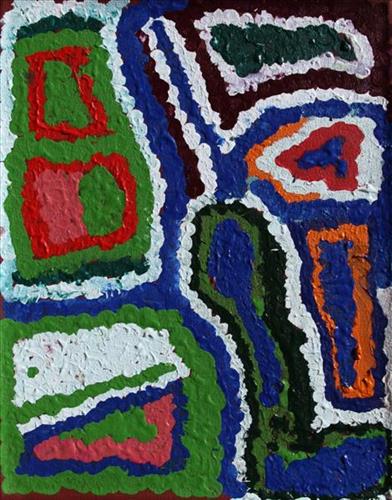
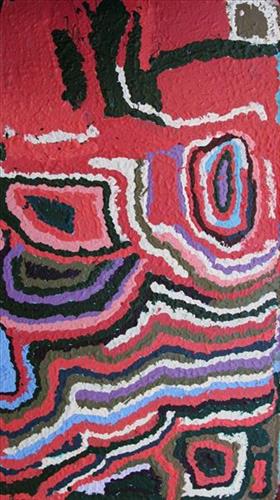
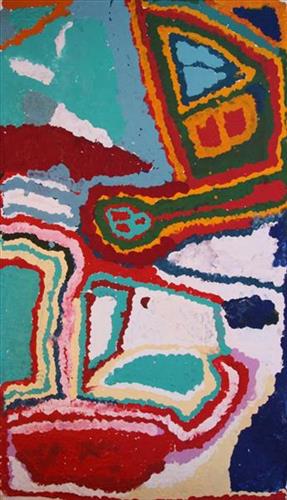
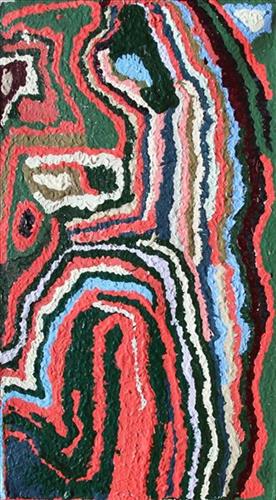
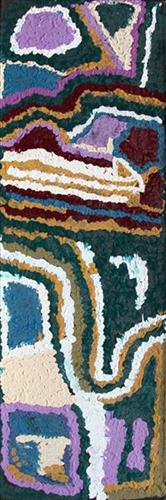
This is Mitutu’s Country- her ‘ngurra’ (home Country, camp). People identify with their ngurra in terms of specific rights and responsibilities, and the possession of intimate knowledge of the physical and cultural properties of one’s Country. Painting ngurra, and in so doing sharing the Jukurrpa (Dreaming) stories and physical characteristics of that place, has today become an important means of cultural maintenance. Mitutu’s ngurra encompasses her birthplace, Yirajarra soak, located close to Lake Auld and just north of Tiwa (Canning Stock Route Well 26), and the Country that her family walked in the pujiman (traditional, desert-dwelling) era, around the Karlamilyi (Rudall River) region.

Portrayed in this work are features of Mitutu’s family’s ngurra, such as the gorges and rivers, dominant permanent red tali (sandhills), warta (trees, vegetation), and the individually named water sources they camped at. Rock holes, waterholes, soaks and springs were all extremely important sites for Martu people during the pujiman period, and are generally depicted with circular forms. 

The encyclopaedic knowledge of the location, quality and seasonal availability of the hundreds of water bodies found in one’s Country sustained Martu as they travelled across their Country, hunting and gathering, visiting family, and fulfilling ceremonial obligations. They would traverse very large distances annually, visiting specific areas in the dry and wet season depending on the availability of water and the corresponding cycles of plant and animal life on which hunting and gathering bush tucker was reliant. As they travelled and hunted they would also burn areas of Country, generating a greater diversity of plant and animal life.
111576230123


Untitled

This is Mitutu’s Country- her ‘ngurra’ (home Country, camp). People identify with their ngurra in terms of specific rights and responsibilities, and the possession of intimate knowledge of the physical and cultural properties of one’s Country. Painting ngurra, and in so doing sharing the Jukurrpa (Dreaming) stories and physical characteristics of that place, has today become an important means of cultural maintenance. Mitutu’s ngurra encompasses her birthplace, Yirajarra soak, located close to Lake Auld and just north of Tiwa (Canning Stock Route Well 26), and the Country that her family walked in the pujiman (traditional, desert-dwelling) era, around the Karlamilyi (Rudall River) region.

Portrayed in this work are features of Mitutu’s family’s ngurra, such as the gorges and rivers, dominant permanent red tali (sandhills), warta (trees, vegetation), and the individually named water sources they camped at. Rock holes, waterholes, soaks and springs were all extremely important sites for Martu people during the pujiman period, and are generally depicted with circular forms. 

The encyclopaedic knowledge of the location, quality and seasonal availability of the hundreds of water bodies found in one’s Country sustained Martu as they travelled across their Country, hunting and gathering, visiting family, and fulfilling ceremonial obligations. They would traverse very large distances annually, visiting specific areas in the dry and wet season depending on the availability of water and the corresponding cycles of plant and animal life on which hunting and gathering bush tucker was reliant. As they travelled and hunted they would also burn areas of Country, generating a greater diversity of plant and animal life.
111576230121


Untitled

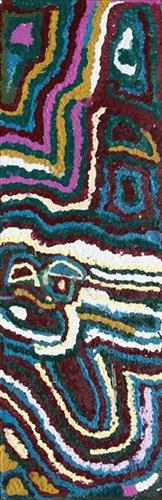
This is Mitutu’s Country- her ‘ngurra’ (home Country, camp). People identify with their ngurra in terms of specific rights and responsibilities, and the possession of intimate knowledge of the physical and cultural properties of one’s Country. Painting ngurra, and in so doing sharing the Jukurrpa (Dreaming) stories and physical characteristics of that place, has today become an important means of cultural maintenance. Mitutu’s ngurra encompasses her birthplace, Yirajarra soak, located close to Lake Auld and just north of Tiwa (Canning Stock Route Well 26), and the Country that her family walked in the pujiman (traditional, desert-dwelling) era, around the Karlamilyi (Rudall River) region.

Portrayed in this work are features of Mitutu’s family’s ngurra, such as the gorges and rivers, dominant permanent red tali (sandhills), warta (trees, vegetation), and the individually named water sources they camped at. Rock holes, waterholes, soaks and springs were all extremely important sites for Martu people during the pujiman period, and are generally depicted with circular forms. 

The encyclopaedic knowledge of the location, quality and seasonal availability of the hundreds of water bodies found in one’s Country sustained Martu as they travelled across their Country, hunting and gathering, visiting family, and fulfilling ceremonial obligations. They would traverse very large distances annually, visiting specific areas in the dry and wet season depending on the availability of water and the corresponding cycles of plant and animal life on which hunting and gathering bush tucker was reliant. As they travelled and hunted they would also burn areas of Country, generating a greater diversity of plant and animal life.
111576230118


Untitled

This is Mitutu’s Country- her ‘ngurra’ (home Country, camp). People identify with their ngurra in terms of specific rights and responsibilities, and the possession of intimate knowledge of the physical and cultural properties of one’s Country. Painting ngurra, and in so doing sharing the Jukurrpa (Dreaming) stories and physical characteristics of that place, has today become an important means of cultural maintenance. Mitutu’s ngurra encompasses her birthplace, Yirajarra soak, located close to Lake Auld and just north of Tiwa (Canning Stock Route Well 26), and the Country that her family walked in the pujiman (traditional, desert-dwelling) era, around the Karlamilyi (Rudall River) region.

Portrayed in this work are features of Mitutu’s family’s ngurra, such as the gorges and rivers, dominant permanent red tali (sandhills), warta (trees, vegetation), and the individually named water sources they camped at. Rock holes, waterholes, soaks and springs were all extremely important sites for Martu people during the pujiman period, and are generally depicted with circular forms. 

The encyclopaedic knowledge of the location, quality and seasonal availability of the hundreds of water bodies found in one’s Country sustained Martu as they travelled across their Country, hunting and gathering, visiting family, and fulfilling ceremonial obligations. They would traverse very large distances annually, visiting specific areas in the dry and wet season depending on the availability of water and the corresponding cycles of plant and animal life on which hunting and gathering bush tucker was reliant. As they travelled and hunted they would also burn areas of Country, generating a greater diversity of plant and animal life.
111576230097


Untitled

This is Mitutu’s Country- her ‘ngurra’ (home Country, camp). People identify with their ngurra in terms of specific rights and responsibilities, and the possession of intimate knowledge of the physical and cultural properties of one’s Country. Painting ngurra, and in so doing sharing the Jukurrpa (Dreaming) stories and physical characteristics of that place, has today become an important means of cultural maintenance. Mitutu’s ngurra encompasses her birthplace, Yirajarra soak, located close to Lake Auld and just north of Tiwa (Canning Stock Route Well 26), and the Country that her family walked in the pujiman (traditional, desert-dwelling) era, around the Karlamilyi (Rudall River) region.

Portrayed in this work are features of Mitutu’s family’s ngurra, such as the gorges and rivers, dominant permanent red tali (sandhills), warta (trees, vegetation), and the individually named water sources they camped at. Rock holes, waterholes, soaks and springs were all extremely important sites for Martu people during the pujiman period, and are generally depicted with circular forms. 

The encyclopaedic knowledge of the location, quality and seasonal availability of the hundreds of water bodies found in one’s Country sustained Martu as they travelled across their Country, hunting and gathering, visiting family, and fulfilling ceremonial obligations. They would traverse very large distances annually, visiting specific areas in the dry and wet season depending on the availability of water and the corresponding cycles of plant and animal life on which hunting and gathering bush tucker was reliant. As they travelled and hunted they would also burn areas of Country, generating a greater diversity of plant and animal life.
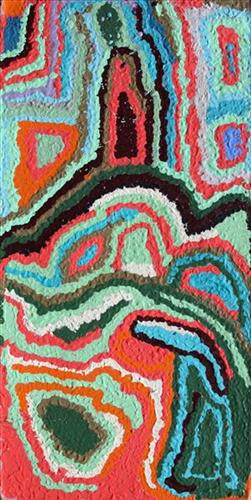
111576333697


Yirrajarra

“Yirrajarra, it’s a yinta (permanent spring) in Warman Country. That’s my camp, that’s my place, that’s my Country. Home there,”

–  Mitutu Mabel Wakarta (dec.)

Yirrajarra comprises of two soaks situated near Lake Auld, and north of Tiwa (Canning Stock Route Well 26). As the site of a continuous source of good fresh water, surrounded by plentiful puri (shade), Yirrajarra was an important semi-permanent camping ground during the pujiman (traditional, desert dwelling) era. 

Yirrajarra is Mabel Mitutu’s birthplace, and as such an integral part of her ngurra (home Country, camp). Having walked all of this country with her family in her youth, Mabel Mitutu here depicts her knowledge of the region and its features in detail. Physical characteristics of the land and the location of its resources are portrayed alongside the Jukurrpa (Dreaming) narratives associated with this area.

During the pujiman period, Martu would traverse very large distances annually in small family groups, moving seasonally from water source to water source, and hunting and gathering bush tucker as they went. At this time knowledge of water sources was critical for survival, and today Martu Country is still defined in terms of the location and type of water. Each of the hundreds of claypans, rockholes, waterholes, soaks and springs found in the Martu desert homelands is known by name, location, quality and seasonal availability through real life experience and the recounting of Jukurrpa (dreaming) narratives.

111576333978


Warla (lake)

This is Mitutu’s Country- her ‘ngurra’ (home Country, camp). People identify with their ngurra in terms of specific rights and responsibilities, and the possession of intimate knowledge of the physical and cultural properties of one’s Country. Painting ngurra, and in so doing sharing the Jukurrpa (Dreaming) stories and physical characteristics of that place, has today become an important means of cultural maintenance. Mitutu’s ngurra encompasses her birthplace, Yirajarra soak, located close to Lake Auld and just north of Tiwa (Canning Stock Route Well 26), and the Country that her family walked in the pujiman (traditional, desert-dwelling) era, around the Karlamilyi (Rudall River) region.

Portrayed in this work are features of Mitutu’s family’s ngurra, such as the gorges and rivers, dominant permanent red tali (sandhills), warta (trees, vegetation), and the individually named water sources they camped at. Rock holes, waterholes, soaks and springs were all extremely important sites for Martu people during the pujiman period, and are generally depicted with circular forms. 

The encyclopaedic knowledge of the location, quality and seasonal availability of the hundreds of water bodies found in one’s Country sustained Martu as they travelled across their Country, hunting and gathering, visiting family, and fulfilling ceremonial obligations. They would traverse very large distances annually, visiting specific areas in the dry and wet season depending on the availability of water and the corresponding cycles of plant and animal life on which hunting and gathering bush tucker was reliant. As they travelled and hunted they would also burn areas of Country, generating a greater diversity of plant and animal life.
111576340161


Untitled

This is Mitutu’s Country- her ‘ngurra’ (home Country, camp). People identify with their ngurra in terms of specific rights and responsibilities, and the possession of intimate knowledge of the physical and cultural properties of one’s Country. Painting ngurra, and in so doing sharing the Jukurrpa (Dreaming) stories and physical characteristics of that place, has today become an important means of cultural maintenance. Mitutu’s ngurra encompasses her birthplace, Yirajarra soak, located close to Lake Auld and just north of Tiwa (Canning Stock Route Well 26), and the Country that her family walked in the pujiman (traditional, desert-dwelling) era, around the Karlamilyi (Rudall River) region.

Portrayed in this work are features of Mitutu’s family’s ngurra, such as the gorges and rivers, dominant permanent red tali (sandhills), warta (trees, vegetation), and the individually named water sources they camped at. Rock holes, waterholes, soaks and springs were all extremely important sites for Martu people during the pujiman period, and are generally depicted with circular forms. 

The encyclopaedic knowledge of the location, quality and seasonal availability of the hundreds of water bodies found in one’s Country sustained Martu as they travelled across their Country, hunting and gathering, visiting family, and fulfilling ceremonial obligations. They would traverse very large distances annually, visiting specific areas in the dry and wet season depending on the availability of water and the corresponding cycles of plant and animal life on which hunting and gathering bush tucker was reliant. As they travelled and hunted they would also burn areas of Country, generating a greater diversity of plant and animal life.
111576429855


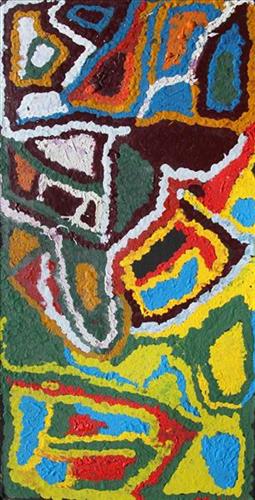
Untitled

This is Mitutu’s Country- her ‘ngurra’ (home Country, camp). People identify with their ngurra in terms of specific rights and responsibilities, and the possession of intimate knowledge of the physical and cultural properties of one’s Country. Painting ngurra, and in so doing sharing the Jukurrpa (Dreaming) stories and physical characteristics of that place, has today become an important means of cultural maintenance. Mitutu’s ngurra encompasses her birthplace, Yirajarra soak, located close to Lake Auld and just north of Tiwa (Canning Stock Route Well 26), and the Country that her family walked in the pujiman (traditional, desert-dwelling) era, around the Karlamilyi (Rudall River) region.

Portrayed in this work are features of Mitutu’s family’s ngurra, such as the gorges and rivers, dominant permanent red tali (sandhills), warta (trees, vegetation), and the individually named water sources they camped at. Rock holes, waterholes, soaks and springs were all extremely important sites for Martu people during the pujiman period, and are generally depicted with circular forms. 

The encyclopaedic knowledge of the location, quality and seasonal availability of the hundreds of water bodies found in one’s Country sustained Martu as they travelled across their Country, hunting and gathering, visiting family, and fulfilling ceremonial obligations. They would traverse very large distances annually, visiting specific areas in the dry and wet season depending on the availability of water and the corresponding cycles of plant and animal life on which hunting and gathering bush tucker was reliant. As they travelled and hunted they would also burn areas of Country, generating a greater diversity of plant and animal life.
111576429844


Parnngurr

This is Mitutu’s Country- her ‘ngurra’ (home Country, camp). People identify with their ngurra in terms of specific rights and responsibilities, and the possession of intimate knowledge of the physical and cultural properties of one’s Country. Painting ngurra, and in so doing sharing the Jukurrpa (Dreaming) stories and physical characteristics of that place, has today become an important means of cultural maintenance. Mitutu’s ngurra encompasses her birthplace, Yirajarra soak, located close to Lake Auld and just north of Tiwa (Canning Stock Route Well 26), and the Country that her family walked in the pujiman (traditional, desert-dwelling) era, around the Karlamilyi (Rudall River) region.

Portrayed in this work are features of Mitutu’s family’s ngurra, such as the gorges and rivers, dominant permanent red tali (sandhills), warta (trees, vegetation), and the individually named water sources they camped at. Rock holes, waterholes, soaks and springs were all extremely important sites for Martu people during the pujiman period, and are generally depicted with circular forms. 

The encyclopaedic knowledge of the location, quality and seasonal availability of the hundreds of water bodies found in one’s Country sustained Martu as they travelled across their Country, hunting and gathering, visiting family, and fulfilling ceremonial obligations. They would traverse very large distances annually, visiting specific areas in the dry and wet season depending on the availability of water and the corresponding cycles of plant and animal life on which hunting and gathering bush tucker was reliant. As they travelled and hunted they would also burn areas of Country, generating a greater diversity of plant and animal life.