111982270111


Ngalkodjek Yawkyawk

This artwork depicts the Ngalkodjek Yawkyawk of Barrihdjowkkeng country.

“This story is very old. That old man [my father Crusoe Kuningbal] when he was alive, told that story to me, to all of us. He told us about the yawkyawk (mermaid) spirit women called Ngalkodjek who lives in the billabong on my country. He told us how they call out loudly, how they call out as they walk along.

That is what they do, calling out. They walked around eating bush foods like those little bush yams. They would pound the yams into a pulp and eat them. That is their traditional food which they eat.

When they walk down from the bush, they follow a set path that belongs to them and they walk along calling out. That is their path which they take. It is an old traditional route.

They placed a woman’s breast into the country. That rock was not there originally, but it was a woman’s breast. It is the breast of those women.

They put that djang [sacred place] there, and then at the time when non-Aboriginal people arrived in the region, then the breast turned to stone. Now it has turned solid into rock.”

– Owen Yalandja
222082276342


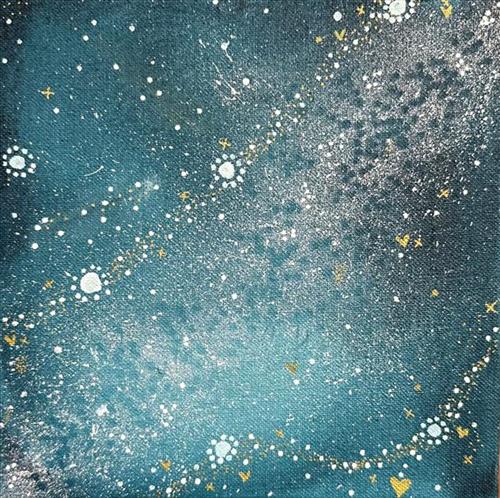
everything

Past, present, and future intertwined. No true loss occurs. As spirits, we transform into stardust, amid the comforting echoes of those who preceded us. Our celestial imprints and stories into the limitless expanse of Dreaming, making us an intrinsic part of the entirety that has always been and ever will be.

222082276341


dreaming

In the physical passage of those dear to us their spirit and essence merges with the Dreamtime. Past, present, and future converge, nothing is lost. Their spirits dance among ones who went before. Joyous, safe, ready. Leaving tracks, memories and knowledge behind. Singing stories into the endless expanse of Dreaming. Our loved ones become timeless constellations, guiding lights for us through the landscapes of existence.

115682275578


Baru Dhawu (Crocodile Story)

Baru (the crocodile man), was from the Gumatj clan. People usually call him Gurdu Gurdu or Baru which means crocodile. He lived his life at a place called Yirrkala. Living near him were other people, and when Baru didn’t have enough to eat he began to kill and eat these other people. After a while others noticed that some people were missing. When Baru went to the toilet, the people could smell this strong smell, so they knew that he ate the other people. Some men went to get help and they took message sticks to the other tribes. Some were sending smoke signals. When they came to Baru’s camp they started to spear him in the left side of his ribs. He dropped into the fire and burnt his left hand and maybe his right hand. He then ran into the bush and yelled to his countrymen – the animals, birds and fish that live on the land and in the sea. He stopped and he named the tribes and clans and also the places until he came to a place called Gamarru/Guyurru. There he took a rest and said to himself “This is where I stop and call this place Gamarru/Guyurru”. Baru, still in pain from the fire, then jumped into the water and turned himself into a crocodile. The fire left scars on his back. Baru paintings belong to Gumatj and Warrawarra and also the Marpi clan. This painting is used at death ceremonies or initiations and it normally is painted on the belly, which means the person the design is painted on is part of Gurdu Gurdu (the crocodile people).

377810582275936


Marebu and Bush Dye

The print design is Marebu (woven pandanus mats).

Artists usually use kundayarr, pandanus spiralis, to weave decorative round or oblong mats, as well as the less common triangular and conical shapes. Weaving is physically hard work, now done only by women. They colour the pandanus using natural dyes made from the roots, leaves or flowers of plants within the weaver’s clan estate.

The radial woven patterns of the finest round mats appear to vibrate with colour, sometimes regarded as an aesthetic manifestation of deep cultural meaning, as there is a significant spiritual dimension to pandanus mats.

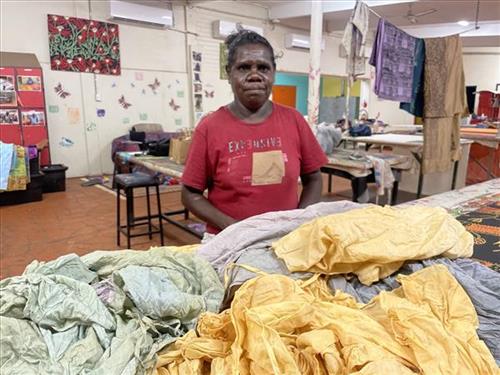
Jocelyn has dyed this silk at Bolkjam Outstation where she was residing over the dry season for ceremony. She has used yellow colour from the root of the man-kurdudjumuk plant (coelospermum reticulatum) which grows in sandy country near the flood plains. Jocelyn had to shave the root in a llaborious process before boiling the fabric in water over hours of boiling. The silk is left with a slightly rough texture. 

377810582275923


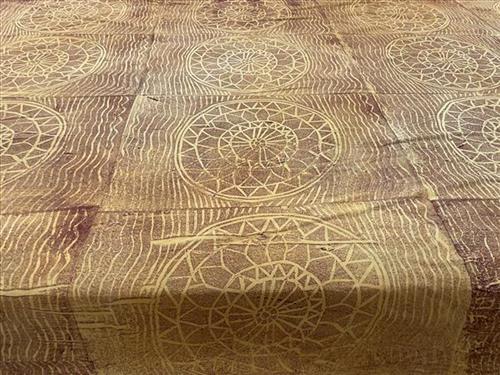
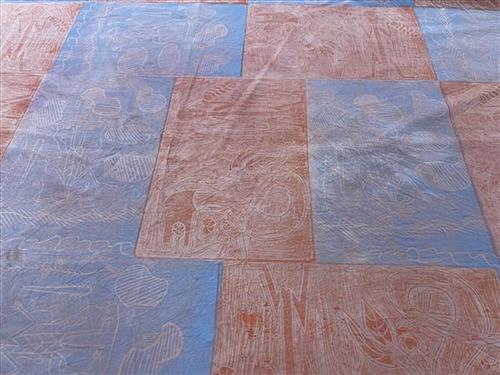
Buluwana (Kuninjku Spirit Woman) 2022

Abigail and her late mother, the renowned Kuninjku fibre and textile artist Jennifer Wurrkidj created this design together. Ruth said her mum was telling the story of Buluwana while they were sitting and drawing.

“She’s an old lady from our ancestor creation time, before mimih spirits roamed the land. Her skin name is Wamutjan– she is from the Dhuwa moiety. When the mimih came to our country, she turned into stone out Yikarrakkal and Manmoyi way.

She lives in a sacred place, where she turned to stone she lives there now forever. She is an important woman for my people.

I draw her because she my dreaming. I can’t tell the full story about Buluwana, because it’s a little bit secret, but it’s okay for me to paint her and share these parts. My people can know the full Buluwana story, and the djungkay (caretaker) can tell the full Buluwana story too.” J. Wurrkidj

This is a collaborative work with Abigail Namundja. Abigail has printed her mother’s Lino designs on a soft bush dyed cotton. 

377810582275920


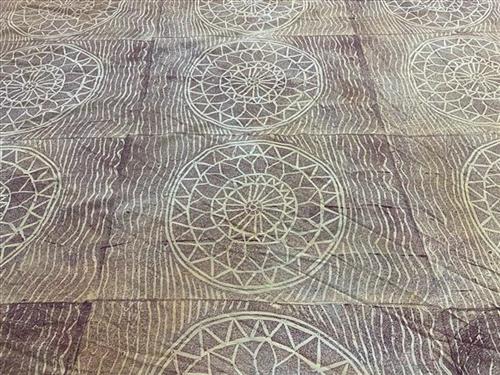
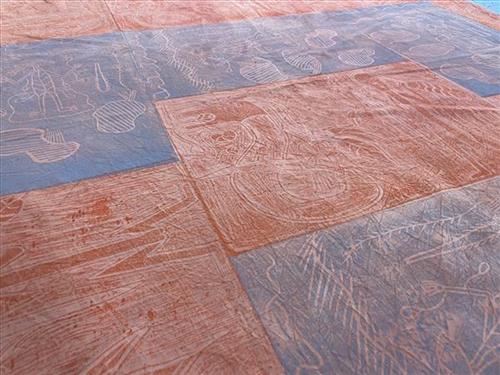
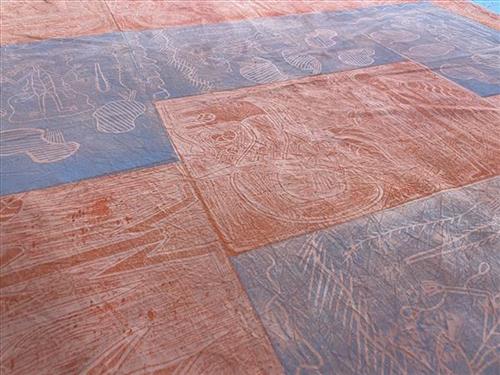
Buluwana (Kuninjku Spirit Woman) 2022

Abigail and her late mother, the renowned Kuninjku fibre and textile artist Jennifer Wurrkidj created this design together. Ruth said her mum was telling the story of Buluwana while they were sitting and drawing.

“She’s an old lady from our ancestor creation time, before mimih spirits roamed the land. Her skin name is Wamutjan– she is from the Dhuwa moiety. When the mimih came to our country, she turned into stone out Yikarrakkal and Manmoyi way.

She lives in a sacred place, where she turned to stone she lives there now forever. She is an important woman for my people.

I draw her because she my dreaming. I can’t tell the full story about Buluwana, because it’s a little bit secret, but it’s okay for me to paint her and share these parts. My people can know the full Buluwana story, and the djungkay (caretaker) can tell the full Buluwana story too.” J. Wurrkidj

This is a collaborative work with Jocelyn Koyole. Abigail has printed her mothers Lino design on a soft cotton bush dye fabric.