11151030305


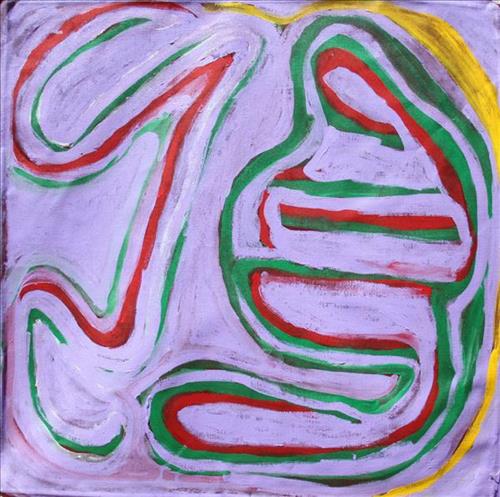
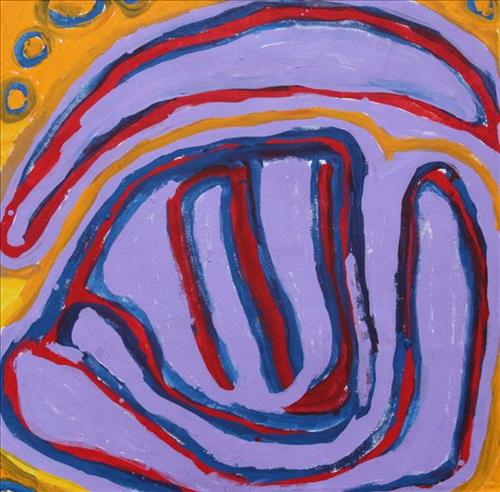
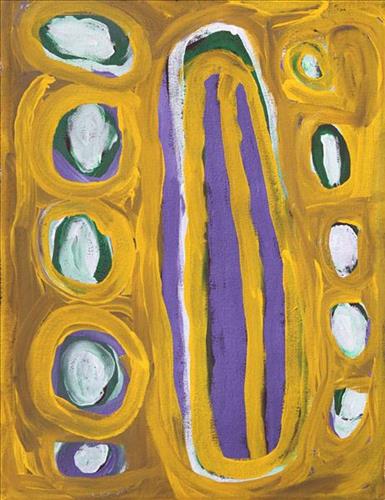
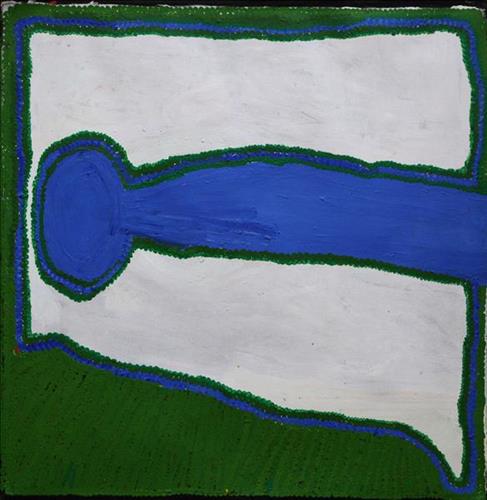
Pilkarti Jila

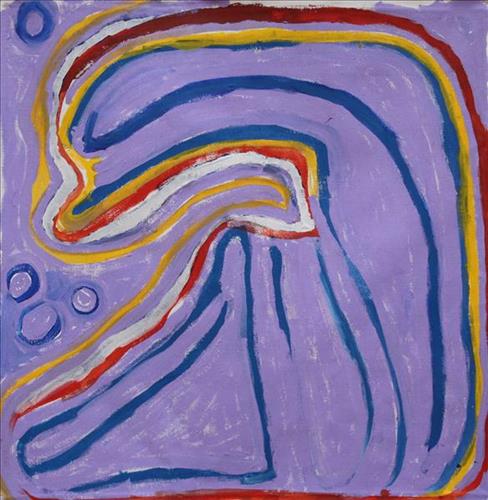
This painting depicts Pilkarti Jila (Jarriny for Nungabar). This artist primarily paints her country in the Canning Stock Route area. As a younger woman the artist lived and travelled traditionally with her family during the pujiman (bush) days. They travelled up and down the Stock Route from well 33 to well 38 and as far as Balgo. Well 33 is now known as Kunawarritji Community and is the artist’s ngurra (home).

11151030678


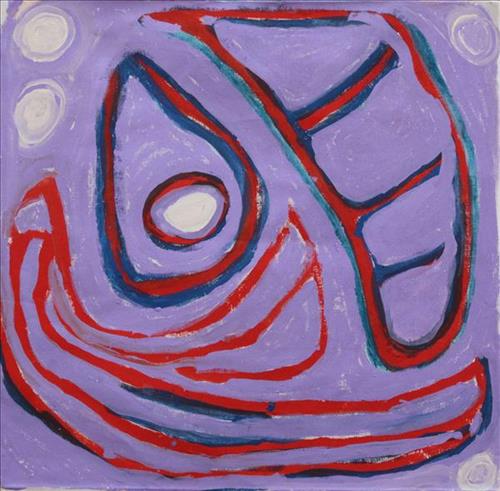
Wurungkura

This artist primarily paints her country in the Canning Stock Route area. As a younger woman the artist lived and travelled traditionally with her family during the pujiman (bush) days. They travelled up and down the Stock Route from well 33 to well 38 and as far as Balgo. Well 33 is now known as Kunawarritji Community and is the artist’s ngurra (home).

11151030677


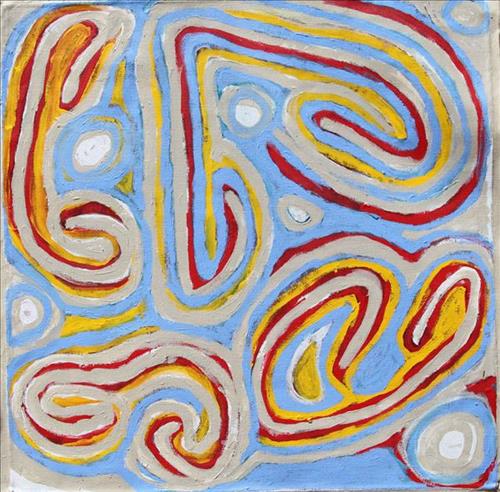
Ngaipi, Kukailpi, Kinyu, Tjuinpa

This is Nungabar’s Country- her ‘ngurra’ (home Country, camp). People identify with their ngurra in terms of specific rights and responsibilities, and the possession of intimate knowledge of the physical and cultural properties of one’s Country. Painting ngurra, and in so doing sharing the Jukurrpa (Dreaming) stories and physical characteristics of that place, has today become an important means of cultural maintenance. Nungabar’s ngurra encompasses her birthplace, near Lipuru well (Libral Well, Canning Stock Route Well 37) and the Country that became Wells 33 through to 38 along the Canning Stock Route, where her family walked in the pujiman (traditional, desert-dwelling) era. From an early age Nungabar and her family had encounters with the white men who drove cattle along the route. As a young woman, together with her close friend Nora Wompi, Nungabar followed the drovers north to Balgo Mission, where she settled and raised a family.

Portrayed in this work are features of Nungabar’s family’s ngurra, such as the striking salt lakes, permanent red tali (sandhills), warta (trees, vegetation), and the individually named water sources they camped at. Rock holes, waterholes, soaks and springs were all extremely important sites for Martu people during the pujiman period, and are generally depicted with circular forms. 

The encyclopaedic knowledge of the location, quality and seasonal availability of the hundreds of water bodies found in one’s Country sustained Martu as they travelled across their Country, hunting and gathering, visiting family, and fulfilling ceremonial obligations. They would traverse very large distances annually, visiting specific areas in the dry and wet season depending on the availability of water and the corresponding cycles of plant and animal life on which hunting and gathering bush tucker was reliant. As they travelled and hunted they would also burn areas of Country, generating a greater diversity of plant and animal life.

11151030767


Ngayipi Kukayilpi

This is Nungabar’s Country- her ‘ngurra’ (home Country, camp). People identify with their ngurra in terms of specific rights and responsibilities, and the possession of intimate knowledge of the physical and cultural properties of one’s Country. Painting ngurra, and in so doing sharing the Jukurrpa (Dreaming) stories and physical characteristics of that place, has today become an important means of cultural maintenance. Nungabar’s ngurra encompasses her birthplace, near Lipuru well (Libral Well, Canning Stock Route Well 37) and the Country that became Wells 33 through to 38 along the Canning Stock Route, where her family walked in the pujiman (traditional, desert-dwelling) era. From an early age Nungabar and her family had encounters with the white men who drove cattle along the route. As a young woman, together with her close friend Nora Wompi, Nungabar followed the drovers north to Balgo Mission, where she settled and raised a family.

Portrayed in this work are features of Nungabar’s family’s ngurra, such as the striking salt lakes, permanent red tali (sandhills), warta (trees, vegetation), and the individually named water sources they camped at. Rock holes, waterholes, soaks and springs were all extremely important sites for Martu people during the pujiman period, and are generally depicted with circular forms. 

The encyclopaedic knowledge of the location, quality and seasonal availability of the hundreds of water bodies found in one’s Country sustained Martu as they travelled across their Country, hunting and gathering, visiting family, and fulfilling ceremonial obligations. They would traverse very large distances annually, visiting specific areas in the dry and wet season depending on the availability of water and the corresponding cycles of plant and animal life on which hunting and gathering bush tucker was reliant. As they travelled and hunted they would also burn areas of Country, generating a greater diversity of plant and animal life.

11151030765


Nyipil and Kinyu

“The man who was chasing the Seven Sisters saw them dancing at Nyipily (Nyipil, Nibil, Canning Stock Route Well 34).”

From Kunawarritji we used to travel north to Nyipily. From here they took the cattle northeast and slaughtered a cow for us as we travelled. We cooked that cow all night at Nyipily. We carried the cooked meat with us as we kept travelling. We went east from Nyipil to Kinyu, eating the cooked meat as we walked, travelling quickly. We carried the meat on our heads, in a piti [wooden dish or coolamon]. We travelled on foot; they didn’t give us a ride on the camels.”

 – Nyangapa Nora Nungabar (dec.)

Nyipily is a soak located north east of Kunawarritji Aboriginal community. This site lies within Nungabar’s ngurra (home Country, camp), the area which she knew intimately and travelled extensively with her family in her youth. 

As referenced here by Nungabar, Nyipily features in the Minyipuru (Jakulyukulyu, Seven Sisters) Jukurrpa (Dreaming). Here, the women were dancing when they heard the sound of jarntu (dingoes) howling and a women’s song, ‘Wulkartungara’. Minyipuru is a key creation narrative for Martu, Ngaanyatjarra, Pitjantjatjara and Yankunytjatjara people that is associated with the seasonal Pleiades star constellation. Beginning in Roebourne on the west coast of Western Australia, the story morphs in its movement eastward across the land, following a group of women as they walk, dance, and even fly from waterhole to waterhole. As they travel the women camp, sing, wash, dance and gather food, leaving markers in the landscape and creating landforms that remain to this day, such as groupings of rocks and trees, grinding stones and seeds. During the entirety of their journey the women are pursued by a lustful old man, Yurla, although interactions with other animals, groups of men, and spirit beings are also chronicled in the narrative.

Nungabar also recalls stopping at Nyipily as a young woman with her close friend Nora Wompi (dec.) as they left their desert lives. Together they followed drovers north to Balgo Mission, where Nungabar remained for many years and there raised a family. The intersection of the Canning Stock Route with Nyipily also made this a site of early contact with Europeans for many Martu then living a pujiman life in the desert. Following the route’s construction, Martu encountered Europeans and other Martu working as cattle drovers as they would travel up and down the Stock Route from water source to water source. Increasingly, pujimanpa (desert dwellers) like Wompi followed the route to newly established ration depots, mission and pastoral stations. They were drawn to the route in search of food, by a sense of curiosity, or by loneliness. By the late 1950s and early 1960s, most of the desert family groups had left the desert. Eventually, these factors combined with an extreme and prolonged drought in the 1960s to prompt the few remaining pujimanpa to move in from the desert.

11151030763


Papulpa – Yalta – Pitarnu

This artist primarily paints her country in the Canning Stock Route area. As a younger woman the artist lived and travelled traditionally with her family during the pujiman (bush) days. They travelled up and down the Stock Route from well 33 to well 38 and as far as Balgo. Well 33 is now known as Kunawarritji Community and is the artist’s ngurra (home).

11151031922


Untitled

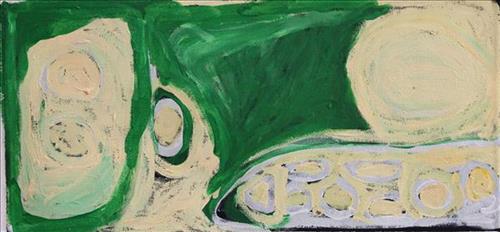
This is Mitutu’s Country- her ‘ngurra’ (home Country, camp). People identify with their ngurra in terms of specific rights and responsibilities, and the possession of intimate knowledge of the physical and cultural properties of one’s Country. Painting ngurra, and in so doing sharing the Jukurrpa (Dreaming) stories and physical characteristics of that place, has today become an important means of cultural maintenance. Mitutu’s ngurra encompasses her birthplace, Yirajarra soak, located close to Lake Auld and just north of Tiwa (Canning Stock Route Well 26), and the Country that her family walked in the pujiman (traditional, desert-dwelling) era, around the Karlamilyi (Rudall River) region.

Portrayed in this work are features of Mitutu’s family’s ngurra, such as the gorges and rivers, dominant permanent red tali (sandhills), warta (trees, vegetation), and the individually named water sources they camped at. Rock holes, waterholes, soaks and springs were all extremely important sites for Martu people during the pujiman period, and are generally depicted with circular forms. 

The encyclopaedic knowledge of the location, quality and seasonal availability of the hundreds of water bodies found in one’s Country sustained Martu as they travelled across their Country, hunting and gathering, visiting family, and fulfilling ceremonial obligations. They would traverse very large distances annually, visiting specific areas in the dry and wet season depending on the availability of water and the corresponding cycles of plant and animal life on which hunting and gathering bush tucker was reliant. As they travelled and hunted they would also burn areas of Country, generating a greater diversity of plant and animal life.

11151032163


Minyi Puru in Kiwirrkurra and Kintore area

“Kunawarritji, Nyipil, Kinyu, and Parnkarpini, the Minyipuru were travelling through all of my Country”.

– Nora Nungabar

Minyipuru, or Jakulyukulyu (Seven Sisters) is a central jukurrpa (dreaming) narrative for Martu, Ngaanyatjarra, Pitjantjatjara and Yankunytjatjara people that is associated with the seasonal Pleiades star constellation. Relayed in song, dance, stories and paintings, Minyipuru serves as a creation narrative, a source of information relating to the physical properties of the land, and an embodiment of Aboriginal cultural laws. When Martumili Artists was established in 2005, this was the first jukurrpa story the artists agreed to paint for a broader public. 

Beginning in Roebourne on the west coast of Western Australia, the story morphs in its movement eastward across the land, following a group of women as they walk, dance, and even fly from waterhole to waterhole. As they travel the women camp, sing, wash, dance and gather food, leaving markers in the landscape and creating landforms that remain to this day, such as groupings of rocks and trees, grinding stones and seeds. During the entirety of their journey the women are pursued by a lustful old man, Yurla, although interactions with other animals, groups of men, and spirit beings are also chronicled.

Nungabar here makes reference in particular to the travels of the Minyipuru through sites located within her ngurra (home Country, camp), including Pangkapirni, between Canning Stock Route Wells 35 and 36. At Pangkapirni Yurla, who had been following the women through their travels, finally caught up with them. The women watched him sleep and when he woke up he grabbed one of them and forcibly slept with her. The other women tried to help their sister escape, but they couldn’t free her. They promised that they would stay with Yurla and made him collect wood for them. They teased him, saying “Come and get us!”, and he began to sing a man’s song and ran away happy; his heart was beating fast. However, the Minyipuru were tricking Yurla and instead hid from him, floating in the air in a long line while he ran around trying to find their tracks. Finally they made a kumpu (urinated) on his face, until he couldn’t see anything at all, but he could hear the Minyipuru giggling and laughing above him. He fetched a jannga (ladder) and tried to reach them, but they just floated higher and then pushed the ladder over when he got too close. He eventually tired and fell down, crawling on his stomach. He crawled a long way and then slept, and while he was asleep, the Minyipuru all flew away. From Pangkapirni the Minyipuru continued to flee far to the east and beyond Martu Country, stopping at various sites through central and South Australia, with Yurla pursuing them throughout their journey.
11151032352


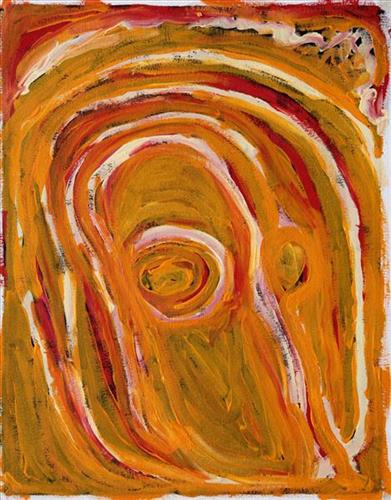
Minyipuru (Jakulyukulyu, Seven Sisters)

“Kunawarritji, Nyipil, Kinyu, and Parnkarpini, the Minyipuru were travelling through all of my Country”.

– Nora Nungabar

Minyipuru, or Jakulyukulyu (Seven Sisters) is a central Jukurrpa (Dreaming) narrative for Martu, Ngaanyatjarra, Pitjantjatjara and Yankunytjatjara people that is associated with the seasonal Pleiades star constellation. Relayed in song, dance, stories and paintings, Minyipuru serves as a creation narrative, a source of information relating to the physical properties of the land, and an embodiment of Aboriginal cultural laws. When Martumili Artists was established in 2005, this was the first Jukurrpa story the artists agreed to paint for a broader public. 

Beginning in Roebourne on the west coast of Western Australia, the story morphs in its movement eastward across the land, following a group of women as they walk, dance, and even fly from waterhole to waterhole. As they travel the women camp, sing, wash, dance and gather food, leaving markers in the landscape and creating landforms that remain to this day, such as groupings of rocks and trees, grinding stones and seeds. During the entirety of their journey the women are pursued by a lustful old man, Yurla, although interactions with other animals, groups of men, and spirit beings are also chronicled.

Nungabar here makes reference in particular to the travels of the Minyipuru through sites located within her ngurra (home Country, camp), including Pangkapirni, between Canning Stock Route Wells 35 and 36. At Pangkapirni Yurla, who had been following the women through their travels, finally caught up with them. The women watched him sleep and when he woke up he grabbed one of them and forcibly slept with her. The other women tried to help their sister escape, but they couldn’t free her. They promised that they would stay with Yurla and made him collect wood for them. They teased him, saying “Come and get us!”, and he began to sing a man’s song and ran away happy; his heart was beating fast. However, the Minyipuru were tricking Yurla and instead hid from him, floating in the air in a long line while he ran around trying to find their tracks. Finally they made a kumpu (urinated) on his face, until he couldn’t see anything at all, but he could hear the Minyipuru giggling and laughing above him. He fetched a jannga (ladder) and tried to reach them, but they just floated higher and then pushed the ladder over when he got too close. He eventually tired and fell down, crawling on his stomach. He crawled a long way and then slept, and while he was asleep, the Minyipuru all flew away. From Pangkapirni the Minyipuru continued to flee far to the east and beyond Martu Country, stopping at various sites through central and South Australia, with Yurla pursuing them throughout their journey.
11151033523


Untitled

“When Martu paint, it’s like a map. Martu draw story on the ground and on the canvas, and all the circle and line there are the hunting areas and different waters and tracks where people used to walk, and [some you] can’t cross, like boundaries. So nowadays you see a colourful painting and wonder what it is, but that’s how Martu tell story long ago. It’s not just a lovely painting, it’s a story and a songline and a history and everything that goes with it.” 

– Ngalangka Nola Taylor and Joshua Booth

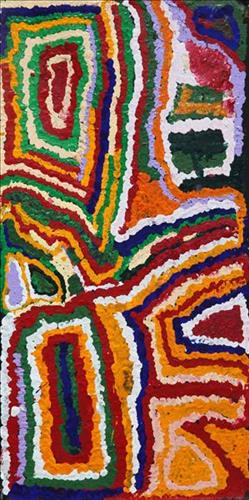
This work portrays an area of Country that can be interpreted in multiple ways. Firstly, the image may be read as an aerial representation of a particular location known to the artist- either land that they or their family travelled, from the pujiman (traditional, desert dwelling) era to now. During the pujiman period, Martu would traverse very large distances annually in small family groups, moving seasonally from water source to water source, and hunting and gathering bush tucker as they went. At this time, one’s survival depended on their intimate knowledge of the location of resources; thus physical elements of Country, such as sources of kapi (water), tali (sandhills), different varieties of warta (trees, vegetation), ngarrini (camps), and jina (tracks) are typically recorded with the use of a use of a system of iconographic forms universally shared across the desert. 

An additional layer of meaning in the work relates to more intangible concepts; life cycles based around kalyu (rain, water) and waru (fire) are also often evident. A thousands of year old practice, fire burning continues to be carried out as both an aid for hunting and a means of land management today. As the Martu travelled and hunted they would burn tracts of land, ensuring plant and animal biodiversity and reducing the risk of unmanageable, spontaneous bush fires. The patchwork nature of regrowth is evident in many landscape works, with each of the five distinctive phases of fire burning visually described with respect to the cycle of burning and regrowth.  

Finally, metaphysical information relating to a location may also be recorded; Jukurrpa (Dreaming) narratives chronicle the creation of physical landmarks, and can be referenced through depictions of ceremonial sites, songlines, and markers left in the land. Very often, however, information relating to Jukurrpa is censored by omission, or alternatively painted over with dotted patterns.