111982308780


Jayma (Queenfish)

Bark paintings have a long cultural tradition, believed to extend back many thousands of years. In northern Australia, the walls of bark shelters in the Kimberley and Arnhem Land may well have been painted to convey and illustrate stories in the same way that rock shelters were. Bark painters in the Maningrida region invoke customary practices and experiment with visual forms. Their paintings merge the natural and spiritual worlds, the secular and sacred, and embody and evoke ancestral presence.The subject matter of some works on bark express or focus on djang, the power of country itself; others the ancestral activities that created it or inhabit it: the powerful Rainbow Serpent Ngalyod, female water spirits including Yawkyawk and jin-Merdewa, and spirit beings such as Namorrorddo and Wangarra. Some paintings feature geometric designs inspired by body painting. Spirit figures such as the long thin Mimih spirits said to live in the rock country are also frequently depicted, as are animals hunted as game, including kangaroo and barramundi. 

The process of making a bark painting begins with the artist choosing a suitable tree (stringybark gum tree, Eucalyptus tetrodonta), in the wet season when the sap is rising and the bark is fairly supple and easy to grip. After finding a section of bark that is free of knots and termite damage, cuts are made top and bottom and, after some encouragement by tugging and prying, a hollow open cylinder of bark is removed. The rough outer bark is stripped off and the bark sheet is trimmed and placed over a fire, inner side downwards, to drive out moisture, including the sap. The bark sheet, pliable from its steaming session, is next placed on the ground and trodden on to flatten it out. Heavy weights are placed on it as it cools to ensure that it doesn’t curl or warp.

Artists use a rich palette of colours derived from natural pigments that can be sourced from their clan estates. The reds, purples, pinks and yellows come from ochres (forms of iron oxide or limonite). Black generally comes from charcoal, and white is from pipeclay. All of these earth pigments are strongly associated with djang. The pipeclay used to create the brilliant white paint, for example, is said to be the faeces of the powerful Rainbow Serpent (Ngalyod in the Kuninjku language) and the spirit essence of the Mardayin ceremony.

Sometimes natural fixatives are mixed in to bind the pigments: wax, yolk of eggs, resins and the sap of orchid plants. Today PVA glue is more commonly used as a binding agent for the pigments. The tool that an artist uses to apply colour to the bark depends on the style of painting and available resources. It may be a feather, or a brush made from a few strands of straight human hair. Cyperus javanicus, a tough sedge grass, may be used to make the slim reed brush required to execute the fine rarrk designs. 
111982308779


Diving duck with fresh water catfish and water plant

Bandjurldjurl has painted dreamings for his mothe’s clan country. The painting represents two sites called Borlinymerre and Warrkmerre. Both belong to the Yirrija clan Bunduri , and are in the Ramingining are in North-central  Arnhem Land.

The painting depicts three Darters (Anhinga Melangoster) called Gorropurda. They are diving into the billabong for fish. They have already eaten some fish which are shown in their bellies: these are archerfish ( Toxotes chatareus ), called Yangkurra. Bandjurldjurl has also painted two kinds of fresh water catfish in the billabong. The largest one in the upper right of the painting is the salmon catfish ( Arius leptaspis), called Gurrkanangarr. The other kind is Garle: an eeltailed catfish (probably Porochilus rendahli). The large plant in the upper left of the painting is called.

111982308778


Mat

Mats can vary greatly. Artists commonly use a mix of naturally dyed and undyed fibre to create a striking variation of coloured bands. Some artists also incorporate different types of looping to produce different patterns and textured finishes. Each type of mat, fibre bag, basket and dilly bag has its own name in the various languages spoken in the Maningrida region.

10754003321


Status: Stock


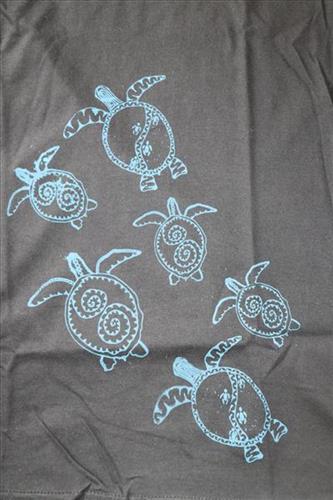
Turtle print on adult t’shirts

100% cotton, preshrunk, soft style, set in sleeve.

Designed by Lizzie Thaiday and hand screen printed in the Erub studio, featuring a little family of green sea turtle swimming in search of food.

Any inconsistencies are an inherent quality of a handmade product and should be treated with care and treasured.

Debi Ari – Good Times!

10754001571


Status: Stock


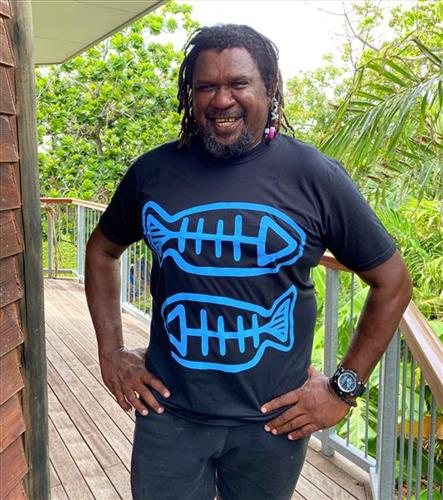
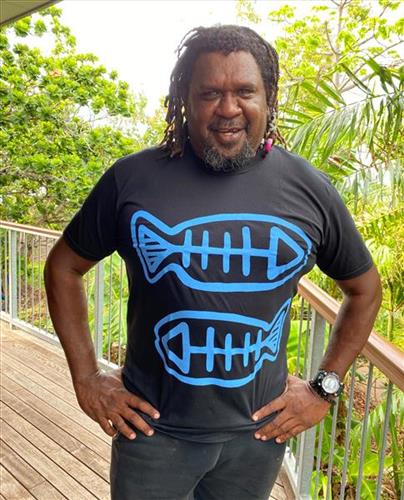
Blue Bone (Unisex)

100% cotton, preshrunk, soft style, set in sleeve.

Designed by Emma Gela, depicting the skeleton of the Parrot fish also known as Blue Bone due to its distinctive bone colouring. Hand screen printed in the Erub studio.

Any inconsistencies are an inherent quality of a handmade product and should be treated with care and treasured.

Debe Ari – Good Times!

10754001518


Status: Stock


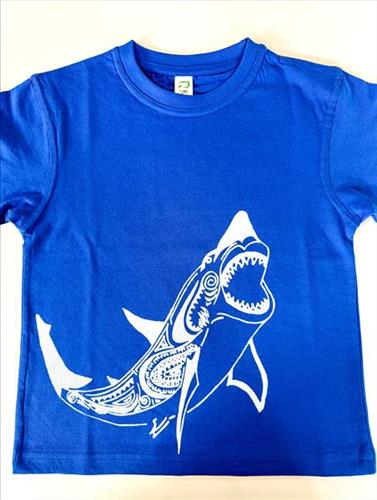
Beizam Kids Tshirt

100% cotton, preshrunk, soft style, set in sleeve.

Designed by Lorenzo Ketchell and hand screen printed in the Erub studio, featuring the Beizam (Great White Shark) it is a well known creature for the people of Erub

Any inconsistencies are an inherent quality of a handmade product and should be treated with care and treasured.

Debi Ari – Good Times!

222082308754


Gone but not forgotten

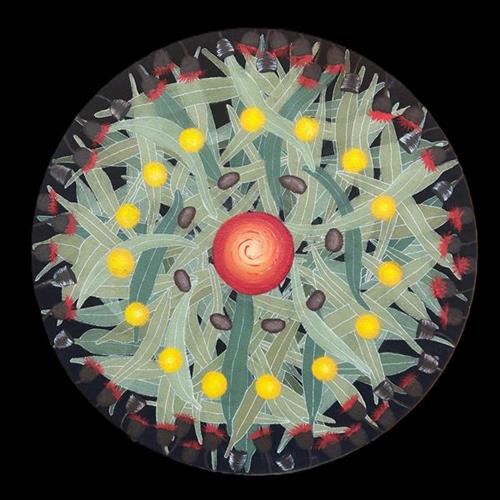
From the fallen gum leaves, to the scars from the eucalyptus leaf beetle. I have depicted my stories using flora to coincide with this years NAIDOC theme, “Keep the Fire Burning: Blak, Loud & Proud”. What the theme means to me and how to portray it through art, from a birds eye view, is testimony through which my Mother has inspired and of course, embracing my Aunty’s in our studio. Symbolically, the gum leaves are representing Aboriginal people in most of my paintings, connected, fuelling the fire, to the fallen. While also portraying factual events, like the smoking ceremony in a coolamon. The tall yellow billy buttons representing the tribes and clans. The gum nuts represent the future generations all encompassing the fire.
What a joy it is to sit around a campfire.
Soaked with the richest memories of my loved ones, while creating new ones!
The fire burning within.
The chaos it can stir.
The regeneration.
The satisfaction of wonderment and the warmth provided.