Blossom 3
Blossom represents spring, a new beginning and growth.
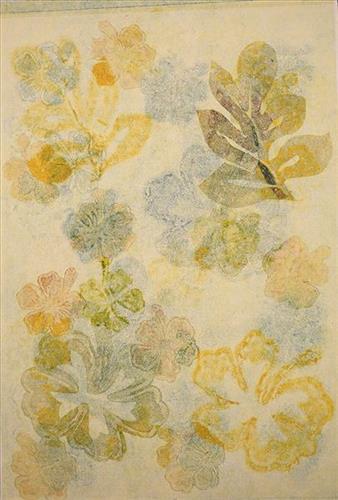
Blossom represents spring, a new beginning and growth.
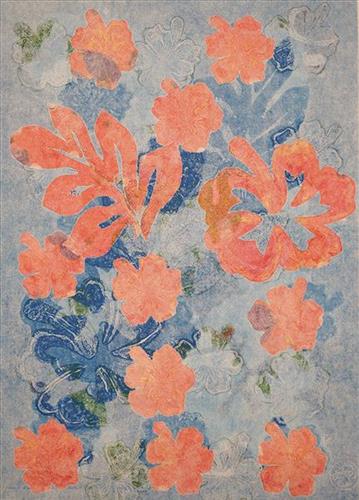
Blossom represent srping, a new beginning and growth.
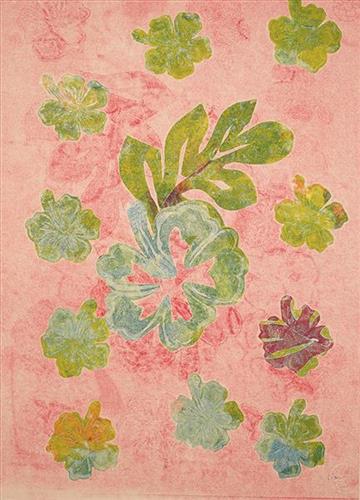
Blossom represent spring, a new beginning and growth.
This is a Kune word that refers to the flattening out of items stones, flat leaves and kunbad (money).
This design shows different items that have flattened out. Carol designed this for her grandkids to show them the tradition of Welebme.
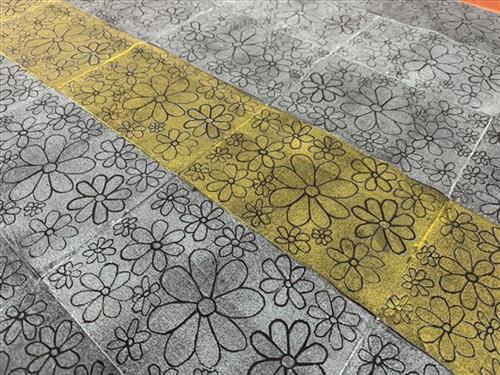
In Kuninjku the name manbirrbbirr is used for a number of densely flowering shrubs and small trees including Verticordia cunninghamii, yellow flowering Austromyrtus species and also Acacia platycarpa which also has dense white.

Baskets are made from natural, locally sourced materials from the Kakadu/West Arnhem Region. Weavers gather fresh kunngobarn (pandanus), from the young leaves in the middle of the palm using a hooked stick called a manmarli, once harvested in large quantities. Kunggobarn is then striped into two, split into fine strands and dried. Once dried, the pandanus is then ready for dying.
Natural dyes are also collected out on Country in various times of the year dependent on weather systems. In Kakadu and West Arnhem Land there are six seasons, Kudjewk (Monsoon season, Dec – March), Bangkerreng (‘Knock ‘em down’ storm season, April), Yekke (Cooler (but still humid) season, May-June), Wurrkeng (Cold weather season, June-Aug), Kurrung (Hot dry weather, Aug-Oct) and Kunumeleng (Pre-monsoon storm season, Oct-Dec). These dyes are dependent on these seasons and fruit, blossom or grow specifically in these times, for example Windilk (seeds from Haemodorum coccineum plant), only grows in Kudjewk, much like Rosella, only grows in Yekke.
Manbedde – Grey/Black (Petalostigma pubescens, leaves)
Windilk – Purple/Pink (Haemodorum coccineum, seeds)
Kunggobarn – Green (Pandanus, the growing shoots)
Wirdilwirdil – Brown (Haemadorum brevicauli grass, red bulb)
Mandjurndum – Yellow/Orange (Coelospermum reticulatus, yellow roots)
Once the pandanus is dyed with the above, the huge, timely process to weaving a basket can begin. Weaving and collecting is usually seen as ‘Women’s business’, as most always, it will be women harvesting and weaving. During weaving, time passes by over cups of tea, daluk (women) having a yarn and the ancient tradition of weaving that naturally gets passed onto wurdurd (children), surrounding daluk.
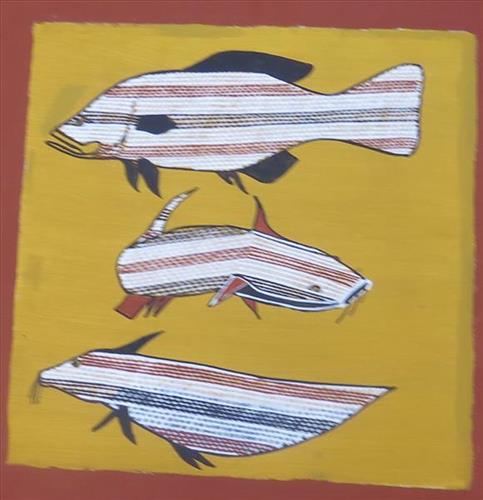
This piece by Norman Lane depicts some common billabong fish in the local area. It is finished with traditional rarrk (fine cross-hatch painting).
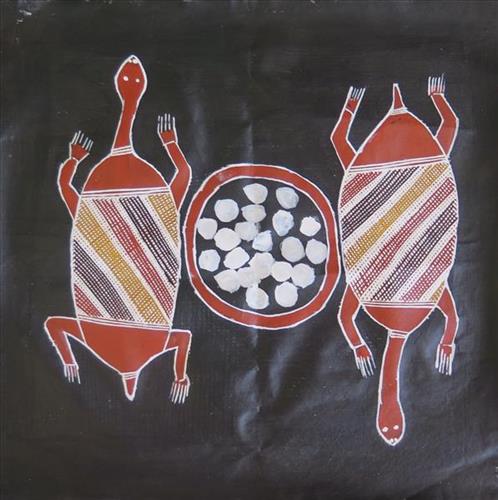
This piece shows two turtles and a nest of turtle eggs. The painting is finished with traditional rarrk (fine cross-hatch style painting).
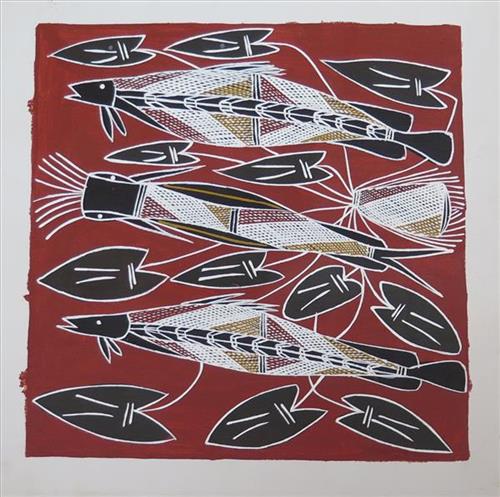
This painting depicts three fish found at Djilpin River, country of Russell Ashley.
At top and bottom are two Barramundi, while in the middle is a Catfish. Lily root and pads are also visible.
Painting has been completed using a handmade Jarlk brush harvested from local billabongs and wet areas. Raark or fine line cross hatching is in Yirritja style and consists of multiple lines before alternating colour.
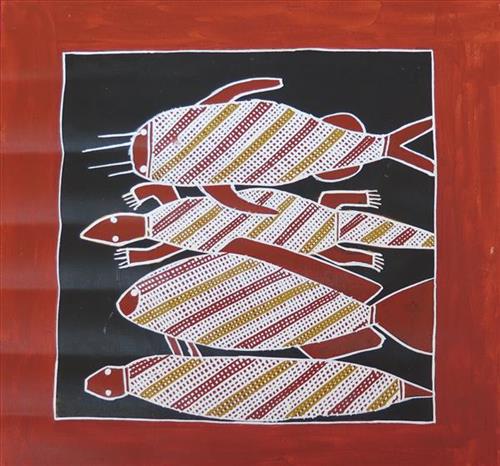
This piece by Frankie (Tango) Lane depicts some favourite local bush tucker. The animals are finished in traditional rarrk style (fine cross-hatching).