377810582308056


Kundayarr (lino tile)

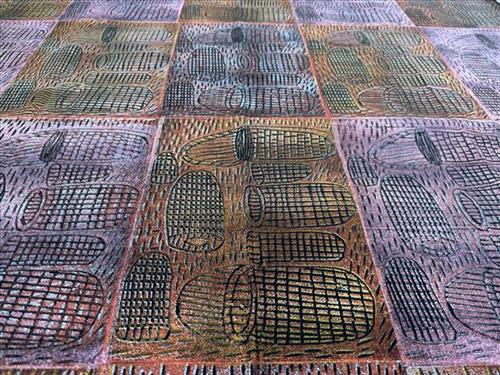
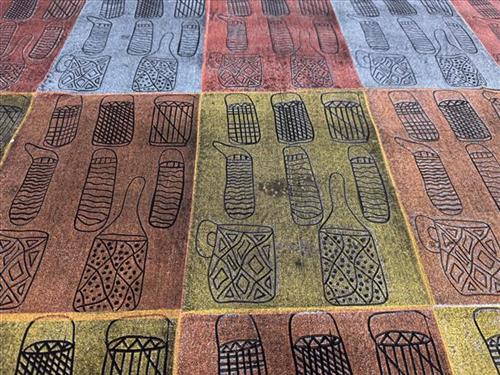
The first tile has different types of kunmadj (dillybag) and marebu (floormat) made with Kundayarr (Pandanus).

‘There are two djerr (dilly bags), one basket, two marebu (floormats) and one kunmadj in this tile. This is how we carry and collect our bush tucker. This basket in the middle with two handles is made with the coil technique. This is a strong basket for clothes, swag, manburrba (clothing, cloth). We use the floormat to sleep on the ground or carry baby. This is from our old peoples time.

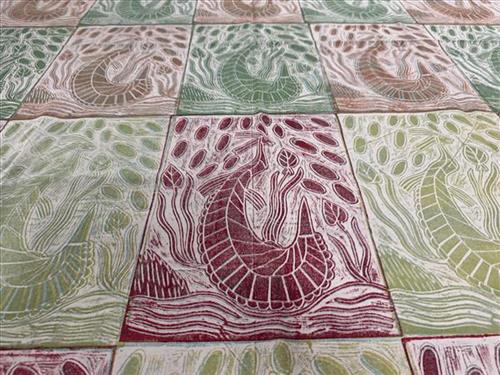
The other tile is kundayarr – pandanus tree and small billabongs with mud and water and grasses. There are 5 billabongs in this tile. We use this kundayarr to make the all the dillybag, kunmadj, marebu and djerr in the other tile. Kunmadj we carry on the head when we are collecting manme (bush tucker). We strip the kundayarr and then we use colour (botanical dyes) to make the different colour. Then we tie up the pandanus.’

Deborah Wurrkidj 2022

Works in fibre from the Maningrida region are widely recognised as some of the finest in Australia. Artists confidently push the boundaries of fibre craft and cultural expression, adapting traditional techniques and forms to produce strikingly inventive and aesthetically exquisite artworks.

Artists usually use kundayarr, pandanus spiralis, to weave decorative round or oblong mats, as well as the less common triangular and conical shapes. Weaving is physically hard work, now done only by women. They colour the pandanus using natural dyes made from the roots, leaves or flowers of plants within the weaver’s clan estate.

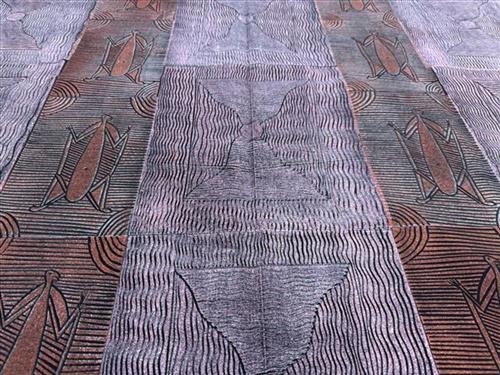
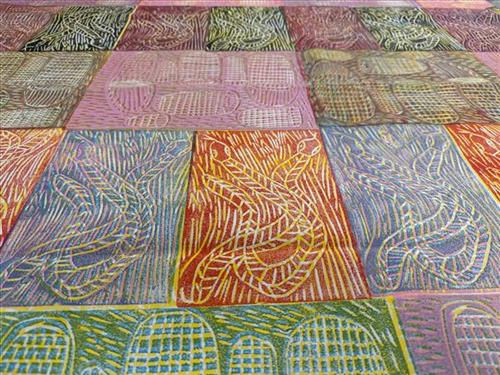
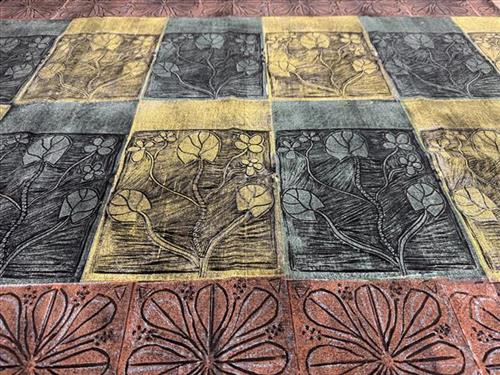
Deborah has used the root of Man-Kurdudjumuk (coelospermun reticulatum) to dye the fabric a beautiful yellow. This fabric has been dyed on country in the outstation of Kakodbubuldi and later printed in our Maningrida studio. Feathers, basket weaves and pandanus plants are pictured.

377810582308054


Kundayarr (lino tile)

The first tile has different types of kunmadj (dillybag) and marebu (floormat) made with Kundayarr (Pandanus).

‘There are two djerr (dilly bags), one basket, two marebu (floormats) and one kunmadj in this tile. This is how we carry and collect our bush tucker. This basket in the middle with two handles is made with the coil technique. This is a strong basket for clothes, swag, manburrba (clothing, cloth). We use the floormat to sleep on the ground or carry baby. This is from our old peoples time.

The other tile is kundayarr – pandanus tree and small billabongs with mud and water and grasses. There are 5 billabongs in this tile. We use this kundayarr to make the all the dillybag, kunmadj, marebu and djerr in the other tile. Kunmadj we carry on the head when we are collecting manme (bush tucker). We strip the kundayarr and then we use colour (botanical dyes) to make the different colour. Then we tie up the pandanus.’

Deborah Wurrkidj 2022

Works in fibre from the Maningrida region are widely recognised as some of the finest in Australia. Artists confidently push the boundaries of fibre craft and cultural expression, adapting traditional techniques and forms to produce strikingly inventive and aesthetically exquisite artworks.

Artists usually use kundayarr, pandanus spiralis, to weave decorative round or oblong mats, as well as the less common triangular and conical shapes. Weaving is physically hard work, now done only by women. They colour the pandanus using natural dyes made from the roots, leaves or flowers of plants within the weaver’s clan estate.

Deborah has used the root of Man-Kurdudjumuk (coelospermun reticulatum) to dye the fabric a beautiful yellow. This fabric has been dyed on country in the outstation of Kakodbubuldi and later printed in our Maningrida studio. Feathers, basket weaves and pandanus plants are pictured.

377810582308052


Kunmadj

Kunmadj is the Kuninjku term for large woven collecting baskets, known as dillybags.

They are often made from the burney vine (Malaisia scandens), a strong, pliable plant that grows along the ground and into the canopy of monsoon vine thickets. The baskets are used to collect a variety of heavy foods, such as fish caught in conical fish traps or a good harvest of yams. As well as being of practical use, dillybags are of cultural significance to Arnhem Land people. Dillybags are totemic objects and they are associated with particular sites in the landscape.

377810582308051


Manyawok (Cheeky Yam)

This design depicts the cheeky yam, which is found on the artist’s country, near the outstation of Mumeka in central Arnhem Land. Yams are an important bush food that are collected during the wet season.

Unlike other yams that can be eaten roasted, the cheeky yam can be poisonous if not properly prepared. The preparation process of the yam traditionally takes two days. Firstly, the yams are dug up with a digging stick and boiled over a fire. They are then peeled and sliced into thin strips, which are placed in a special dillybag woven by women from pandanus leaves. The yam-laden dillybag is then strung from an overhanging branch into a river, so the bag just touches the flowing fresh water. The cheeky yams are left like this overnight to allow the running water to remove the toxins. The next morning, people return and collect the dillybag, and leave the yam pieces in full sunlight to dry out. Finally, when the yam pieces have dried in the sun for a day, they are ready to eat.

377810582308050


Kunmadj

Kunmadj is the Kuninjku term for large woven collecting baskets, known as dillybags.

They are often made from the burney vine (Malaisia scandens), a strong, pliable plant that grows along the ground and into the canopy of monsoon vine thickets. The baskets are used to collect a variety of heavy foods, such as fish caught in conical fish traps or a good harvest of yams. As well as being of practical use, dillybags are of cultural significance to Arnhem Land people. Dillybags are totemic objects and they are associated with particular sites in the landscape.

377810582308049


Kundayarr (lino tile)

The first tile has different types of kunmadj (dillybag) and marebu (floormat) made with Kundayarr (Pandanus).

‘There are two djerr (dilly bags), one basket, two marebu (floormats) and one kunmadj in this tile. This is how we carry and collect our bush tucker. This basket in the middle with two handles is made with the coil technique. This is a strong basket for clothes, swag, manburrba (clothing, cloth). We use the floormat to sleep on the ground or carry baby. This is from our old peoples time.

The other tile is kundayarr – pandanus tree and small billabongs with mud and water and grasses. There are 5 billabongs in this tile. We use this kundayarr to make the all the dillybag, kunmadj, marebu and djerr in the other tile. Kunmadj we carry on the head when we are collecting manme (bush tucker). We strip the kundayarr and then we use colour (botanical dyes) to make the different colour. Then we tie up the pandanus.’

Deborah Wurrkidj 2022

Works in fibre from the Maningrida region are widely recognised as some of the finest in Australia. Artists confidently push the boundaries of fibre craft and cultural expression, adapting traditional techniques and forms to produce strikingly inventive and aesthetically exquisite artworks.

Artists usually use kundayarr, pandanus spiralis, to weave decorative round or oblong mats, as well as the less common triangular and conical shapes. Weaving is physically hard work, now done only by women. They colour the pandanus using natural dyes made from the roots, leaves or flowers of plants within the weaver’s clan estate.

Deborah has used the root of Man-Kurdudjumuk (coelospermun reticulatum) to dye the fabric a beautiful yellow. This fabric has been dyed on country in the outstation of Kakodbubuldi and later printed in our Maningrida studio. Feathers, basket weaves and pandanus plants are pictured.
377810582308046


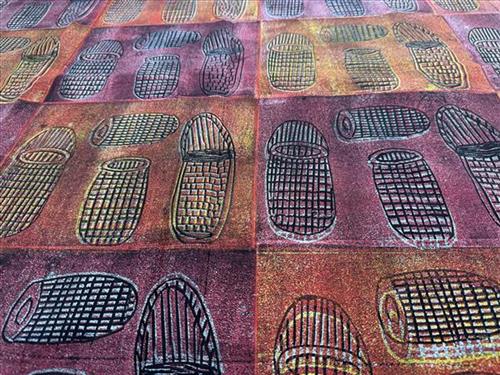
Kundayarr (lino tile)

The first tile has different types of kunmadj (dillybag) and marebu (floormat) made with Kundayarr (Pandanus).

‘There are two djerr (dilly bags), one basket, two marebu (floormats) and one kunmadj in this tile. This is how we carry and collect our bush tucker. This basket in the middle with two handles is made with the coil technique. This is a strong basket for clothes, swag, manburrba (clothing, cloth). We use the floormat to sleep on the ground or carry baby. This is from our old peoples time.

The other tile is kundayarr – pandanus tree and small billabongs with mud and water and grasses. There are 5 billabongs in this tile. We use this kundayarr to make the all the dillybag, kunmadj, marebu and djerr in the other tile. Kunmadj we carry on the head when we are collecting manme (bush tucker). We strip the kundayarr and then we use colour (botanical dyes) to make the different colour. Then we tie up the pandanus.’

Deborah Wurrkidj 2022

Works in fibre from the Maningrida region are widely recognised as some of the finest in Australia. Artists confidently push the boundaries of fibre craft and cultural expression, adapting traditional techniques and forms to produce strikingly inventive and aesthetically exquisite artworks.

Artists usually use kundayarr, pandanus spiralis, to weave decorative round or oblong mats, as well as the less common triangular and conical shapes. Weaving is physically hard work, now done only by women. They colour the pandanus using natural dyes made from the roots, leaves or flowers of plants within the weaver’s clan estate.

Deborah has used the root of Man-Kurdudjumuk (coelospermun reticulatum) to dye the fabric a beautiful yellow. This fabric has been dyed on country in the outstation of Kakodbubuldi and later printed in our Maningrida studio. Feathers, basket weaves and pandanus plants are pictured.

377810582308045


Kunmadj

Kunmadj is the Kuninjku term for large woven collecting baskets, known as dillybags.

They are often made from the burney vine (Malaisia scandens), a strong, pliable plant that grows along the ground and into the canopy of monsoon vine thickets. The baskets are used to collect a variety of heavy foods, such as fish caught in conical fish traps or a good harvest of yams. As well as being of practical use, dillybags are of cultural significance to Arnhem Land people. Dillybags are totemic objects and they are associated with particular sites in the landscape.

377810582308043


Tea cup and dillybag

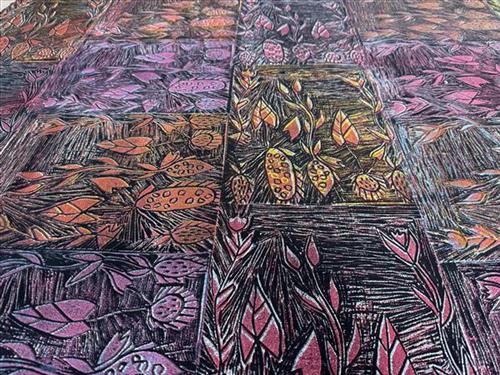
The first tile has different types of kunmadj (dillybag) and marebu (floormat) made with Kundayarr (Pandanus).

‘There are two djerr (dilly bags), one basket, two marebu (floormats) and one kunmadj in this tile. This is how we carry and collect our bush tucker. This basket in the middle with two handles is made with the coil technique. This is a strong basket for clothes, swag, manburrba (clothing, cloth). We use the floormat to sleep on the ground or carry baby. This is from our old peoples time.

The other tile is kundayarr – pandanus tree and small billabongs with mud and water and grasses. There are 5 billabongs in this tile. We use this kundayarr to make the all the dillybag, kunmadj, marebu and djerr in the other tile. Kunmadj we carry on the head when we are collecting manme (bush tucker). We strip the kundayarr and then we use colour (botanical dyes) to make the different colour. Then we tie up the pandanus.’

Deborah Wurrkidj 2022

Works in fibre from the Maningrida region are widely recognised as some of the finest in Australia. Artists confidently push the boundaries of fibre craft and cultural expression, adapting traditional techniques and forms to produce strikingly inventive and aesthetically exquisite artworks.

Artists usually use kundayarr, pandanus spiralis, to weave decorative round or oblong mats, as well as the less common triangular and conical shapes. Weaving is physically hard work, now done only by women. They colour the pandanus using natural dyes made from the roots, leaves or flowers of plants within the weaver’s clan estate.

Deborah has used the root of Man-Kurdudjumuk (coelospermun reticulatum) to dye the fabric a beautiful yellow. This fabric has been dyed on country in the outstation of Kakodbubuldi and later printed in our Maningrida studio. Feathers, basket weaves and pandanus plants are pictured.
377810582308036


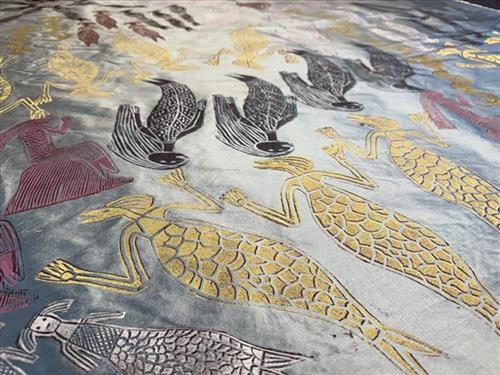
Yawkyawk – Major Work

‘Yawkyawk swim underneath the rock. They always stay there. When the sun comes out they come out from underneath the river, make themselves warm. They sit and they look around. When they sit, they cry to themselves. Ngaldjorlhbo (mother of everything) she created them – yawkyawk and the other one [Ngalng].

The Mimih one is a long way from the stone country. He is from my uncles country Bardijokhang. My uncle is the famous artist Crusoe Kurddal and he carves and paints Mimih.  

‘Sometimes yawkyawk sit inside the rock. Sometimes they go out to find the manme (food) and the mankung (sugarbag). Also they can sing inside the rock cave. Sometimes yawkyawk will see the big rain. When the big rain comes they start looking and when the rain comes they go inside and hide themselves.’

Some yawkyawk stay on the dry land in a special place inland from Bardijolhwang.

Some of the stones get stuck on the breasts of the yawkyawk.

There are two yawkyawk in this artwork. One, the wet season yawkyawk has a round face and long hair. The dry season yawkyawk has short hair. There are lots of different yawkyawk in the water.

In my fabric they are all coming together with the grass trees and leaves and the blowing wind. Some of the leaves will fall onto the water. All the round shapes are kunred (rocky country) with dry grass.

This country is called Gamadery (sp), which is located near Mankorlod and Korlobididah, Arnhem Land.’ 

Janet Marawarr 2022