115682319859


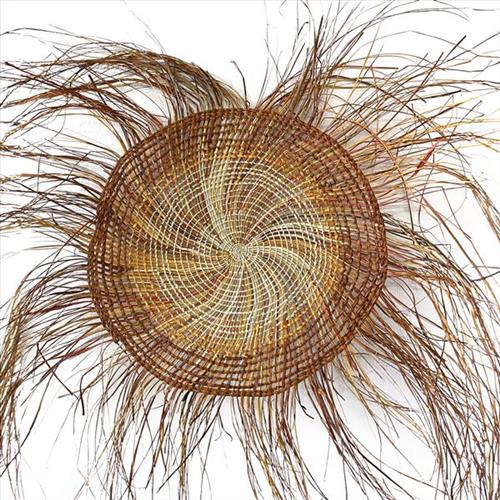
Woven Mat

Traditionally, Nganiyal (conical mats) were used as an insect screen when erected, and as a sitting mat when folded. They are used in Ceremony as well as a functional item. 

Nowadays, artists weave many different shapes including flat, round and oblong. 

220982319821


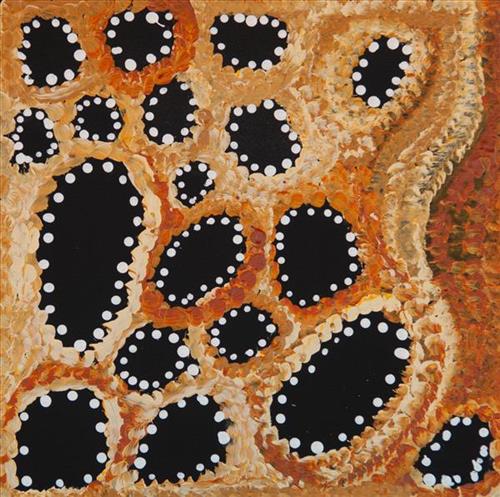
My Mother’s Country – Daisy Kemarre Moss

The community of Ampilatwatja made a conscious decision not to paint ‘altyerr’ dreaming stories. The artists paint their country where those stories sit.

Daisy has painted her Mother’s country, “Kngwarraye” country. Kngwarraye is one of the four main skin names of Ampilatwatja.

Bush medicine, goanna and many other traditional bush foods are found here. This is where Daisy’s traditional laws lie.

Daisy paints her country to keep her country strong.

220982319818


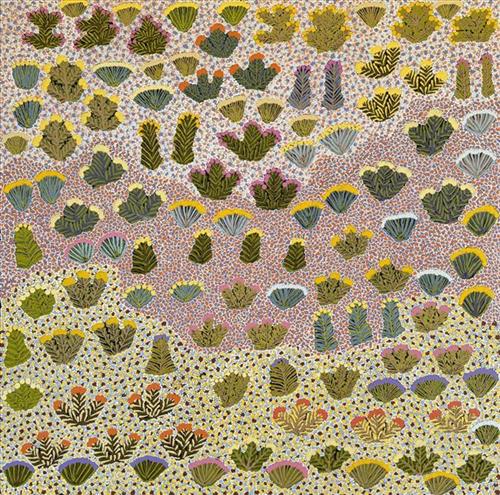
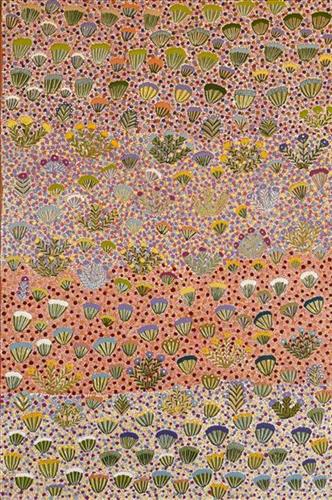
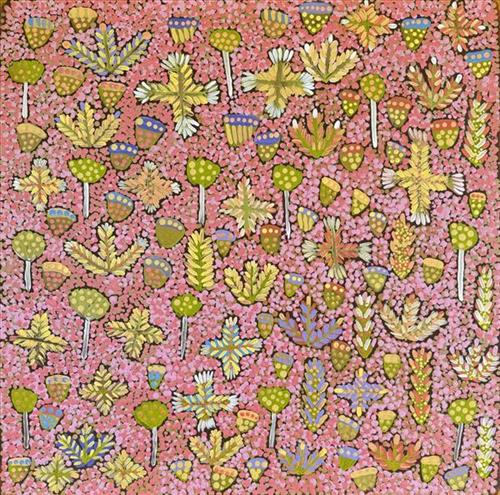
My Country Antarrengeny – Lilly Morton Kemarre

The community of Ampilatwatja made a conscious decision not to paint ‘altyerr’ dreaming stories. The artists paint their country where those stories sit.

Lilly has painted her country, Antarrengeny. The brightly coloured flowers and small bushes are bush medicine and are still used within the community.

Lilly’s landscapes beautifully communicate the rich knowledge she possesses of both medicinal plants and country, the heart of her culture.

As a young girl, Lilly lived traditionally off of the land with her family and Alyawarr people. In Lilly’s lifetime, she has experienced and borne witness to the irreversible changes of country and way of life, that were previously unchanged for thousands of years.
She is a kind and gentle elder of the community and often tells stories of how life used to be, in Alywarre, her language, to her family and friends. These stories are also a great inspiration for many of the artists within the community.

Lilly is passionate about nature, especially her country and the plants that grow on it, and though she has little English, she is keen to explain the various bush medicines which she depicts in her paintings.

220982319813


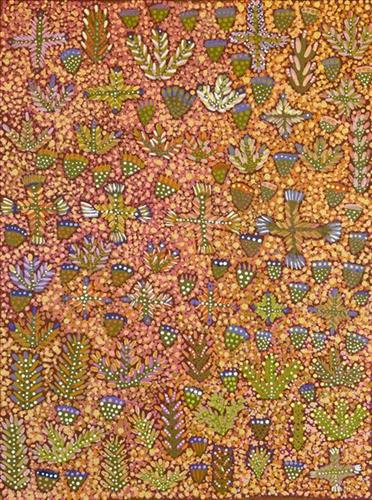
Bush Medicine Plants

“Bush medicine plants are used for healing on the body and for drinking. We make this by grinding the plants with a rock, we use the juice and the fibre of the plant.

We collect bush medicine plants when we are out hunting. Different kinds of plants grow during different seasons.

There are lots of different medicines, we know what their stories are, we learnt them from our parents and we teach these stories to our children.”

Bush medicine knowledge is still strong in Ampilatwatja, it continues to be passed down to the younger generations and is widely used.


When the women go hunting they often gather bush medicine. The plants depicted here are found in the country around Ampilatwatja, they are used for soothing skin infections and to make a drink to help with colds and coughs.


Painting bush medicine stories is important because it helps to maintain a strong knowledge and culture for the community.

220982319812


Bush Medicine Plants

“Bush medicine plants are used for healing on the body and for drinking. We make this by grinding the plants with a rock, we use the juice and the fibre of the plant.

We collect bush medicine plants when we are out hunting. Different kinds of plants grow during different seasons.

There are lots of different medicines, we know what their stories are, we learnt them from our parents and we teach these stories to our children.”

Bush medicine knowledge is still strong in Ampilatwatja, it continues to be passed down to the younger generations and is widely used.


When the women go hunting they often gather bush medicine. The plants depicted here are found in the country around Ampilatwatja, they are used for soothing skin infections and to make a drink to help with colds and coughs.


Painting bush medicine stories is important because it helps to maintain a strong knowledge and culture for the community.

220982319807


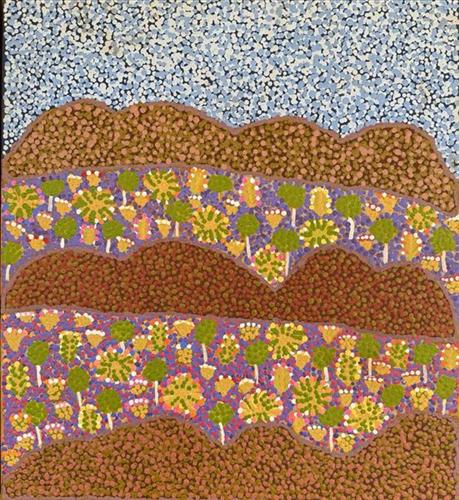
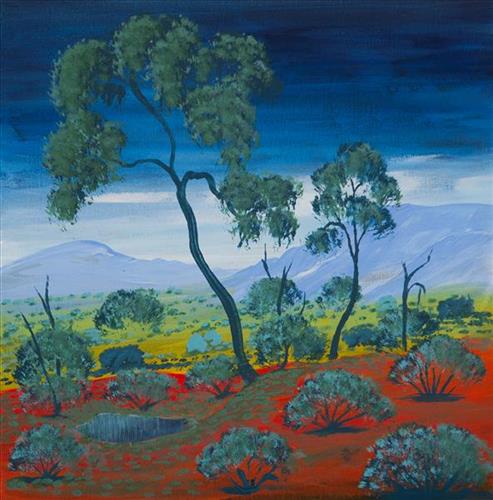
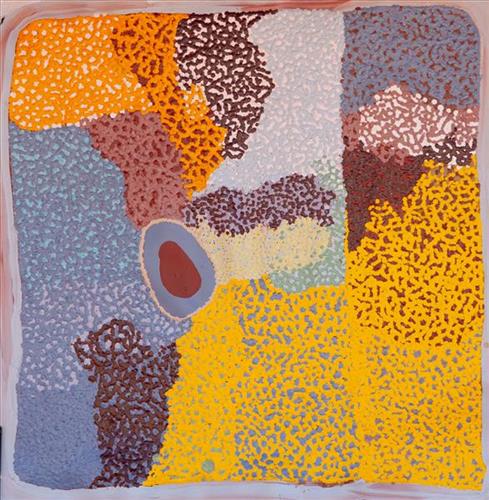
View Of Country

The community of Ampilatwatja made a conscious decision not to paint ‘altyerr’ dreaming stories, the artists paint their country where those stories sit.

This painting shows the layered landscape of Alyawarr, Central Australia. Knowing your country is an important part of living in a remote community like Ampilatwatja. Knowing when and where to go hunting and gathering, knowing where there is ‘soakage’ (where you can dig for water), travelling with family for ceremonies, and maintaining a connection with the land.

“This is my country, my view of country.”

111582319942


Untitled

“I like painting. It’s a good way to learn from the old people and keep the stories going.”

 – Cyril Whyoulter

Cyril Whyoulter is one of the most dynamic and exciting practitioners to emerge from the youngest generation of Martumili Artists. He, like his contemporaries, began to paint with his parents, grandparents and extended family, thus fostering an organic process of learning not only about painting techniques, but also specific locations, family histories, traditional ways of life, and Jukurrpa (Dreaming). He has been a key driving force behind a number of major collaborative projects that have promoted the transfer of cultural knowledge through visual arts, including exhibitions; Pujiman (Desert dwelling, traditional) and Wantili (Warntili, Canning Stock Route Well 25).

Stylistically Cyril’s work melds traditional, contemporary, and experimental elements, demonstrating the development of his own aesthetic while continuing to reflect the powerful influence of his elders. Cyril first began drawing with his grandfather Larry Patterson, and later began painting with his mother, Betty Whyoulter, and grandmother and renowned Martumili artist, Bugai Whyoulter. Having collaborated with and worked alongside Bugai in particular, her influence is most readily identifiable in his work.

Frequently depicted in Cyril’s paintings are Jukurrpa narratives, Jila Kujarra (Two Snakes) and Wati Kujarra (Two Goanna Men), as well as various sites forming part of his family’s ngurra (home Country, camp). These sites encompass a large tract of land, ranging from the south western edge of the Karlamilyi (Rudall River) region through to Wantili, and north to the area surrounding Kunawarritji (Canning Stock Route Well 33).  

111582319941


Parnngurr

Parnngurr is an Aboriginal community located 370km east of Newman, at the Southern end of the Karlamilyi (Rudall River) area, and in the Pilbara region of Western Australia. Created during the return to Country movement of the 1980s, with the recognition of Aboriginal land rights and native title, the community was named after its’ original primary water source, a nearby rockhole and yinta (permanent spring). Until recently the community was widely known as Cotton Creek, after the European name for the ephemeral creek running alongside the community. Parnngurr and its surrounds are physically dominated by distinctively red tali (sandhills), covered sparingly with spinifex and low lying shrub.

Historically Parnngurr Rockhole was an important site for Aboriginal people during the pujiman (traditional, desert born) era. During this nomadic period families stopped and camped here depending on the seasonal availability of water and the corresponding cycles of plant and animal life on which hunting and gathering bush tucker was reliant. At Parnngurr and other similarly important camp sites, families would meet for a time before moving to their next destination. 

Parnngurr is also a site chronicled in the epic Jukurrpa (Dreaming) story of the Minyipuru (Jakulyukulyu, Seven Sisters), as they flee from the lustful old man, Yurla. The sisters stopped to rest on Parnngurr Hill before continuing on their long journey east. Minyipuru is a central Jukurrpa narrative for Martu, Ngaanyatjarra, Pitjantjatjara and Yankunytjatjara people that is associated with the seasonal Pleiades star constellation. Relayed in song, dance, stories and paintings, Minyipuru serves as a creation narrative, a source of information relating to the physical properties of the land, and an embodiment of Aboriginal cultural laws. Beginning in Roebourne on the west coast of Western Australia, the story morphs in its movement eastward across the land, following the women as they walk, dance, and even fly from waterhole to waterhole. As they travel the women camp, sing, wash, dance and gather food, leaving markers in the landscape and creating landforms that remain to this day, such as groupings of rocks and trees, grinding stones and seeds. During the entirety of their journey the women are pursued by a lustful old man, Yurla, although interactions with other animals, groups of men, and spirit beings are also chronicled in the narrative.

111582319940


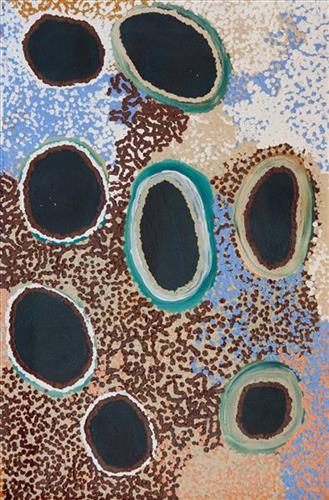
Laripuka

Laripuka is a waterhole kayili (north) of the Percival Lakes region of Western Australia’s Great Sandy desert. This is Yikartu’s ngurra (home Country, camp); she was born here. Yikartu recalls travelling here with her family and Grandmother in the pujiman (traditional, desert dwelling) days.

The Western Desert term ‘ngurra’ is hugely versatile in application. Broadly denoting birthplace and belonging, ngurra can refer to a body of water, a camp site, a large area of Country, or even a modern house. People identify with their ngurra in terms of specific rights and responsibilities, and the possession of intimate knowledge of the physical and cultural properties of one’s Country. This knowledge is traditionally passed intergenerationally through family connections. Painting ngurra, and in so doing sharing the Jukurrpa (Dreaming) stories and physical characteristics of that place, has today become an important means of cultural maintenance. Physical maintenance of one’s ngurra, like cultural maintenance, ensures a site’s wellbeing, and is a responsibility of the people belonging to that area.

111582319939


Kurturarra

“When I was a little girl, my father and mother took me around [Yulparija Country, north of Manyjilyjarra Country]. We travelled with my grandmother and all the family, we travelled with my sisters and brothers. We went from place to place, stopping in one place, hunting around and stopping in another place. We visited all the yinta (permanent springs). We used to walk around when I was a little girl.

[Later] I lost my mother and my grandmother, but my other grandmother kept looking after me. I was still travelling with my mother’s mother when I got married and had my daughter, Barli. When I was travelling with my husband and all the family, we went south to Wirnpa and Kurturarra. We stayed around there for a time and then went northeast, on the tableland. During the wet season we would travel out from the yinta across the tableland… We would walk together, hunting as we went.”

– Yikartu Bumba

Kurturarra is a yinta (permanent spring) located within the largest of the salt lakes in the Percival Lakes region, and surrounded by acacia trees. The Percival Lakes form a string of ephemeral salt lakes in the north of Western Australia, extending across a distance of 350km. They lie at the southern region of the Great Sandy Desert and east of the Karlamilyi (Rudall River) region.

The region surrounding Kurturarra was formed by Wirnpa, one of the most powerful of the ancestral jila (snake) men and the last to travel the desert during the Jukurrpa (Dreaming). Wirnpa is a rainmaking jila who lived and hunted in the Percival Lakes area. His travels are described in the songs and stories of many language groups across the Western Desert, even those far removed from his home site. In his epic travels, Wirnpa met and feasted with many other ancestral beings, exchanged ceremonial objects, and created a series of different laws and ceremonies. When he finally returned home, he searched for his many children only to discover that they had already died. They had laid down and become the salt springs of the Percival Lakes. Wirnpa wept for his children before himself transforming into a snake and entering the soak where he still resides. 

As Yikartu describes in her account, she moved around this area seasonally with her grandmother, husband and daughter, walking between water sources, and hunting and gathering bush tucker as they went. At this time knowledge of water sources was critical for survival, and today Martu Country is still defined in terms of the location and type of water. Each of the hundreds of claypans, rockholes, waterholes, soaks and springs found in the Martu desert homelands is known by name, location, quality and seasonal availability through real life experience and the recounting of Jukurrpa narratives.