111982134801


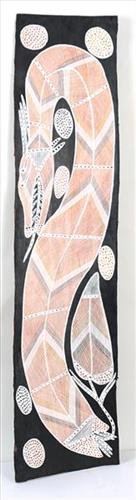
Ngalyod (Rainbow Serpent)

The rainbow serpent is a powerful mythological figure for all Aboriginal people throughout Australia. Characteristics of the rainbow serpent vary greatly from group to group and also depending on the site. Often viewed as a female generative figure, the rainbow serpent can sometimes also be male. She has both powers of creation and destruction and is most strongly associated with rain, monsoon seasons and of course the colour seen in rainbows which arc across the sky like a giant serpent. For Aboriginal people in Northern Australia, the rainbow serpent is said to be active during the wet season.

Known as Ngalyod in the Kuninjku language of western central Arnhem Land, the rainbow serpent is mostly associated with bodies of water such as billabongs, creeks, rivers and waterfalls where she resides. Therefore she is responsible for the production of most water plants such as water lilies, water vines, algae and palms, which grow near water. The roar of waterfalls in the escarpment country is said to be her voice. Large holes in stony banks of rivers and cliff faces are said to be her tracks. She is held in awe because of her apparent ability to renew her life by shedding her skin and emerging anew. Aboriginal myths about the rainbow serpent often describe her as a fearful creature that swallows humans only to regurgitate them, transformed by her blood. The white ochre used by artists to create the brilliant white paint for bark paintings, body decoration and in the past, rock art, is said to be the faeces of the rainbow serpent.

Aboriginal people today respect and care take sacred sites where the rainbow serpent is said to reside. Often certain activities are forbidden at these places for fear that the wrath of the great snake will cause sickness, accidents and even tempests. This is not always the case however and there are many rainbow serpent sites today where people may enter to hunt, fish or swim. By painting this figure on bark today, Aboriginal people are carrying on the longest uninterrupted mythological tradition in the world, which has been the subject of art and ceremony for possibly thousands of years.

107582144619


Jimmy

Stitching reclaimed fishing nets (also known as Ghostnets) that drift aimlessly at sea indiscriminately fishing and killing marine animals was used to create shark. I am recycling these nets and making these creatures that gets caught and dies amongst these deadly drift nets. Sharks are a part of our culture and traditions, they are considered to be an important cultural symbol. It is also a tribal totem for a number of tribes. Sharks have also been portrayed in traditional dance with the dancers either wearing a facemask or headdress representing the shark and mimic the movement of the shark. Around the Australian coast sharks are perceived as dangerous predators but the marine debris that man is creating is equally as lethal.

This work is made by hand, any inconsistencies are inherent qualities of the process and should be treasured as such. This work is made from recycled fishing gear and other materials that have been repurposed. While all care has been taken to ensure the longevity of these materials, it is best to avoid strong direct sunlight and exposure to extreme weather conditions. Clean with water only.

107582144605


Raych

A variety of rays are found around our island home, from the shallow waters of the shoreline to the reefs and deeper waters. This ray has been created by stitching reclaimed fishing net, rope and twine. Reclaimed fishing nets (also known as ghost nets) are derelict fishing nets that drift aimlessly at sea indiscriminately fishing, killing turtles, other creatures and tangling boat propellers. We are recycling these nets, incorporating other flotsam and making products for enjoyment and use. By purchasing this artwork you are helping indigenous communities who collect this net and other groups who make items to develop economic opportunities. We hope this product brings you great joy and helps spread the ghost net message.

This work is made by hand, any inconsistencies are inherent qualities of the process and should be treasured as such. This work is made from recycled fishing gear and other materials that have been repurposed. While all care has been taken to ensure the longevity of these materials, it is best to avoid strong direct sunlight and exposure to extreme weather conditions. Clean with water only.

111982145199


Mimih Spirit

The mimih spirit exists in a realm that runs parallel to and mirrors many facets of human life, also demonstrating the deep sense of time and place understood by Aboriginal and Torres Strait Islander people. Such spirits feature importantly in relation to Aboriginal spirituality, cosmology, social and moral tales as well as ritual. As is true with the multiple mediums employed by artists of West Arnhem Land, the development of artistic style and form is in line with an awareness by the artist that the work produced is predominantly made for a broader audience. Whether show in a national or international context these works communicate and exist in a particular space that is cross-cultural and simultaneously so particular to the Arnhem region.


The mimih sits within a complex and important pedagogical and religious body of knowledge which links Kuninjku people to their distinctive escarpment homelands. Young Kuninjku artists, or apprentices, employ the mimih as an important exercise for the practice of the rarrk technique, as it could be achieved on a smaller surface area before, being attempted in larger scale, on pieces of bark. The mimih serves a purpose for those young artists first learning to carve in a social space of sharing and innovating. The initial mimih manifestation was a large form that almost mirrored the anatomy of a human and at this stage the sculptures have been likened to morkuy carvings visible in eastern Arnhem Land. Contemporaneously, mimih are depicted in a refined, slender, even emaciated form with a broad range of facial expressions giving both individual character to, and denoting the potential volatility and humour that mimih spirits are notable for in their interaction with bininj (humans). The sculptures are frequently carved from the thin trunks of softwoods such as kapok (bombax ceiba or cottonwood) kurrajong, beach hibiscus or leichardt and are painted with earth pigments for their colouring and design.

A leading figure engaging the spirit in visual storytelling was Crusoe Kuningbal, a Kuninjku man, who while traveling was familiarised with carving styles from the east of Arnhem at the mission in Milingimbi pre-dating World War II. This showing a notable connection and interaction of different language groups across such space. As well as travel and the development of art forms being informed by cross cultural dialogues within northern Aboriginal language groups. The mimih became a valued inclusion in performance and public ceremony by Kuninjku people like Kuningbal. At times these ceremonies were performed for extended language groups in the local region.


Now a familiar and broadly depicted figure of iconography, it is important to acknowledge the development of this quite recent sculptural tradition. The depiction of this particular spirit being, once used as an addition to the sharing of song cycles and ceremony, has since been elevated to a prominent form and subject of contemporary sculpture. Variation in the creation of
mimih acts as an indication of the individualism of each artist and their stylistic markers. Additionally significant to note is that in the space of the past thirty years the mimih has begun being produced by multiple language groups residing in the Maningrida area including the traditional owners of Maningrida, the Ndjébbana, speaking Kunibidji as well as Gurrgoni people who have strong ties to Kuninjku.

________
*Maningrida Arts & Culture acknowledge the work of many academic and non-academic voices when writing on this topic, it is important to note Luke Taylor, who’s broad research has informed this text.

107582150960


Raydon

A variety of rays are found around our island home, from the shallow waters of the shoreline to the reefs and deeper waters. This ray has been created by stitching reclaimed fishing net, rope and twine.

Reclaimed fishing nets (also known as ghost nets) are derelict fishing nets that drift aimlessly at sea indiscriminately fishing, killing turtles, other creatures and tangling boat propellers. We are recycling these nets, incorporating other flotsam and making products for enjoyment and use.

By purchasing this artwork you are helping indigenous communities who collect this net and other groups who make items to develop economic opportunities. We hope this product brings you great joy and helps spread the ghost net message

107582150841


Torres

A variety of rays are found around our island home, from the shallow waters of the shoreline to the reefs and deeper waters. This ray has been created by stitching reclaimed fishing net, rope and twine.

Reclaimed fishing nets (also known as ghost nets) are derelict fishing nets that drift aimlessly at sea indiscriminately fishing, killing turtles, other creatures and tangling boat propellers. We are recycling these nets, incorporating other flotsam and making products for enjoyment and use.

By purchasing this artwork you are helping indigenous communities who collect this net and other groups who make items to develop economic opportunities. We hope this product brings you great joy and helps spread the ghost net message

107582172480


Waumer

Waumer – Pirates of the Air When I watch the waumer I can tell what the weather is going to do. When they fly high in the sky you know the weather is fine – they fly in spirals with their wings stretched out riding the thermals hardly flapping at all. When they come over land at coconut tree height you know there is strong wind coming. I like to watch them as they glide through the air. I call them pirates of the air because they are quite lazy often stealing fish from other birds. There are three different types of frigate birds all of them fly near our island. I have tried to capture them in flight as I see them flying overhead. The frigate bird with the red under its neck is my totem.

This work is made by hand, any inconsistencies are inherent qualities of the process and should be treasured as such. This work is made from recycled fishing gear and other materials that have been repurposed. While all care has been taken to ensure the longevity of these materials, it is best to avoid strong direct sunlight and exposure to extreme weather conditions. Clean with water only.

107582172478


Waumer

Waumer – Pirates of the Air When I watch the waumer I can tell what the weather is going to do. When they fly high in the sky you know the weather is fine – they fly in spirals with their wings stretched out riding the thermals hardly flapping at all. When they come over land at coconut tree height you know there is strong wind coming. I like to watch them as they glide through the air. I call them pirates of the air because they are quite lazy often stealing fish from other birds. There are three different types of frigate birds all of them fly near our island. I have tried to capture them in flight as I see them flying overhead. The frigate bird with the red under its neck is my totem.

This work is made by hand, any inconsistencies are inherent qualities of the process and should be treasured as such. This work is made from recycled fishing gear and other materials that have been repurposed. While all care has been taken to ensure the longevity of these materials, it is best to avoid strong direct sunlight and exposure to extreme weather conditions. Clean with water only.

107582172475


Waumer

Waumer – Pirates of the Air When I watch the waumer I can tell what the weather is going to do. When they fly high in the sky you know the weather is fine – they fly in spirals with their wings stretched out riding the thermals hardly flapping at all. When they come over land at coconut tree height you know there is strong wind coming. I like to watch them as they glide through the air. I call them pirates of the air because they are quite lazy often stealing fish from other birds. There are three different types of frigate birds all of them fly near our island. I have tried to capture them in flight as I see them flying overhead. The frigate bird with the red under its neck is my totem.

This work is made by hand, any inconsistencies are inherent qualities of the process and should be treasured as such. This work is made from recycled fishing gear and other materials that have been repurposed. While all care has been taken to ensure the longevity of these materials, it is best to avoid strong direct sunlight and exposure to extreme weather conditions. Clean with water only.

107582172696


Kebi Nam, Hurry Up We Go

A number of varieties of turtles nest and breed on the shores of the Torres Strait. Turtles are important to Torres Strait Islanders in so many different ways. It is one of their traditional tribal totems and it has been part of their customs to hunt turtles as one of their main food sources.

In Australia, abandoned fishing nets (also known as ghost nets) from boats are washed ashore, trapping marine species such as turtles and dugongs. Sadly, these turtles make up 80 percent of the marine life found caught in the nets. As an environmental project, Erub Artists are utilising these abandoned ghost nets in an attempt to clean up the oceans. Their objective is to raise awareness about the negative impacts of ghost nets by creating art such as this turtle out of reclaimed fishing nets.