220982318060


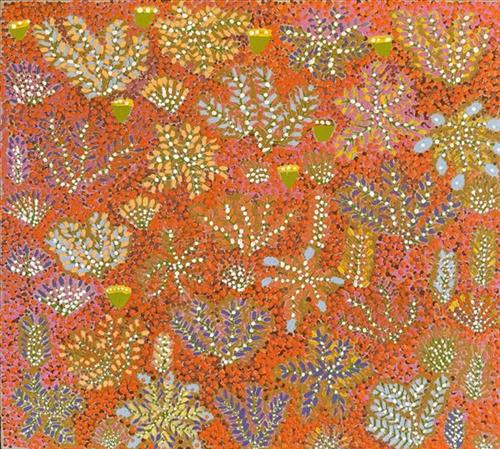
Bush Medicine Plants

“Bush medicine plants are used for healing on the body and for drinking. We make this by grinding the plants with a rock, we use the juice and the fibre of the plant.

We collect bush medicine plants when we are out hunting. Different kinds of plants grow during different seasons.

There are lots of different medicines, we know what their stories are, we learnt them from our parents and we teach these stories to our children.”

Bush medicine knowledge is still strong in Ampilatwatja, it continues to be passed down to the younger generations and is widely used.


When the women go hunting they often gather bush medicine. The plants depicted here are found in the country around Ampilatwatja, they are used for soothing skin infections and to make a drink to help with colds and coughs.


Painting bush medicine stories is important because it helps to maintain a strong knowledge and culture for the community.
220982317963


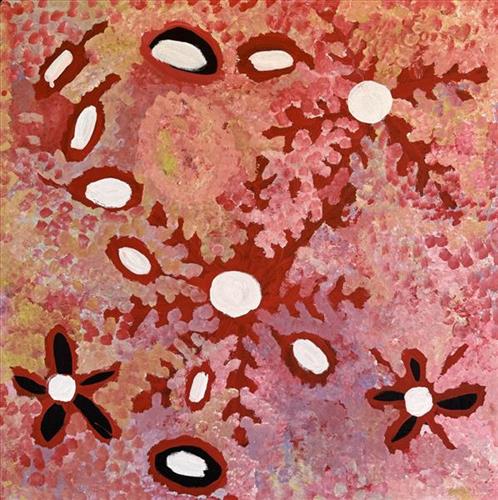
Bush Tucker – Maisie Petyarre Bundey;-

Maisie paints the bush tucker found in her country, the area that surrounds Boundary Bore in the Utopia homelands. She paints bush plums, bush bananas, bush potatoes and bush medicine plants. The main motif which recurs often in Maisie artworks is a full coolamon. When she paints she always speaks of gathering and hunting on her country ‘long way from here, long time ago’, filling up coolamons with ‘bush potato, bush banana, goanna and porcupine.’ Maisie always says her family are ‘happy ones, healthy ones.’
 

111982318276


An-gujechiya (Fish Trap)

To make fish traps and fish net fences artists firstly get vine (mirlarl) from the jungle and they put it in water for one night to make it soft. Next they start weaving it; they make rings for the inside to keep the fish trap’s shape. Artists work for three or four weeks on the fish trap. They also make string from kurrajong (burdaga) to attach the hibiscus (bardainy) rings and to tie the conical end of the fish trap. This fish trap is used in saltwater and freshwater. People also use fish net fences called mun-dirra. A long time ago they would put the mun-dirra across rivers and creeks. In the middle they would place the an-gujechiya. They also used small things like sticks, rocks, mud and grass to block the fish from going through. People would then catch fish like saltwater barramundi rajarra, freshwater barramundi (janambal), small black freshwater catfish (buliya), bonefish (an-guwirrpiya), and sand bass (dalakan) in these fish traps.

111982318273


Burlupurr – large dillybag

Burlupurr, or dilly bag, is a large woven collecting basket. These large bags are often made from the vine ‘Malasia scandens’, a strong pliable plant which grows along the floor and into the canopy of monsoon vine thickets. The bags are used to collect any kind of large numbers of heavy foods such as fish caught in conical fish traps or large collections of yams.

They can also be made from Pandanus spiralis, a plant which grows in many areas of Arnhem Land. These dilly bags are a tightly woven collecting basket, very finely made. These dilly bags are often used to collect sugarbag, the native honey 

As well as being of practical use, dilly bags are also of religious significance to Arnhem Land people. Dilly bags are said to be totemic objects and associated with particular sites in the landscape.

111982318268


Burlupurr – large dillybag

Burlupurr, or dilly bag, is a large woven collecting basket. These large bags are often made from the vine ‘Malasia scandens’, a strong pliable plant which grows along the floor and into the canopy of monsoon vine thickets. The bags are used to collect any kind of large numbers of heavy foods such as fish caught in conical fish traps or large collections of yams.

They can also be made from Pandanus spiralis, a plant which grows in many areas of Arnhem Land. These dilly bags are a tightly woven collecting basket, very finely made. These dilly bags are often used to collect sugarbag, the native honey 

As well as being of practical use, dilly bags are also of religious significance to Arnhem Land people. Dilly bags are said to be totemic objects and associated with particular sites in the landscape.

111982318266


An-gujechiya (Fish Trap)

To make fish traps and fish net fences artists firstly get vine (mirlarl) from the jungle and they put it in water for one night to make it soft. Next they start weaving it; they make rings for the inside to keep the fish trap’s shape. Artists work for three or four weeks on the fish trap. They also make string from kurrajong (burdaga) to attach the hibiscus (bardainy) rings and to tie the conical end of the fish trap. This fish trap is used in saltwater and freshwater. People also use fish net fences called mun-dirra. A long time ago they would put the mun-dirra across rivers and creeks. In the middle they would place the an-gujechiya. They also used small things like sticks, rocks, mud and grass to block the fish from going through. People would then catch fish like saltwater barramundi rajarra, freshwater barramundi (janambal), small black freshwater catfish (buliya), bonefish (an-guwirrpiya), and sand bass (dalakan) in these fish traps.

111982318264


Yawkyawk (Ngalkunburriyaymi)

This is a depiction of Ngalkunburriyaymi or Yawkyawk, the fish-women spirit. Sometimes compared to the European notion of mermaids, they exist as spiritual beings living in freshwater streams, particularly those in the stone country. These water spirits are perhaps the most enigmatic, and are usually described and depicted with the tails of fish. Thus the Kuninjku people sometime call them ngalberddjenj which literally means ‘the woman who has a tail like a fish’. They have long hair which is associated with trailing blooms of green algae (man-bak in Kuninjku) found in freshwater streams and rock pools. At times they leave their aquatic homes to walk about on dry land, particularly at night.

Aboriginal people believe that at one time all animals were humans. During the time of the creation of landscapes and plants and animals, these ancestor heroes in human form changed into their animal forms via a series of various significant events now recorded as oral mythologies. Today the Kuninjku believe that ngalkunburriyaymi are alive and well and living in freshwater sites in a number of sacred locations. The Kuninjku also believe that ‘clever’ man (magicians with mystical powers called na-kordang) may take these spirits as wives. The father of Mandarrk, a well known artist who resided in the Central Arnhem area, is said to have had such a spirit as a wife. Unfortunately, it is said, she failed one day to return from being sent to fetch water from the river, and returned to her kin. The ngalkunburriyaymi also have husbands and children of their own kind. Their sites are usually shared with the rainbow serpent ngalyod. Some have ritual importance, for example in some depictions, the yawkyawk spirit holds ceremonial string, just like the lengths of string women hold between both hands today during certain public ceremonies. 

There are at least three major ngalkunburriyaymi sacred sites that are well known in the area south and south-west of Maningrida. One site Bolerrhlerr is on the Mann River at a place near Yikarrakkal Outstation where there are rugged rocky banks and clefts beneath stone overhangs in the water. Another very similar site further west in the Kumadderr River district is surrounded by a number of small but very old rock art sites and has become known in English as ‘Dreaming Lady’. A third site is a major yawkyawk dreaming place which is so significant that the traditional Dangkorlo clan custodians have set up an outstation near the site. The identity of this group is very much related to their yawkyawk dreaming for which they have spiritual and practical responsibility. 

111582318015


The Flag

This work portrays an area known to the artist, painted here from memory. During the pujiman (traditional, desert dwelling) era one’s survival depended on their intimate knowledge of the location of resources; thus physical elements of Country, such as sources of kapi (water), tali (sandhills), and different varieties of warta (trees, vegetation) were carefully observed and remembered. Today, this relationship with Country remains equally strong, despite the movement of Martu out of the desert and into remote Aboriginal communities, towns and cities.

Also visible may be traces of life cycles based around kalyu (rain, water) and waru (fire). A thousands of year old practice, fire burning continues to be carried out as both an aid for hunting and a means of land management today. As the Martu travelled and hunted they would burn tracts of land, ensuring plant and animal biodiversity and reducing the risk of unmanageable, spontaneous bush fires. The patchwork nature of regrowth is visible in many landscape works, with each of the five distinctive phases of fire burning visually described with respect to the cycle of burning and regrowth.  

Finally, metaphysical information relating to a location may also be recorded; Jukurrpa (Dreaming) narratives chronicle the creation of physical landmarks, and can be referenced through depictions of ceremonial sites, songlines, and markers left in the land. 

221382318907


Handwoven dilly bag earrings in sterling silver

Wagilak Yapa Watj (Wagilak Sisters) range –
exclusive jewellery from indigenous women of Beswick. Developed in studio workshops with jeweller Kate Sale and weaver Fiona Gavino, traditional fibre artists are translating their skills into a series of fine woven wire earrings and pendants. Hand woven in sliver, gold and copper, traditional forms are transformed as delicate interpretations of string and dilly bags, baskets and mats.

Featuring sterling silver, 9ct gold and copper (all nickel-free work).

221382318906


Handwoven dilly bag earrings in sterling silver

Wagilak Yapa Watj (Wagilak Sisters) range –
exclusive jewellery from indigenous women of Beswick. Developed in studio workshops with jeweller Kate Sale and weaver Fiona Gavino, traditional fibre artists are translating their skills into a series of fine woven wire earrings and pendants. Hand woven in sliver, gold and copper, traditional forms are transformed as delicate interpretations of string and dilly bags, baskets and mats.

Featuring sterling silver, 9ct gold and copper (all nickel-free work).