111582329660


Laripuka

Laripuka is a waterhole kayili (north) of the Percival Lakes region of Western Australia’s Great Sandy desert. This is Yikartu’s ngurra (home Country, camp); she was born here. Yikartu recalls travelling here with her family and Grandmother in the pujiman (traditional, desert dwelling) days.

The Western Desert term ‘ngurra’ is hugely versatile in application. Broadly denoting birthplace and belonging, ngurra can refer to a body of water, a camp site, a large area of Country, or even a modern house. People identify with their ngurra in terms of specific rights and responsibilities, and the possession of intimate knowledge of the physical and cultural properties of one’s Country. This knowledge is traditionally passed intergenerationally through family connections. Painting ngurra, and in so doing sharing the Jukurrpa (Dreaming) stories and physical characteristics of that place, has today become an important means of cultural maintenance. Physical maintenance of one’s ngurra, like cultural maintenance, ensures a site’s wellbeing, and is a responsibility of the people belonging to that area.

111582329659


Jupurrl

“This one a yinta (permanent springs) in my ngurra (home Country, camp), Jupurrl. It’s kakarra (east) of Kulyakartu and kayili (north) side of Wirnpa. I was a married woman when I was walking around this place, pujiman (traditional, desert dwelling) time. I married a good man. There’s lots of kapi (water) there. Lots of yukari (green grass, vegetation). Plenty of bushtucker, pussycat and goanna. There’s no kapi when you first get there, but you dig him up and then there’s lots of kapi. We’ve got to take all the kids to that ngurra. Show them my daddy’s ngurra. There’s another waterhole, not far from there called Jakapinka. A jila (snake) made that kapi. It’s my brother’s Country.”

– Yikartu Bumba


During the pujiman (traditional, desert dwelling) days, Yikartu and her family travelled extensively through this Country. At this time Martu would traverse very large distances annually in small family groups, moving seasonally from water source to water source, and hunting and gathering bush tucker as they went. Knowledge of water sources was critical for survival, and today Martu Country is still defined in terms of the location and type of water. Each of the hundreds of claypans, rockholes, waterholes, soaks and springs found in the Martu desert homelands is known by name, location, quality and seasonal availability through real life experience and the recounting of Jukurrpa (Dreaming) narratives. 

111582329658


Jupurrl

“This one a yinta (permanent springs) in my ngurra (home Country, camp), Jupurrl. It’s kakarra (east) of Kulyakartu and kayili (north) side of Wirnpa. I was a married woman when I was walking around this place, pujiman (traditional, desert dwelling) time. I married a good man. There’s lots of kapi (water) there. Lots of yukari (green grass, vegetation). Plenty of bushtucker, pussycat and goanna. There’s no kapi when you first get there, but you dig him up and then there’s lots of kapi. We’ve got to take all the kids to that ngurra. Show them my daddy’s ngurra. There’s another waterhole, not far from there called Jakapinka. A jila (snake) made that kapi. It’s my brother’s Country.”

– Yikartu Bumba


During the pujiman (traditional, desert dwelling) days, Yikartu and her family travelled extensively through this Country. At this time Martu would traverse very large distances annually in small family groups, moving seasonally from water source to water source, and hunting and gathering bush tucker as they went. Knowledge of water sources was critical for survival, and today Martu Country is still defined in terms of the location and type of water. Each of the hundreds of claypans, rockholes, waterholes, soaks and springs found in the Martu desert homelands is known by name, location, quality and seasonal availability through real life experience and the recounting of Jukurrpa (Dreaming) narratives. 

116482329642


Turtle Dreaming

When we see sea turtles it can mean that they can be mating and that makes us aware that they will soon be going to lay eggs. Some of our people eat the eggs and turtles.

37781064005220


Status: Stock


Hill Country – Rowena Morgan

Hill Country design by Rowena Morgan uses symbols to map out important places within this landscape, particularly the hills that form the ranges in her Kija Country.

Description:

  • Long sleeve men’s shirt
  • Hand screenprint on cotton
  • Designed by Nagula Jarndu Artists
  • Made ethically by The Social Studio, Melbourne

These are limited edition garments with only 50 of each design made.

*Please note that the pattern placement will vary slightly on each garment.

Your purchase of this garment provides income for Aboriginal women artists and helps give them a platform to share their culture and stories.

Nagula Jarndu (Saltwater Woman) is a not-for-profit, 100% Aboriginal owned and governed organisation and the profits from your purchase will go directly to the artist and back into the organisation to fund future projects.

The Social Studio are another not-for-profit based in Melbourne. They train and employ refugee and new migrant people in the clothing design and manufacturing business.

Size and fit guide:

XXXX is a size XX and is wearing a size XX. He is XXXcm tall.

S: 53cm / 51cm/ 75cm
M: 56cm / 57cm / 76cm
L: 61cm / 60cm / 77cm
XL: 65cm / 64cm / 83cm
XXL: 68cm / 67cm / 83cm

Measurements are laying flat – Chest / Waist / Length

Care and washing guide:
Our designs are hand screen printed onto cotton with quality fabric ink and professionally heat set.
Handwashing your garment in cold water and ironing from the inside-out, will ensure that it is a part of your wardrobe for years to come.

37781064003244


Status: Stock


Yingarliwa (blue bone) – Amanda Rose

Yingarliwa design by Amanda Rose is inspired by her love of fishing and spending time on country fishing with her family, throwing her handline into the nagula (ocean) to see what she can catch. Amanda says ‘You’ve gotta wait for Man-gala Season (The Wet Season) to catch these reef fish because that’s when they are nice and fat.’

Description:

  • Long sleeve men’s shirt
  • hand screenprint on cotton
  • Designed by Nagula Jarndu Artists
  • Made ethically by The Social Studio, Melbourne

These are limited edition garments with only 50 of each design made.

*Please note that the pattern placement will vary slightly on each garment.

Your purchase of this garment provides income for Aboriginal women artists and helps give them a platform to share their culture and stories.

Nagula Jarndu (Saltwater Woman) is a not-for-profit, 100% Aboriginal owned and governed organisation and the profits from your purchase will go directly to the artist and back into the organisation to fund future projects.

The Social Studio are another not-for-profit based in Melbourne. They train and employ refugee and new migrant people in the clothing design and manufacturing business.

Size and fit guide:

XXXX is a size XX and is wearing a size XX. He is XXXcm tall.

S: 53cm / 51cm/ 75cm
M: 56cm / 57cm / 76cm
L: 61cm / 60cm / 77cm
XL: 65cm / 64cm / 83cm
XXL: 68cm / 67cm / 83cm

Measurements are laying flat – Chest / Waist / Length

Care and washing guide:
Our designs are hand screen printed onto cotton with quality fabric ink and professionally heat set.
Handwashing your garment in cold water and ironing from the inside-out, will ensure that it is a part of your wardrobe for years to come.

110664979572


DURROODJIE- Black Hill in Bow River- By Kathy Ramsay

This hill is the home of the caveman called Yoonggoog. He’s a spirit that clams the land. He’s like a traditional owner. Like our Ancestors, also knows who belongs to the land.

Also back in the days, where the Mistake Massacre happened, two of my Grandfathers Grandfathers ran away from the kardiya (white fella} and his tracker, who tried to kill them. He chased them on horseback. They shot one on the leg, so he acted like he was dead. The other one told him “you play dead so I can keep running.” He ran towards the black hill, but sadly, the bad black fella shot him before he could climb that black hill and grabbed him and cut his head off and left his body there. The man took the head and showed the kardiya. The white man was so happy about it. So tragic and sad.

110664979612


Yarrunga – Chinamen’s Garden – IVY DRILL

As growing up me and my family used to go looking for gold and we put it in Milk Tins and bury the tins under ground, til we need it for rations or buy a Toyota for  whole family to go bush. The Warmun mob used to come visit us [at Yarrunga Chinamen’s Garden] for a few days, sometimes weeks. When that flood come we run up. Run to Halls Creek. We been camp then, camping there and go back, back Chinamen Garden. We been go there and camp, and see that cement where them houses used to be. That cement on the side, and that hole in the middle where houses used to be. They’re building now, building for us. I did them [painting] in Halls Creek. That’s my memory, Chinamen Garden after the flood, when I been in Halls Creek.

110664980129


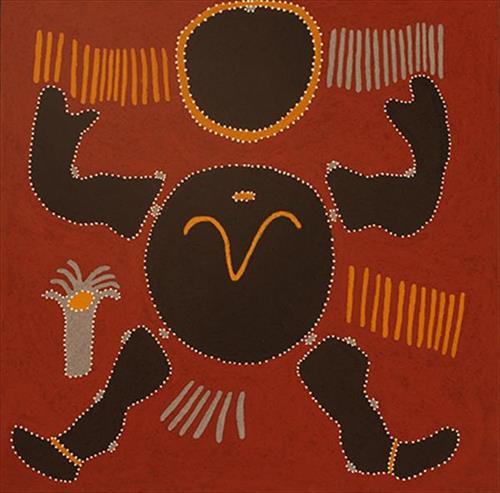
Garajbebirri Woolmooj-Woolmooj-Ngarri Yarrurn / When we twitch in our bodies

‘When we jump-jump you know la garajbe [twitch in our bodies]. Garajbebirri woolmooj-woolmooj-ngarri yarrurn [When we twitch in our bodies]. Well dambi lingagengarri yimberramenbeyoo jemernngarremboorroo [That is giving us a sign, reminding us about all those people from far away]. That mean we know all the people coming from long way country. That mean stranger [someone who lives far away] is coming.’ Shirley’s painting describes how, in Gija culture, twitches or spasms in certain muscles in the body are signals that someone from far away is about to visit or that something serious has happened to a family member. In this painting, the small circles painted on the body are these specific points where family members are ‘felt’. Shirley says these sensations can signal events that have happened to this relation, such as their dying, falling ill or being in danger. The small grey tree on the right of the body symbolises a relative’s death. It represents traditional Gija burial rites in which a body would be placed on a wooden platform in a tree. The lines emanating from around the groin signify that sensations in this part of the body signal that there is a dangerous person at large that is a threat to them. Shirley explains that each body part is associated with a different kinship relationship. For example, if the muscles at your breast ‘jump’, your children might arrive, they might be in danger or sick or they may have died. This relates both to biological relations and to people who are your classificatory family. According to the Gija kinship system, every person is related to every other through their skin-name. Shirley says she feels her father in her right shoulder and her mother in her right knee and all of those people with the same skin-name as her parents. The vertical lines radiating out from the body near the head represent the skin groups in Gija society.