115681423440


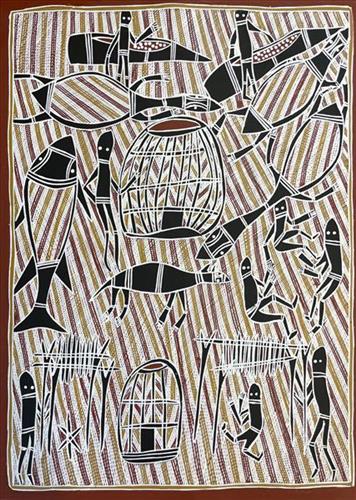
Good bush food story

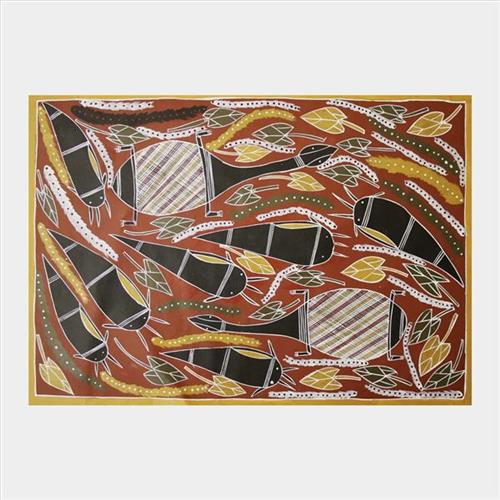
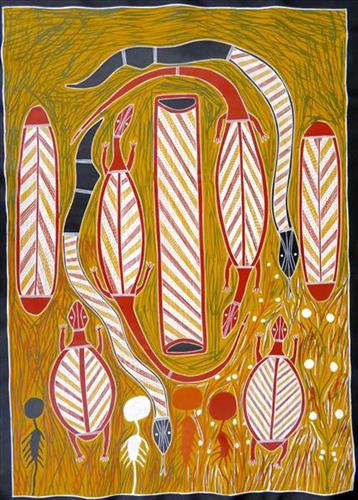
This is a story of the artists dreaming and his family. A freshwater story of looking for food, you can see the long-neck turtles and file snakes in the water. It is a good find for the file snakes because their bellies are so full of eggs. In the reeds between the water lillies and under the water are the favourite bush tucker for everybody the water bulbs you eat fresh. The hollow log for ceremony in the centre and the clapping sticks shows everybody is happy and singing for eating such good bush food.

115682105288


Evonne’s Buliya (catfish) dhawu (story)

In this painting, Evonne has painted her Mari (mothers, mother) dreaming of Buliya (catfish). This is a freshwater story from Ganalbingu country in the Arafura Wetlands. Evonne’s Mari taught Evonne’s mother, Joy Burruna, to paint at an early age. Joy passed on her knowledge and taught Evonne to paint at an early age, keeping alive Yolngu traditions for many generations.


115682340144


Baru Dhawu (Crocodile Story)

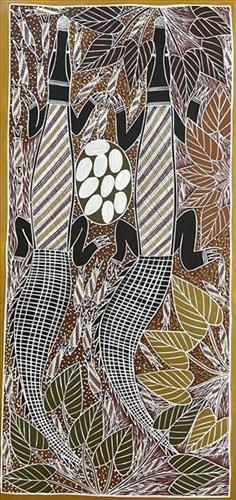
Baru (the crocodile man), was from the Gumatj clan. People usually call him Gurdu Gurdu or Baru which means crocodile. He lived his life at a place called Yirrkala. Living near him were other people, and when Baru didn’t have enough to eat he began to kill and eat these other people. After a while others noticed that some people were missing. When Baru went to the toilet, the people could smell this strong smell, so they knew that he ate the other people. Some men went to get help and they took message sticks to the other tribes. Some were sending smoke signals. When they came to Baru’s camp they started to spear him in the left side of his ribs. He dropped into the fire and burnt his left hand and maybe his right hand. He then ran into the bush and yelled to his countrymen – the animals, birds and fish that live on the land and in the sea. He stopped and he named the tribes and clans and also the places until he came to a place called Gamarru/Guyurru. There he took a rest and said to himself “This is where I stop and call this place Gamarru/Guyurru”. Baru, still in pain from the fire, then jumped into the water and turned himself into a crocodile. The fire left scars on his back. Baru paintings belong to Gumatj and Warrawarra and also the Marpi clan. This painting is used at death ceremonies or initiations and it normally is painted on the belly, which means the person the design is painted on is part of Gurdu Gurdu (the crocodile people).
115682345105


Woven Mat

Traditionally, Nganiyal (conical mats) were used as an insect screen when erected, and as a sitting mat when folded. They are used in Ceremony as well as a functional item. 

Nowadays, artists weave many different shapes including flat, round and oblong. 

115682345062


Woven Mat

Traditionally, Nganiyal (conical mats) were used as an insect screen when erected, and as a sitting mat when folded. They are used in Ceremony as well as a functional item. 

Nowadays, artists weave many different shapes including flat, round and oblong. 

115682345061


Goose egg hunting

This painting depicts the very important tradition where the men go out for days on an expedition looking for the magpie geese nests.

Naku (canoes) were made traditionally from the bark of a particular tree and used for hunting. In this painting, the Yolngu men hunting for gumang (magpie geese) eggs. you can see the “platforms” used to stay off the ground to keep safe from crocodiles, as will as a traditional bark hunt in the centre of the painting.

225182345241


Kirbaji (Dugong)

Kirbaji (Dugong) is an Ancestral Spirit Being (Totem) that I inherited it from my mother’s side.  It is my Totem. The dugong was also an important food source for my ancestors. Only men were allowed to hunt them, and only men had the right to cook and distribute the meat to all the families. My uncles and cousins showed me how to hunt dugongs and they passed down to me the cultural knowledge about them.

My ancestors used to wrap the dugong meat in ginger leaves for flavour, close the wraps with a vine and cook them in the ground oven. Dugongs were only hunted on special occasions such as births, weddings and funerals to provide food for large family gatherings.Dugong fat was also melted to make oil which was used as a medicine for skin and hair ailments or as ointment to treat an upset stomach.