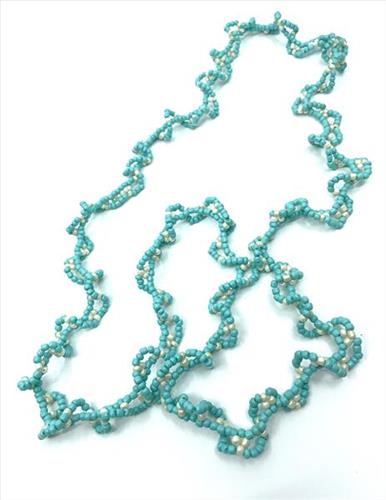
Art Centre notes:
This Necklace have is made from glass beads and fishing line following traditional colour palettes.

Art Centre notes:
This Necklace have is made from glass beads and fishing line following traditional colour palettes.

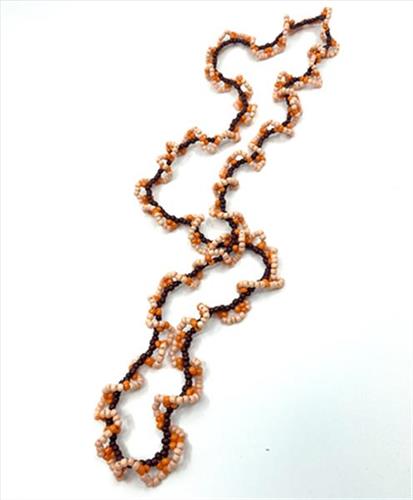
Art Centre notes:
This Necklace have is made from glass beads and fishing line following traditional colour palettes.
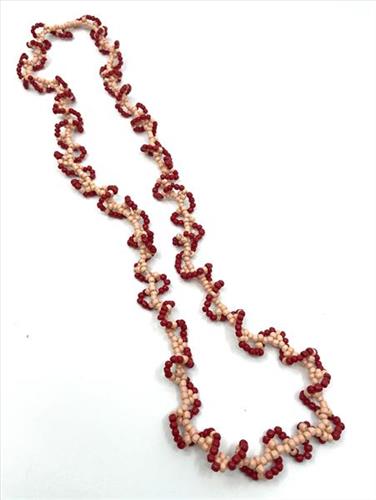
Art Centre notes:
This Necklace have is made from glass beads and fishing line following traditional colour palettes.

Works in fibre from the Maningrida region are widely recognised as some of the finest in Australia. Artists confidently push the boundaries of fibre craft and cultural expression, adapting traditional techniques and forms to produce strikingly inventive and aesthetically exquisite artworks.
Commonly used fibres include the leaves of pandanus (Pandanus spiralis), and palms (Livistonus), mírlírl (burney or jungle vine, Malaisia scandens), and the inner bark of kurrajong and stringybark eucalyptus trees. Weaving is physically hard work, now done only by women. Artists commonly use a mix of naturally dyed and undyed fibre to create a striking variation of coloured bands. They colour the pandanus using natural dyes made from the roots, leaves or flowers of plants within the weaver’s clan estate. Some artists also incorporate different types of looping to produce different patterns and textured finishes. Each type of mat, fibre bag, basket and dilly bag has its own name in the various languages spoken in the Maningrida region.
Artists weave many different kinds of mats. Conical mats were traditionally used to shield babies from mosquitoes. Long flat mats were used for blocking creeks so that fish would be diverted into fish traps. A small triangular mat made of pandanus fibre used to be worn by women during ceremonial gatherings, tied around their back and covering them at the front. Mats are also used for wrapping and rinsing food in water.
Artists usually use ngarakáya, pandanus spiralis, to weave fragrant, decorative round or oblong mats, as well as the less common triangular and conical shapes. The radial woven patterns of the finest round mats appear to vibrate with colour, sometimes regarded as an aesthetic manifestation of deep cultural meaning, as there is a significant spiritual dimension to pandanus mats.
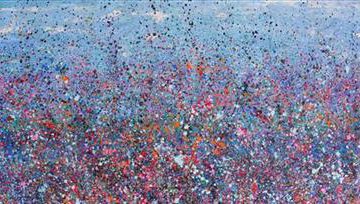
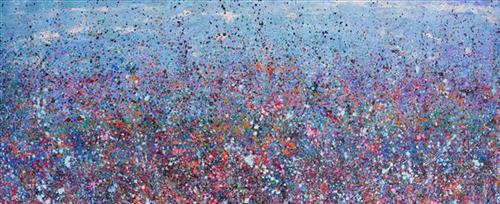
In September, when we are looking for gum from the Blue Gum Tree, we walk through the spinifex country. We pick the gum when it is crystal colour, and we eat it, or put it into hot water to make it like a toffee. We call it sugar lolly.
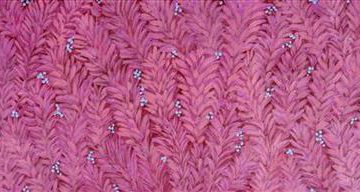
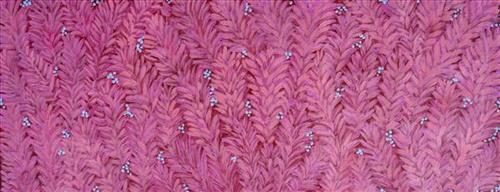
This is the Fortescue Mulla Mulla or ‘Gumbarli’ in Yindjibarndi language. The flower is a purplish colour. It’s not a bush medicine, just a flower that grows in the country, in lines along the roads and everywhere. In this painting, the seeds of the Mulla Mulla are all blowing out. Once the leaves and petals have fallen off, the seeds are blown all through the land to bring flowers again the next year.

Works in fibre from the Maningrida region are widely recognised as some of the finest in Australia. Artists confidently push the boundaries of fibre craft and cultural expression, adapting traditional techniques and forms to produce strikingly inventive and aesthetically exquisite artworks.
Commonly used fibres include the leaves of pandanus (Pandanus spiralis), and palms (Livistonus), mírlírl (burney or jungle vine, Malaisia scandens), and the inner bark of kurrajong and stringybark eucalyptus trees. Weaving is physically hard work, now done only by women. Artists commonly use a mix of naturally dyed and undyed fibre to create a striking variation of coloured bands. They colour the pandanus using natural dyes made from the roots, leaves or flowers of plants within the weaver’s clan estate. Some artists also incorporate different types of looping to produce different patterns and textured finishes. Each type of mat, fibre bag, basket and dilly bag has its own name in the various languages spoken in the Maningrida region.
Artists weave many different kinds of mats. Conical mats were traditionally used to shield babies from mosquitoes. Long flat mats were used for blocking creeks so that fish would be diverted into fish traps. A small triangular mat made of pandanus fibre used to be worn by women during ceremonial gatherings, tied around their back and covering them at the front. Mats are also used for wrapping and rinsing food in water.
Artists usually use ngarakáya, pandanus spiralis, to weave fragrant, decorative round or oblong mats, as well as the less common triangular and conical shapes. The radial woven patterns of the finest round mats appear to vibrate with colour, sometimes regarded as an aesthetic manifestation of deep cultural meaning, as there is a significant spiritual dimension to pandanus mats.

This painting depicts a sacred site at ‘Kurrurldul’, an outstation south of Maningrida.
The ‘rarrk’, or abstract crosshatching, on this work represents the design for the crow totem ancestor called ‘Djimarr’. Today this being exists in the form of a rock, which is permanently submerged at the bottom of Kurrurldul Creek. The ‘Djimarr’ rock in the stream at Kurrurldul is said to move around and call out in a soft hooting tone at night. Both the stone itself and the area around it are considered sacred.
The imagery represents the rock mentioned above at the bottom of Kurrurldul creek, which is the final transmutation of the dreaming ancestor ‘Djimarr’. Finally, the pattern used here is also the crow design used in the sacred ‘Mardayin’ ceremony, which is a large regional patri-moiety ceremony now rarely conducted in central and eastern Arnhem Land.
The women of Maningrida and surrounding homelands use a combination of locally found seeds, bone and shells to make a variety of jewellery including necklaces. earrings and bracelets. Many of the artists use complex patterns and designs to make their beautiful creations.
The women of Maningrida and surrounding homelands use a combination of locally found seeds, bone and shells to make a variety of jewellery including necklaces. earrings and bracelets. Many of the artists use complex patterns and designs to make their beautiful creations.