jac necklace
red yellow circles
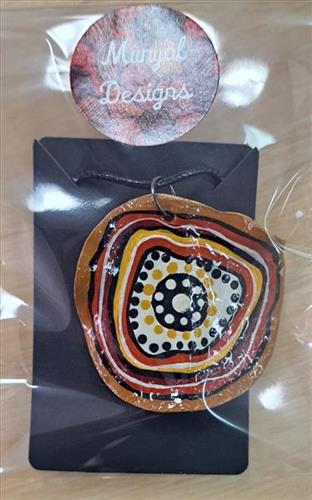
red yellow circles
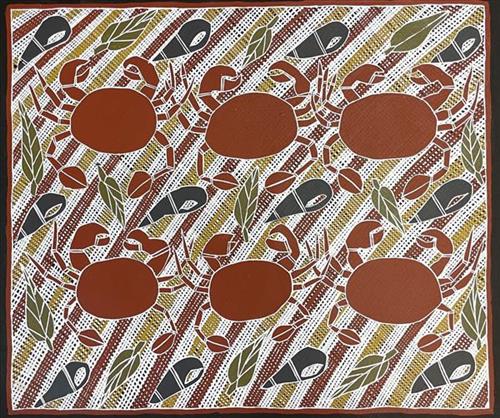
Here the artist paints shellfish and mud crabs at Gariyak, the county represented in many paintings relating to the Djang’kawu Sisters’ journey. In the coastal mangroves the sisters hunted mud crabs, and baler and conch shells to eat.
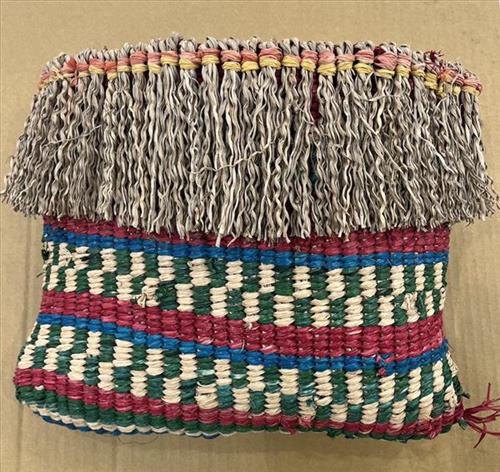
Red Basket Basket have a lot of twists and turns, over and under still gets to start to the end. See red all over and blues for seas surrounding our island. Lovely green for land that provide beautiful materials for me for use that I create the beautiful one twist baskets.
Art Centre notes: The bag is made of natural raffia and sea cord. It is made using a traditional ‘one twist’ method. The dyes are commercial and colour fast.
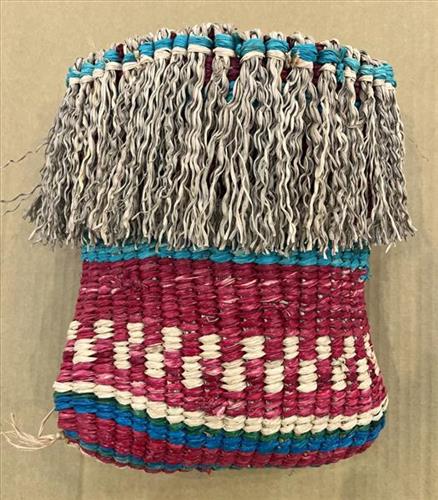
Red Basket Basket have a lot of twists and turns, over and under still gets to start to the end. See red all over and blues for seas surrounding our island. Lovely green for land that provide beautiful materials for me for use that I create the beautiful one twist baskets.
Art Centre notes: The bag is made of natural raffia and sea cord. It is made using a traditional ‘one twist’ method. The dyes are commercial and colour fast.
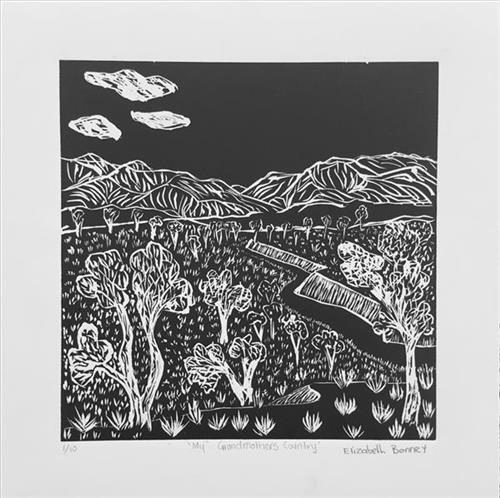
I still hunt my Grand Mothers country for goanna, bush medicine and yams.
I hunt all year round, hunting and walking through the country makes me happy. When I look at the distant hills I can feel my grandmother. Bush flowers are everywhere.
Painting and printing my grandmother’s country reminds about those times.
The Yolngu people of Arnhem Land originate from a spiritual source, fixed in a particular place in their land or the sea. These ‘Spiritual Reservoirs’ are often in the form of special waterholes made by Wangarr (Creative Beings) long ago close to the beginning of time. These creator beings moved across the country side, shaping the land and implanting in each tract of country, the spiritual life force for the people who were to own it. These Creative Spirits took many forms. When they gave the land to each group they also gave songs, dances, ceremony, the associated laws and language. The Creation story for Ganalbingu people took place near the middle section of the Glyde River where it becomes the Goyder River. Their land, Ngaliyindi, sits astride the Arafura Swamp in Central Arnhem Land.
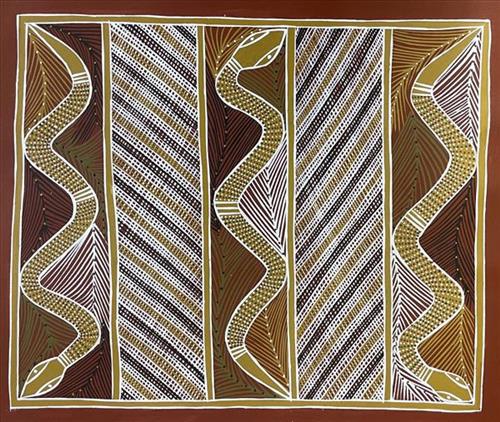
This painting is of Gunungurr, the black-nose python. Gunungurr is a creator being for the Ganalbingu people and is a bringer of lightning at the commencement of the wet season. Animals and plants are commonly portrayed in Arnhem Land art – often in association with ancestral places and seasonal events. This is because animals and plants were created through the activities of ancestral beings, and can represent them. In art, the animals and plants are usually depicted in a realistic style.


This design depicts the patterns of the freshwater mud ripples, which emerge after strong monsoonal wet seasons on the Djinkarr and Nangak flood plains.
These ripples form on the earth’s surface in delicate repetitive and shifting patterns. The mud ripples move, crack, disappear and re-emerge in response to the changing wind, rains and new sun.
The mud ripples depicted in this design are on Elizabeth’s homeland, the Djinkarr and Nangak floodplains south of Maningrida in Arnhem Land.
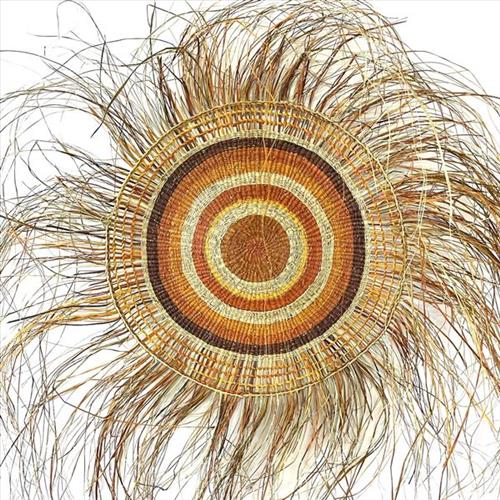
Traditionally, Nganiyal (conical mats) were used as an insect screen when erected, and as a sitting mat when folded. They are used in Ceremony as well as a functional item.
Nowadays, artists weave many different shapes including flat, round and oblong.
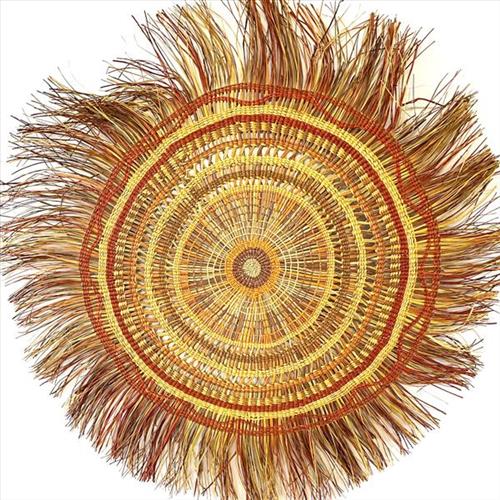
Traditionally, Nganiyal (conical mats) were used as an insect screen when erected, and as a sitting mat when folded. They are used in Ceremony as well as a functional item.
Nowadays, artists weave many different shapes including flat, round and oblong.
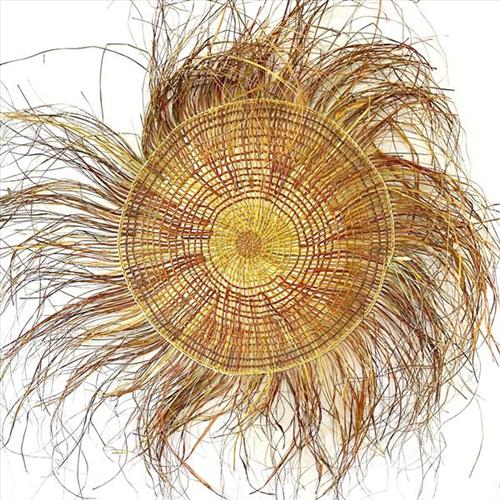
Traditionally, Nganiyal (conical mats) were used as an insect screen when erected, and as a sitting mat when folded. They are used in Ceremony as well as a functional item.
Nowadays, artists weave many different shapes including flat, round and oblong.