220982347158


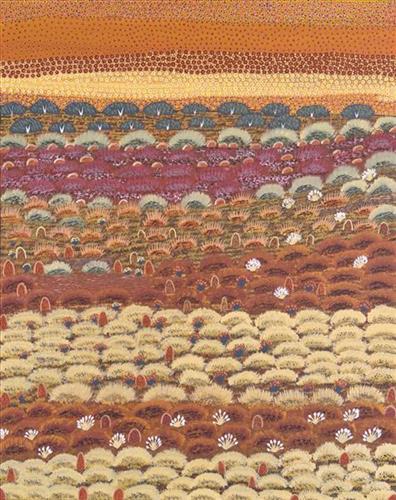
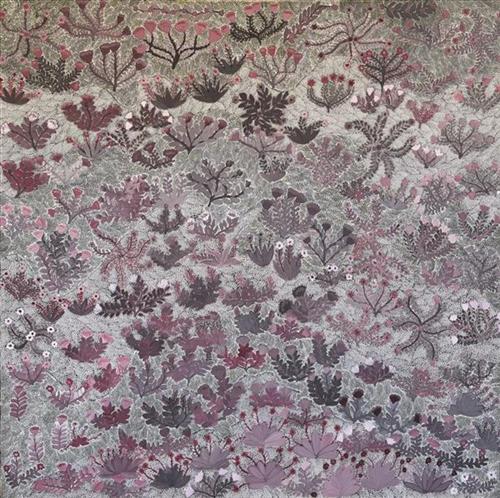
Kathleen Nanima Rambler – Awerle Anatye (yam plant)

When I go visit my family we drive along Bluebush Road, the road is south of Ali Curung towards the Stuart Highway.  The road is sandy.

Bluebush Road has a dam, after Cyclone Tracey hit it was so large that it looked like the sea.  This is where I see the big cream coloured bush tomatos, pink desert roses and goannas running across the road.  All along the road is a sea of desert roses.  The secret yams grow under the ground, you follow the cracks in the dirt and this is where you find the ripe yams.  The secrets of the earth we call them.

The community of Ampilatwatja made a conscious decision not to paint ‘altyerr’ dreaming stories. The artists paint their country where those stories sit.

114182348670


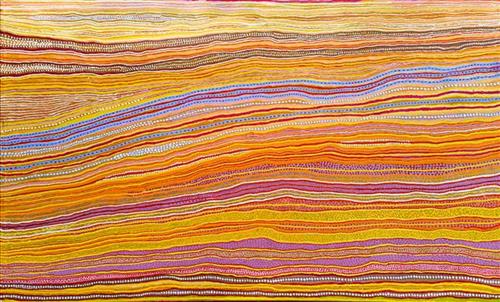
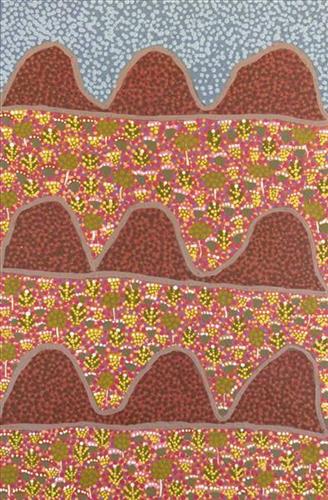
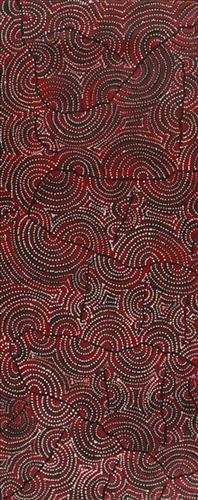
Kungkarrangkalpa (Seven Sisters)

Kungkarrangkalpa (The Seven Sisters or Pleiades) is an important Tjukurrpa (Dreaming) story, known across many cultures and reflected in the stars. The Australian Aboriginal songline is one chapter of this vast, interconnected narrative, with each region holding its own understanding of the journey.

In the Ngaanyatjarra lands, the story tells of Wati Nyiru (the Magic Man), who fell in love with the sisters. But he was of the wrong skin group to marry them, and so the sisters fled across the country to escape his relentless pursuit. He used magic to try and deceive them, disguising himself as a kampurarrpa (bush tomato) or a Yirli (wild fig tree) to lure them in. But the sisters were wise to his tricks, outsmarting him again and again, choosing hunger over capture.

Frustrated, Nyiru made the eldest sister sick, hoping to slow them down, but the other sisters cared for her and helped her recover. He even managed to capture the youngest sister for a time, but with the help of her older siblings, she escaped. As he chased them across the land, Nyiru transformed into a Quandong tree, a Yirli tree, and even a carpet snake, spying on the sisters as they rested and dug for food. Eventually, the sisters took to the sky, becoming the constellation known as the Pleiades, with Nyiru following as Orion—forever chasing but never reaching them.

Angilyiya Mitchell is a custodian of the Seven Sisters Dreaming at Kuru Ala—a sacred women’s place in her mother’s country, south of Papulankutja (Blackstone). This painting depicts that site.

The sweeping lines in the artwork evoke the rolling sandhills of this country, mapping the journey of the sisters as they travelled across the land. The site remains deeply significant today, a place where the echoes of this ancient story still resonate.

220982348975


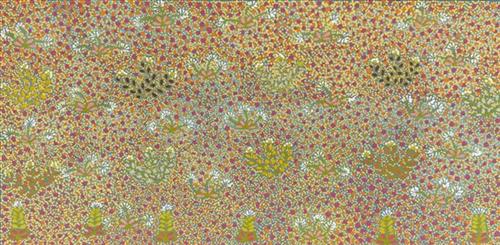
Dakota Petrick – Bush Flowers

The artists of Ampilatwatja made a conscious decision not to paint ‘altyerr’ dreaming stories. The artists paint their country where those stories sit.

These bush flowers grow seasonly in Alyawarr country, some of which are also used in bush medicine remedies.

“My twin sister Lotoya and I have just started painting, our grandmother Elizabeth Ngwarraye Bonney has been teaching us, she tells us all about the bush Flowers and bush medicine.

220982348967


Jacinta Pula Morrison – View of Country

The community of Ampilatwatja made a conscious decision not to paint ‘altyerr’ dreaming stories, the artists paint their country where those stories sit.

This painting shows the layered landscape of Alyawarr, Central Australia. Knowing your country is an important part of living in a remote community like Ampilatwatja. Knowing when and where to go hunting and gathering, knowing where there is ‘soakage’ (where you can dig for water), travelling with family for ceremonies, and maintaining a connection with the land.

“This is my country, my view of country.”

220982348963


View Of Country

The community of Ampilatwatja made a conscious decision not to paint ‘altyerr’ dreaming stories, the artists paint their country where those stories sit.

This painting shows the layered landscape of Alyawarr, Central Australia. Knowing your country is an important part of living in a remote community like Ampilatwatja. Knowing when and where to go hunting and gathering, knowing where there is ‘soakage’ (where you can dig for water), travelling with family for ceremonies, and maintaining a connection with the land.

“This is my country, my view of country.”

118282350533


Mina Mina Jukurrpa (Mina Mina Dreaming)

Mina Mina is an extremely important ceremonial site for Napangardi and Napanangka women that is located approximately 600kms west of Yuendumu, just east of Lake Mackay and the WA border. The area has a ‘marluri’ (salt lake or claypan) that is usually dry, without water. There are also a number of ‘mulju’ (soakages), sandhills, and a large stand of ‘kurrkara’ (desert oaks [Allocasuarina decaisneana]). The Mina Mina Jukurrpa is an important source of Warlpiri ritual knowledge and social organization, particularly relating to the different roles performed by men and women.

The ‘kirda’ (owners) of this country are Napangardi/Napanangka women and Japangardi/Japanangka men, who can depict portions of the Mina Mina Jukurrpa in their paintings. There are a number of different components of the Mina Mina Jukurrpa; artists usually choose to depict one particular aspect. These can include ‘karnta’ (women), ‘karlangu’ (digging sticks), ‘majardi’ (hairstring skirts/tassels), ‘ngalyipi’ (snakevine [Tinospora smilacina]), ‘jintiparnta’ (desert truffle [Elderia arenivaga]), and ‘kurrkara’ (desert oak [Allocasuarina decaisneana]).

The Mina Mina Jukurrpa tells the story of a group of ancestral ‘karnta’ (women) who traveled from west to east. In the Dreamtime, these ancestral women danced at Mina Mina and ‘karlangu’ (digging sticks) rose up out of the ground. They collected these digging sticks and started travelling to the east. They carried their digging sticks over their shoulders and they were adorned with ‘majardi’ (hairstring belts), white feathers, and necklaces made from ‘yinirnti’ (bean tree [Erythrina vespertilio]) seeds. They continuously anointed themselves with ‘minyira’ (shiny fat) to increase their ritual powers as they went along. As the women travelled, they were followed by a ‘yinkardakurdaku’ (spotted nightjar [Eurostopodus argus]) from the Jakamarra subsection. The bird would call out and then hide in the bushes behind them as they travelled.

When the women danced at Mina Mina, they created a large dust cloud that swept up the ‘walyankarna’ (snake ancestors). The ‘walyankarna’ had previously transformed themselves from witchetty grubs into snakes at Kunajarrayi (Mount Nicker, 200km southwest of Yuendumu), and they had stopped at Mina Mina to watch the women dance. This dust cloud blew the ‘walyankarna’ further north to Yaturluyaturlu (near the Granites gold mine). In this way, the ‘karnta Jukurrpa’ (women’s Dreaming) and ‘ngarlkirdi Jukurrpa’ (witchetty grub Dreaming) intersect. This allowed the ancestral women to observe the witchetty grubs and learn how to best locate and cook them, which are skills that Warlpiri women still use today.

The women went east from Mina Mina, dancing, digging for bush tucker, and creating many places as they went. As they went east, they passed through Kimayi (a stand of ‘kurrkara’ (desert oak)). They passed through sandhill country where the ‘yarla’ (bush potato or ‘big yam’ [Ipomea costata]) ancestors from Yumurrpa and the ‘ngarlajiyi’ (pencil yam or ‘small yam’ [Vigna lanceolata]) ancestors from Yumurrpa were engaged in a huge battle over women. This battle is also a very important Warlpiri Jukurrpa narrative. The women went on to Janyinki and stopped at Wakakurrku (Mala Bore), where they stuck their digging sticks in the ground. These digging sticks turned into mulga trees, which still grow at Wakakurrku today. The women then went on to Lungkardajarra (Rich Bore), where they looked back towards their country in the west and started to feel homesick for what they’d left behind. 

The women split up at Lungkardajarra. Some of them travelled eastwards to Yarungkanyi (Mount Doreen), and kept going east. They passed through Coniston in Anmatyerre country, and then went on to Alcoota and Aileron and beyond. The other group of women travelled travelled northwards from Lungkardajarra to Karntakurlangu. These women stopped at Karntakurlangu to dig for ‘wardapi’ (sand monitor/goanna [Varanus gouldii]) and ‘jintiparnta’ (desert truffle) before going further north. Both groups eventually got so homesick for their desert oak country in the west that they went all the way back to Mina Mina, where they stayed for good.

This Jukurrpa contains important information about the different roles that men and women play in Warlpiri culture, particularly in the context of ritual performance. It alludes to an earlier time in which their ritual and social roles were reversed, in which women controlled the sacred objects and weapons that are now exclusively “owned” by men.

In contemporary Warlpiri paintings, traditional iconography can be used to represent the Jukurrpa, particular sites, and other elements. In paintings of the Mina Mina Jukurrpa,  sinuous lines are often used to represent ‘ngalyipi’ (snakevine). Circles and roundels can represent the ‘jintiparnta’ (desert truffle) that the women collected as they travelled, and straight lines are used to represent the ‘karlangu’ (digging sticks). ‘Majardi’ (hairstring skirts) are represented by wavy lines suspended from a single curved line.
221382350347


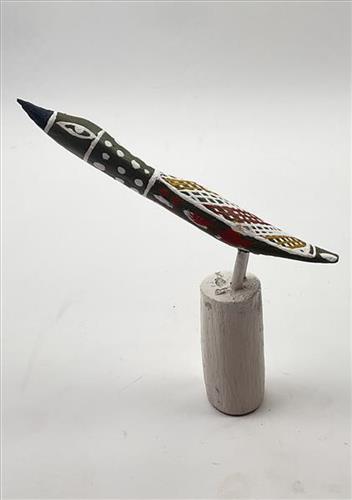
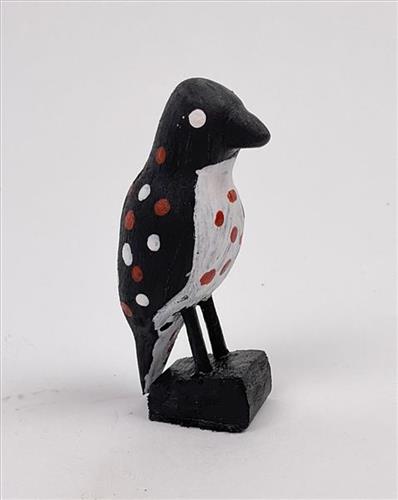
Bird Wood Carving

Wood carving has always been part of Aboriginal culture and Djilpin artists continue this tradition. Men carved wood for many purposes – tools for hunting or gathering food, axes and knives for building shelters, spears and clubs for protection of their lives and territory, objects for ceremony and to mark sacred sites.

Hunting implements include the boomerang, woomera and spear. The woomera is a lever which helps to increase the speed and distance the spear travels. Clapsticks are used as percussion instruments by the Songmen to accompany dancing along with the didgeridoo (mago).

As well as the more functional carvings, artists portray animals and birds in wood, and these carvings are often painted. Ceremonial carvings include spirit creatures including mukuy (devil devils) and mimi.

Some fine mimi figures have been cast in bronze.

221382351370


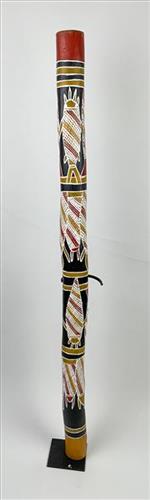
Didjeridu

Didjeridus from this region are made in the West Arnhem style. Called Mago, they’re different and special and follow the tradition made famous by Beswick’s Mago Master, elder David Blanasi.

Ghunmarn didjeridus are sourced on country, and hand cut from Woolybutt trees. Artists travel considerable distances on foot to find the right woolybutt tree naturally hollowed out by termites. Good instruments are hand-cut and taken back to camp to be worked, shaped, sanded, tuned and then finally painted.

These are top quality musical instruments, highly regarded worldwide, and still used in ceremony and performance today. Featuring traditional designs handed painted with a Jarlk grass brush.


Most Ghunamrn didjeridus are high pitch D, low pitch D, F, C or G. The longer the dij the lower the pitch, a shorter didj will give a higher sound.

221382351369


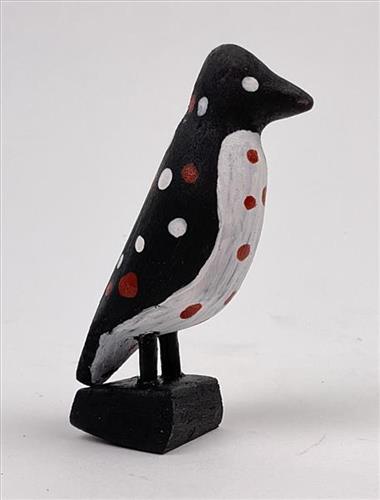
Bird Wood Carving

Wood carving has always been part of Aboriginal culture and Djilpin artists continue this tradition. Men carved wood for many purposes – tools for hunting or gathering food, axes and knives for building shelters, spears and clubs for protection of their lives and territory, objects for ceremony and to mark sacred sites.

Hunting implements include the boomerang, woomera and spear. The woomera is a lever which helps to increase the speed and distance the spear travels. Clapsticks are used as percussion instruments by the Songmen to accompany dancing along with the didgeridoo (mago).

As well as the more functional carvings, artists portray animals and birds in wood, and these carvings are often painted. Ceremonial carvings include spirit creatures including mukuy (devil devils) and mimi.

Some fine mimi figures have been cast in bronze.

221382351368


Bird Wood Carving

Wood carving has always been part of Aboriginal culture and Djilpin artists continue this tradition. Men carved wood for many purposes – tools for hunting or gathering food, axes and knives for building shelters, spears and clubs for protection of their lives and territory, objects for ceremony and to mark sacred sites.

Hunting implements include the boomerang, woomera and spear. The woomera is a lever which helps to increase the speed and distance the spear travels. Clapsticks are used as percussion instruments by the Songmen to accompany dancing along with the didgeridoo (mago).

As well as the more functional carvings, artists portray animals and birds in wood, and these carvings are often painted. Ceremonial carvings include spirit creatures including mukuy (devil devils) and mimi.

Some fine mimi figures have been cast in bronze.