359709482355462
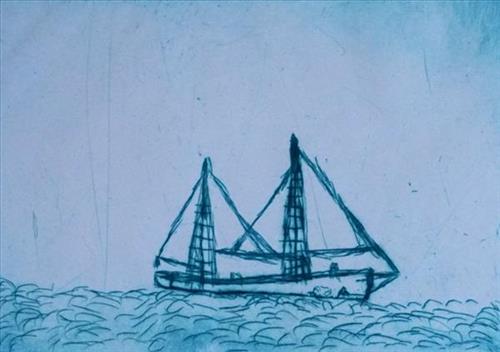
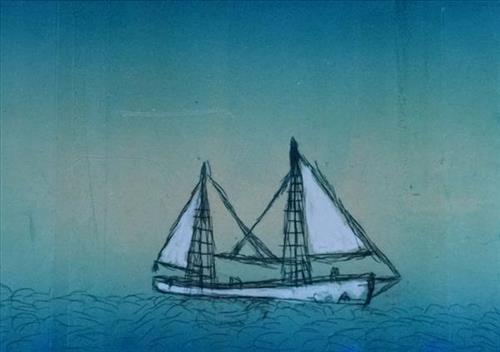
Siomi
I grew up with uncle Tommy Fuji together with his children on Thursday Island.. This lugger Boat called siomi was owned by uncle Tommy Fuji. This was my childhood memories.
220182355456
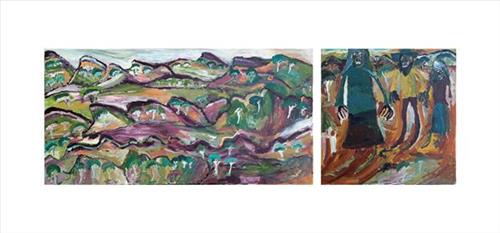
My Sister, Julie, My Daughter and I
220982337232
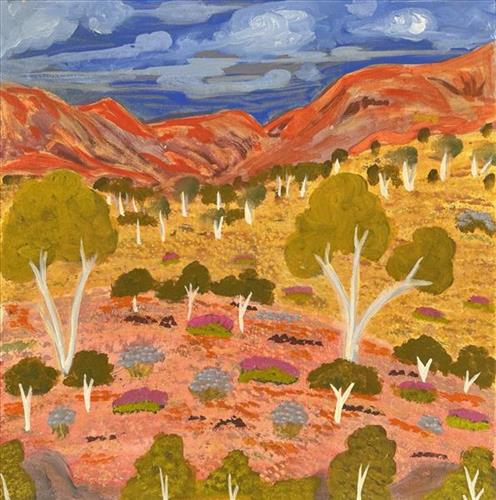
My Mothers Country – Eileen Bonney
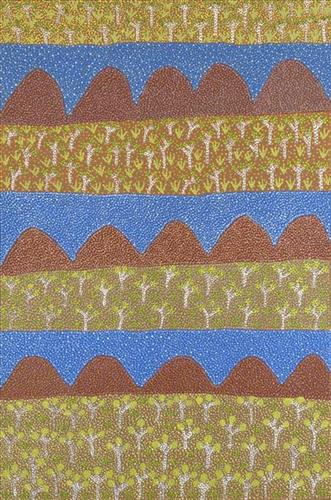
The community of Ampilatwatja made a conscious decision not to paint ‘altyerr’ dreaming stories. The artists paint their country where those stories sit.
Eileen has painted ‘Tijamburra’, her mothers country.
“This is my mothers country, we go hunting there for wild onions, goannas, echidnas and sugarbag honey in the trees. I like to hunt there, there’s water all year round. Even if it doesn’t look like there is, we follow the bird tracks to know where to dig and we find water.”
From living here in the remote community of Ampilatwatja, going hunting out bush and traveling for family and ceremonies Eileen knows this land, her country.
220982337735
My Mothers Country – Vicky Pula Holmes
Ampilatwatja is my Mothers country, I come from a long line of artists.
My family still traditionally hunt and gather, I share my love for the land, plants, flowers and trees, with my children and grandchildren. My paintings are inspired by the changing seasons and I sometimes collect bush medicine plants which I make into tea to drink and bush medicine body lotions. My favourite is aherr-aherr (lemon grass) which I boil up and then use as a body and hair wash, this always makes me feel right and good.
Knowing your country is an important part of living in a remote community like Ampilatwatja. Knowing when and where to go hunting and gathering, knowing where there is ‘soakage’ (where you can dig for water), traveling with family for ceremonies, and maintaining a connection with the land.
The community of Ampilatwatja made a conscious decision not to paint ‘altyerr’ dreaming stories, the artists paint their country where those stories sit.
“This is my Mothers country, my view of country” Vicky Pula Holmes
221282337959
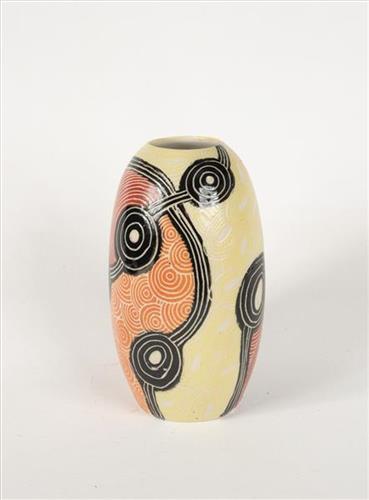
Tjala / Honey Ants
Tjala or honey ants live in nests about a metre underground beneath mulga trees, and they are a highly favoured food source. The tjala tunnels that lead down to the ants’ nests are called nyinantu, and the larvae are called ipilyka-ipilyka. After the rain when the ground is soft the women go digging for tjala by looking for the drill holes under the trees. They then use shovels and crowbars to dig down following the tunnels to find the tjala inside. Anangu suck the delicious rich honey-like liquid from the distended abdomen of the tjala. The story of the tjala is told across the Northern Territory into South Australia and is an important link between Anangu mythology and inter-dependence on the environment.
221282338391
Anumara – Caterpillar
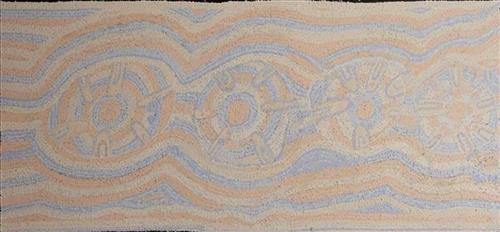
Yurpiya is painting a place called Anumara, which is a place near Irrunytju (Wingellina) in WA. This is Yurpiya’s family’s country. Anumara is also the name for a kind of caterpillar and Anumara is the tjukurpa (dreaming) place for this caterpillar. This caterpillar lives in the grass and can be eaten if the grass it eats is removed. The place shares the same colours of the caterpillar – brown, yellow and pale green. Keeping this place safe will ensure that the caterpillars multiply.
221282338394
Kungkarangkalpa / Seven Sisters
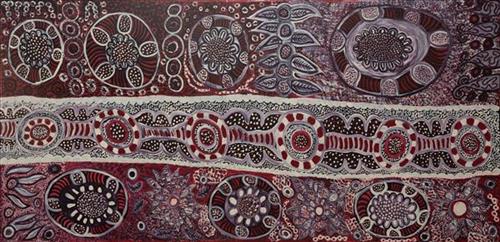
Kungkarangkalpa means the Seven Sisters. This is an extensive creation story that relates to the Pleiades constellation in the southern hemisphere. The story traverses Australia taking on different forms, however local women are privy to the part of the story which takes place in the country near Ernabella. For this part of the story, the man called Nyiru is chasing the sisters as he wants to sleep with the oldest sister. All the younger sisters are deeply afraid of him. As Nyiru is chasing the sisters, he tries to catch them by using magic to turn himself into the most tempting bush tomatoes for the sisters to eat and the most beautiful ili (fig) tree for the sisters to camp under. However, the sisters are aware of his magic and go hungry and run through the night rather than be caught by Nyiru. Eventually, to escape Nyiru, the sisters fly into the sky where they turn into stars and form the constellation.
220982340555
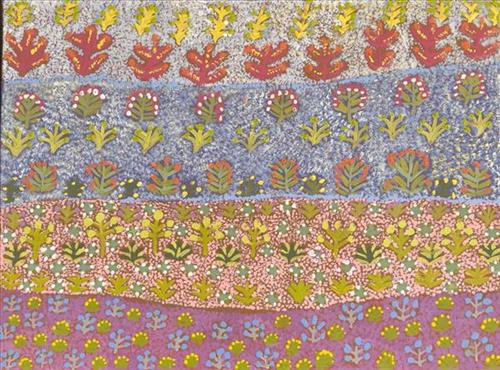
Rosie Kemarre Morton – My Father’s Country and Bush Medicine
The community of Ampilatwatja made a conscious decision not to paint ‘altyerr’ dreaming stories. The artists paint their country where those stories sit.
Rosie has painted her Father’s country, where she can always find bush tucker and bush medicine. She is very happy when out bush hunting and gathering, as it brings back memories of her childhood when she used to live traditionally off of the land with her family.
Rosie uses these hunting trips as her inspiration for her artworks, each one reflecting the layered landscape and various colours as she has seen them. “They are always changing, with the light of day and the seasons of the year
Rosie enjoys and understands the importance of painting bush medicine plants. They help in the healing of her people and it keeps the tradition and knowledge strong. These particular plants are very plentiful after rain and can be used for numerous conditions, such as skin irritations, flu, coughs and infections.
Rosie’s dreaming is the “Araluta” or kangaroo plant. This bush is a rich source of food for the kangaroos and keeps them fat and healthy and good for hunting.
221282341496
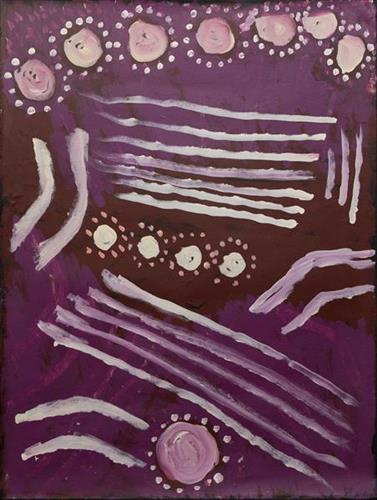
Kulata Tjuta – Many Spears
Freddy is painting his grandfather’s country in far west South Australia. He depicts kulata tjuta (many spears) travelling through the sky to catch wati wanampi (snake man). Those wati wanampi are moving fast through the sky. There was one woman waiting there with a baby and she said there was a wati who was nearby hiding in a bush, ready to duck down and go and then throw those spears.