111982355394


Wak Wak

This painting depicts a sacred site at ‘Kurrurldul’, an outstation south of Maningrida.

The ‘rarrk’, or abstract crosshatching, on this work represents the design for the crow totem ancestor called ‘Djimarr’. Today this being exists in the form of a rock, which is permanently submerged at the bottom of Kurrurldul Creek. The ‘Djimarr’ rock in the stream at Kurrurldul is said to move around and call out in a soft hooting tone at night. Both the stone itself and the area around it are considered sacred.

The imagery represents the rock mentioned above at the bottom of Kurrurldul creek, which is the final transmutation of the dreaming ancestor ‘Djimarr’. Finally, the pattern used here is also the crow design used in the sacred ‘Mardayin’ ceremony, which is a large regional patri-moiety ceremony now rarely conducted in central and eastern Arnhem Land.

111982355393


Wak Wak

This painting depicts a sacred site at ‘Kurrurldul’, an outstation south of Maningrida.

The ‘rarrk’, or abstract crosshatching, on this work represents the design for the crow totem ancestor called ‘Djimarr’. Today this being exists in the form of a rock, which is permanently submerged at the bottom of Kurrurldul Creek. The ‘Djimarr’ rock in the stream at Kurrurldul is said to move around and call out in a soft hooting tone at night. Both the stone itself and the area around it are considered sacred.

The imagery represents the rock mentioned above at the bottom of Kurrurldul creek, which is the final transmutation of the dreaming ancestor ‘Djimarr’. Finally, the pattern used here is also the crow design used in the sacred ‘Mardayin’ ceremony, which is a large regional patri-moiety ceremony now rarely conducted in central and eastern Arnhem Land.

11194007114


Status: Stock


Bush Jewellery – Earrings

The women of Maningrida and surrounding homelands use a combination of naturally dyed pandanus fibre and locally found seeds, bone and shells to make a variety of jewellery including necklaces. earrings and bracelets.  Many of the artists use complex patterns and designs to make their beautiful creations.

11564007075


Status: Stock


Twelve Canoes (DVD)

We live in Arnhem Land, in Northern Territory of Australia. For long time our people been wanting to show our culture to the world. We made that film, Ten Canoes. That was really beginning of it. 
So now here is our culture, our place, our history… here is 12 Canoes. Different stories, 12 of them… Creation, and First White Men, all different parts of our history. 

11564007073


Status: Stock


Ten Canoes (DVD)

A parable of forbidden love from Australia’s mythical past, with storytelling by Australian icon David Gulpilil and starring his son Jamie as the covetous youth Dayini, Ten Canoes is a ground-breaking glimpse into aboriginal life centuries before European settlement. Shot in and around the Arafura Wetlands of Central Arnhem Land, Rolf de Heer and the People of Ramingining have created a pioneering and timeless tale for all people and all cultures. 

11564007071


Status: Stock


The Balanda and the Bark Canoes (DVD)

The making of landmark film Ten Canoes provides the framework for the Balanda and the Bark Canoes, a documentary exploring much more than simply the practicalities of working with non-professional actos in crocodiles-infested waters. Long before cameras rolled on Ten Canoes, de Heer was involved in complex consultations with the Aboriginal case and community members.

11564007069


Status: Stock


Charlie’s Country (DVD)

An official selection at the prestigious Cannes Film Festival, Charlie’s Country pairs renowned director Rolf de Heer with screen legend David Gulpilil for their third film collaboration following the multi-award winning Ten Canoes and their first feature The Tracker. 

11564007068


Status: Stock


Still Our Country (DVD)

A poetic celebration of country and culture, Still Our Country documents the swiftly changing lives of the Yolngu people of Ramingining in the Northern Territory. Originally conceived as an online installation, this evocative carnival of images and sounds makes a bold declaration of identity and offers a hopeful promise of a future. 


37781064007035


Status: Stock


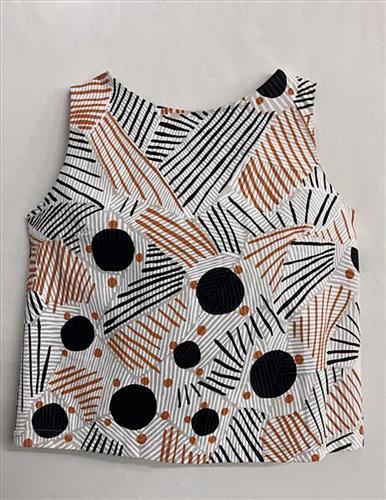
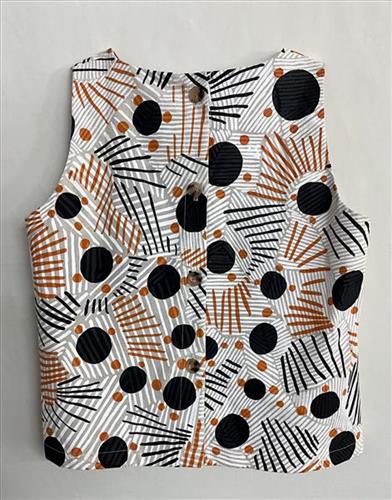
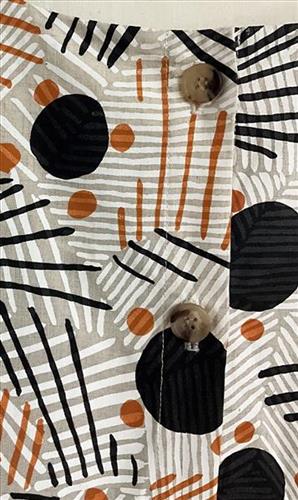
Mangalagun (Crab Creek)

‘This design shows Mangalagun – Crab Creek Country where our family used to take us to when we were small. It is everyone’s favourite fishing spot. People gather there and catch up, yelling out “Aye you get any fish?!” Then we all sit down around the fire and cook up our beautiful feed that we just caught and drink a smokey tea, sharing the catch with everyone.’

These are limited edition garments with only 60 of each design made.

*Please note that the pattern placement will vary slightly on each garment.

Size guide:

8: 47cm / 50cm
10: 50cm / 50cm
12: 52cm / 51cm
14: 55cm / 51cm
16: 56cm / 51cm

Measurements are laying flat – bust / length from top of shoulder to base of top

Care and washing guide:
Our designs are hand screen printed onto cotton with quality fabric ink and professionally heat set.
Handwashing your garment in cold water and ironing from the inside-out, will ensure that it is a part of your wardrobe for years to come.

11194006844


Status: Stock


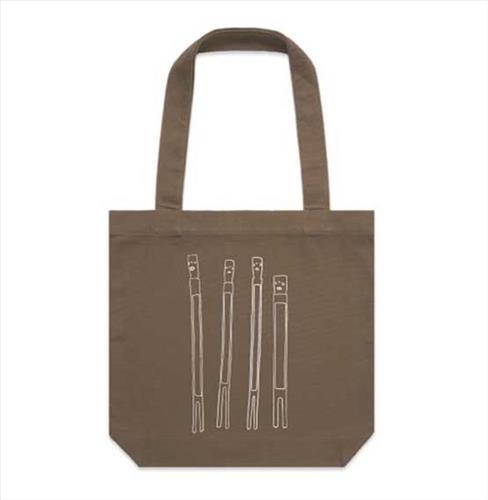
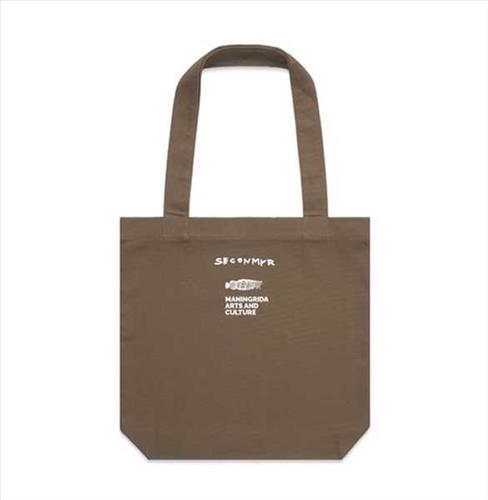
Seymour Tote bag | Walnut

Heavy weight, 320gsm
%100 cotton canvas
Printed in Australia

The mimih spirit exists in a realm that runs parallel to and mirrors many facets of human life, demonstrating the deep sense of time and place understood by Aboriginal and Torres Strait Islander people. Such spirits feature importantly in relation to Aboriginal spirituality, cosmology, social and moral tales as well as ritual. As is true with the multiple mediums employed by artists of West Arnhem Land, the development of artistic style and form is in line with an awareness by the artist that the work produced is predominantly made for a broader audience. Whether shown in a national or international context these works communicate and exist in a particular space that is cross-cultural and simultaneously particular to the Arnhem region.

The mimih sits within a complex pedagogical and religious body of knowledge which links Kuninjku people to their distinctive escarpment homelands. Young Kuninjku artists, or apprentices, employ the mimih as an important exercise for the practice of the rarrk technique, as it could be achieved on a smaller surface area before being attempted in larger scale on pieces of bark. The mimih serves a purpose for those young artists first learning to carve in a social space of sharing and innovating. The initial mimih manifestation was a large form that almost mirrored the anatomy of a human and at this stage the sculptures have been likened to mokuy carvings visible in eastern Arnhem Land. Contemporaneously, mimih are depicted in a refined, slender, even emaciated form with a broad range of facial expressions giving both individual character to, and denoting the potential volatility and humour that mimih spirits are notable for in their interaction with bininj (humans). The sculptures are frequently carved from the thin trunks of softwoods such as kapok (bombax ceiba or cottonwood) kurrajong, beach hibiscus or leichardt and are painted with earth pigments for their colouring and design.

A leading figure engaging the spirit in visual storytelling was Crusoe Kuningbal, a Kuninjku man, who while traveling was familiarised with carving styles from the east of Arnhem at the mission in Milingimbi pre-dating World War II. The connection and development of art forms informed by cross cultural dialogues within northern Aboriginal language groups is notable. The mimih became a valued inclusion in performance and public ceremony by Kuninjku people like Kuningbal. At times these ceremonies were performed for extended language groups in the local region. 

Now a familiar and broadly depicted figure of iconography, it is important to acknowledge the development of this quite recent sculptural tradition. The depiction of this particular spirit being, once used as an addition to the sharing of song cycles and ceremony, has since been elevated to a prominent form and subject of contemporary sculpture. Variation in the creation of mimih acts as an indication of the individualism of each artist and their stylistic markers. Additionally significant to note is that in the space of the past thirty years the mimih has begun being produced by multiple language groups residing in the Maningrida area including the traditional owners of Maningrida, the Ndjébbana, speaking Kunibidji as well as Gurrgoni people who have strong ties to Kuninjku. 

________
*Maningrida Arts & Culture acknowledge the work of many academic and non-academic voices when writing on this topic, it is important to note Luke Taylor, who’s broad research has informed this text.