
222082358858

Stories in the Sand
222082358852
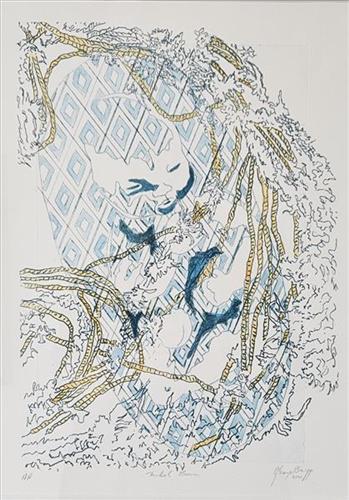
Tribal Born
222082358850
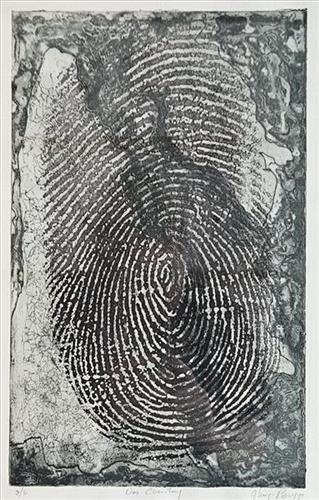
On Country
TBC
221382359039
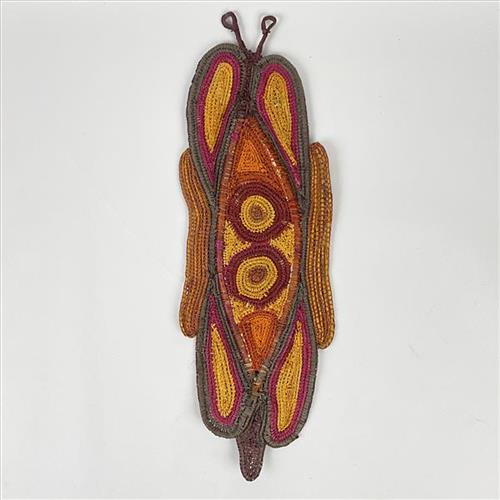
Butterfly
Fibre Art is an ancient Aboriginal women’s craft that is still made today using the same techniques as their ancestors. Making fibre art is labour intensive and much care and fine needlework is required to ensure the finished object is both functional and beautiful. Fibre art from Ghunmarn Culture Centre includes dilly bags, floor mats, bush fans, woven creatures found in the landscape, plants such as yams (bush potato), baskets, place mats, and spirit figures such as mermaids and Mukuys. Natural pandanus fibre (Mukarra), is used to make much of the fibre art produced by the artists of Djilpin Arts. Women collect the pandanus by pulling from the top of the pandanus tree, then stripping and drying the leaves before they are dyed with natural bush colour collected from the Beswick surrounds.
115682359329
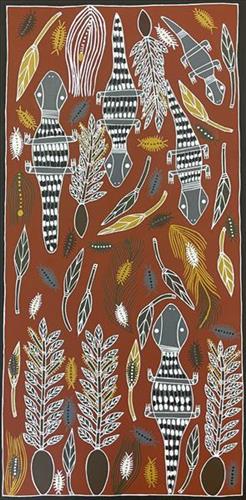
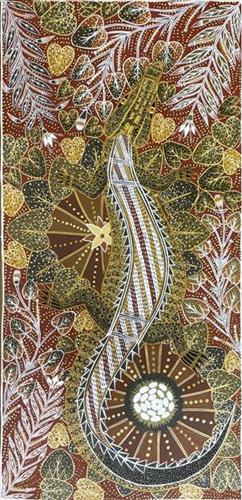
Damilipa (Blue Tongue Lizard)
This painting depicts Damilipa (Blue Tongue Lizard) scouring the vast landscapes of Gurrwiliny, NE Arnhem Land. Damilipa can be seen across Arnhem Land all year around. Damilipa is the dreaming for this artist’s family.
115682359627
Baru Dhawu (Crocodile Story)
Baru (the crocodile man), was from the Gumatj clan. People usually call him Gurdu Gurdu or Baru which means crocodile. He lived his life at a place called Yirrkala. Living near him were other people, and when Baru didn’t have enough to eat he began to kill and eat these other people. After a while others noticed that some people were missing. When Baru went to the toilet, the people could smell this strong smell, so they knew that he ate the other people. Some men went to get help and they took message sticks to the other tribes. Some were sending smoke signals. When they came to Baru’s camp they started to spear him in the left side of his ribs. He dropped into the fire and burnt his left hand and maybe his right hand. He then ran into the bush and yelled to his countrymen – the animals, birds and fish that live on the land and in the sea. He stopped and he named the tribes and clans and also the places until he came to a place called Gamarru/Guyurru. There he took a rest and said to himself “This is where I stop and call this place Gamarru/Guyurru”. Baru, still in pain from the fire, then jumped into the water and turned himself into a crocodile. The fire left scars on his back. Baru paintings belong to Gumatj and Warrawarra and also the Marpi clan. This painting is used at death ceremonies or initiations and it normally is painted on the belly, which means the person the design is painted on is part of Gurdu Gurdu (the crocodile people).
115682360776

Buliya (catfish)
Buliya (catfish) are a favourite fish for Yolngu, They are often depicted amongst the waterlillies, leeches and natural debris such as leaves and reeds.
114582360949
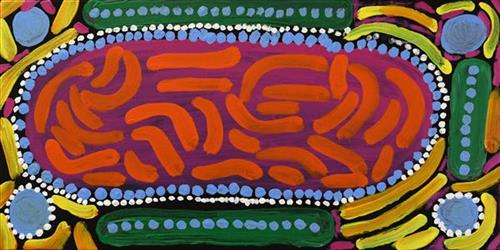
Billabong Country
The roots of the lily pad can be roasted and eaten. They are found in billabongs and springs and have a beautiful flower. You can see the flowers that come up after the rain season. All the flowers and animals that come round the billabong.