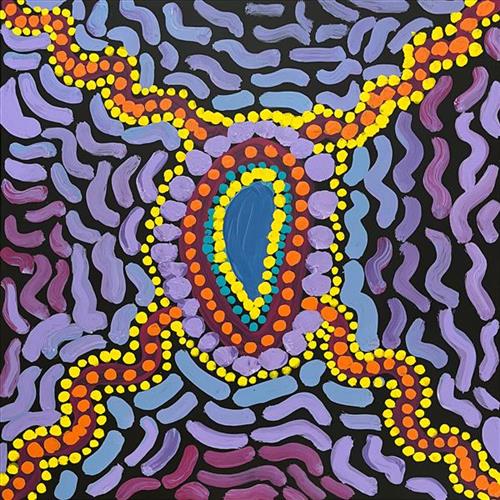
Baby Stingrays Feeding
This perspex is about when the baby stingrays jinup are born and are learning to feed and swim around in the ocean bed. Jinup is also my totem I cannot kill or eat it or I will get sick.

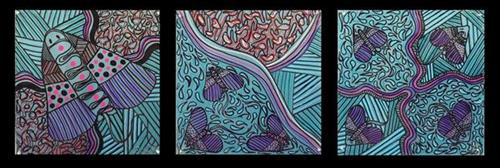
This perspex is about when the baby stingrays jinup are born and are learning to feed and swim around in the ocean bed. Jinup is also my totem I cannot kill or eat it or I will get sick.

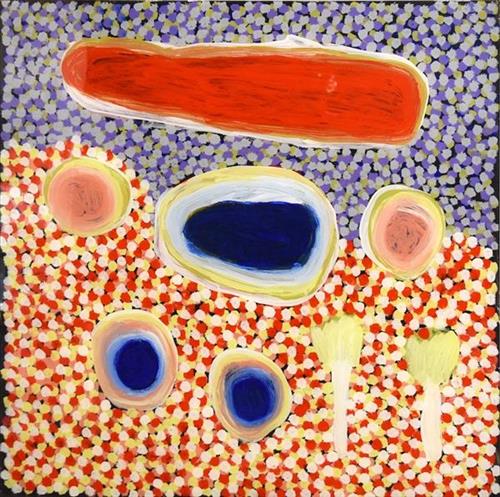
THESE ARE THE WATERHOLES OUT IN THE DESERTTHE BIG ONE IN THE MIDDLE IS .AIN WATERHOLE AND LITTLES ONES ARE SALT LAKES WITH SANDHILLS

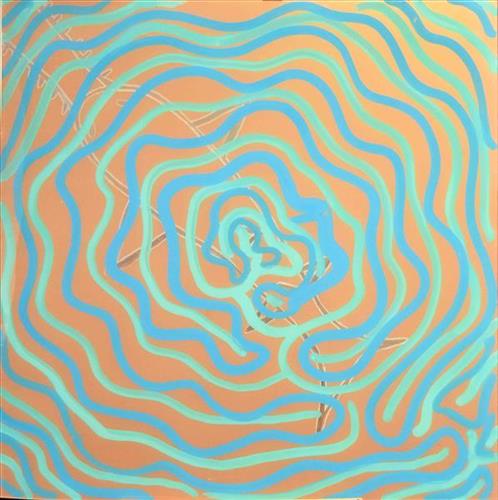
This fish is called Piyalpiyal (swordfish), we catch them along the Fitzroy River its also my father’s totem

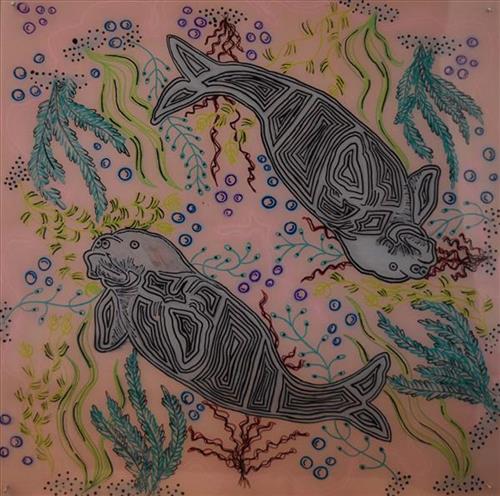
Some of us saltwater people hunt dugong during full moon time. It’s a favourite tucker to eat. Dugongs eat seaweed and sea grasses off the sea bed.

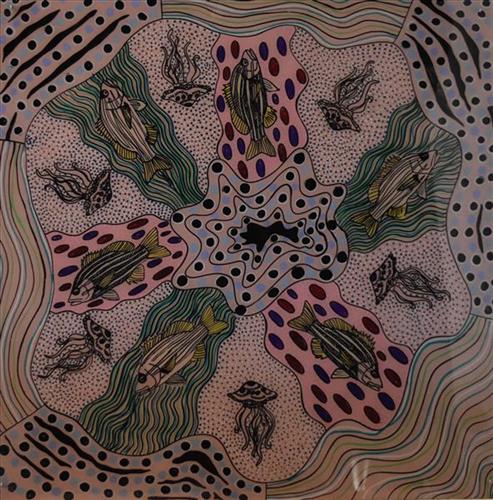
This painting is about the spanish flag fish its a reef fish and is really good eating its a beautiful fish with stripes colours of silver, yellow and black also jellyfish is in paintings i come from saltwater country so i like to paint saltwater animals.

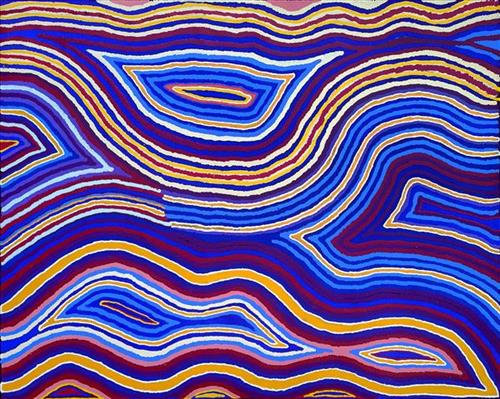
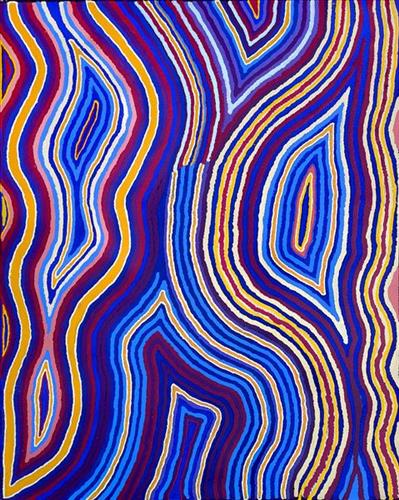
In this painting, Angilyiya is focusing on the man — these are his eyes staring at you.
‘Kungkarrangkalpa’ (The Seven Sisters or Pleiades) is significant Tjukurrpa (Dreamtime). Its origins may be familiar to you in astronomy, through its connection to Wati Nyiru (Magic Man or Orion). The roots of this dreaming stretch across many Indigenous cultures around the world. The Australian Aboriginal songline is just one part of this larger dreaming that can be traced globally. For the ladies of the Ngaanyatjarra Lands, this story carries a particular chapter — one tied deeply to their understanding of country and the journey of the sisters. The different versions of this story depend on where you live and the importance of local Tjukurrpa places.
Nyiru fell in love with the sisters but was the wrong skin group to marry them. Still, he pursued them relentlessly. The sisters travel across the land to escape Nyiru’s unwanted attentions, always just out of reach. Their path can still be read in the land today — rocks, caves, and waterholes that carry this memory. As Nyiru is chasing the sisters he tries to catch them by using magic to turn into the most tempting kampurarrpa (bush tomato) and the most beautiful Yirli (wild fig tree), for them to eat and camp under. However, the sisters are knowledgeable of his magic and too clever for Nyiru, who they outwit again and again. They go hungry and run through the night rather than be caught by him. As the journey continues, Nyiru gets so frustrated at the wit of the sisters that he uses his magic to make the oldest sister sick to try and get closer to her. The other sisters rescue the big sister and nurse her back to health. It is said he also captures the youngest sister, but with the help of the oldest sister, she escapes back to her sisters who are waiting for her. Eventually, the sisters fly into the sky to escape Nyiru, forming the constellation. Nyiru, heartbroken and longing, used his magic to follow them — and now chases them forever across the sky.
This painting maps the site of Kuru Ala — meaning “two eyes”, a women’s site in Angilyiya’s mother’s country south of Papulankutja (Blackstone). Here, Wati Nyiru was spying on the women, watching them from the shadows of the cave — disguised as a quandong tree, a fig tree, then a snake — as they camped and dug for food.

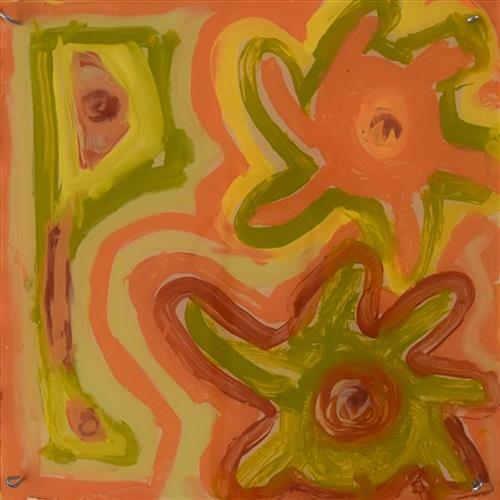
This is about Gogo station on the old road. When I was young we were living there. We used to collect the coloured rocks from the hills, all different colours. Our mothers too and parents collected stones. We would gift it to our teachers and people as a gift from our country.
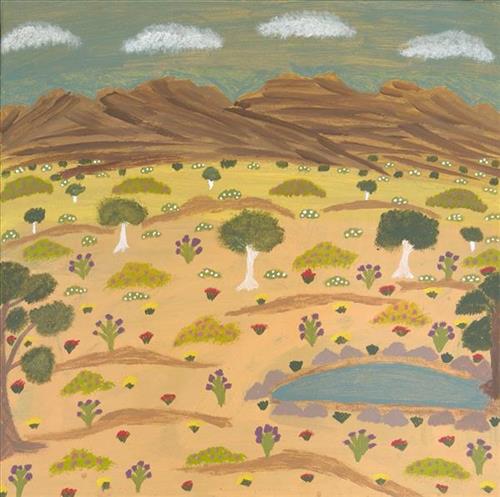
My mothers country is flowers, trees and mountains. I love to paint them. We see springs, the water from the springs is like rainwater, fresh and clean. We hunt goanna and turkeys, we roast them in the fire and the flesh is strong and sweet.
When we hunt we sleep at night next to the fire, the skies are big and the stars are beautiful, it makes me feel good.
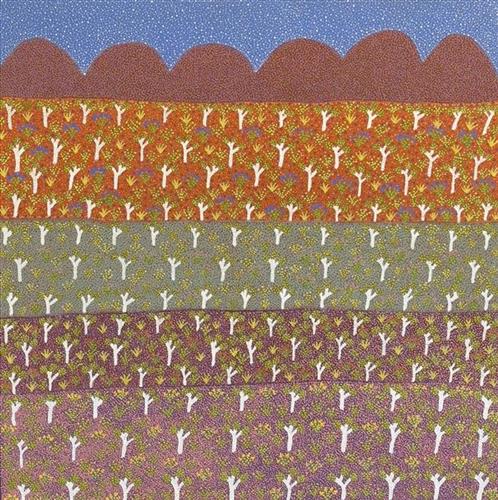
Ampilatwatja is my Mothers Country, I come from a long line of artists.
My family still traditionally hunt and gather, I share my love for the land, plants, flowers and trees, with my children and grandchildren.
My paintings are inspired by the changing seasons and I sometimes collect bush medicine plants which I make into tea to drink and bush medicine body lotions. My favourite is aherr-aherr (lemon grass) which I boil up and then use as a body and hair wash, this always makes me feel right and good.
Knowing your country is an important part of living in a remote community like Ampilatwatja. Knowing when and where to go hunting and gathering, knowing where there is ‘soakage’ (where you can dig for water), traveling with family for ceremonies, and maintaining a connection with the land.
“This is my Mothers country, my view of country”
The community of Ampilatwatja made a conscious decision not to paint ‘altyerr’(dreaming stories). The artists paint their country where those stories sit.