221282359103


Mai – Bush Tucker Daisybell’s Story

Travelling around getting bush tucker near my home. From when I was a tjitji (child) collecting mai (food). Travelling from home, not today but a long time ago. I would go with my family, friends, with tjitji tjuta (many children).

221282359102


Tjanmata – Bush Onion

Tanmata or bush onions are found near creek beds on the Aṉangu Pitjantjatjara Yankunytjatjara (APY) Lands in the remote northwest of SA. Aṉangu bake the small bulbs in hot ashes and then remove the outer papery covering (nyiri) before eating them.

Until comparatively recently, bush foods were the primary source of sustenance for Aṉangu Pitjantjatjara. Many bush foods are still gathered regularly, almost exclusively by women, and they therefore feature strongly in women’s mark making. Women learn the art of gathering each of the foods from a young age and much inma (ceremony) relates to these practices and the maintenance of supply.

221282359101


Kalaya Tjukurpa – Emu Dreaming

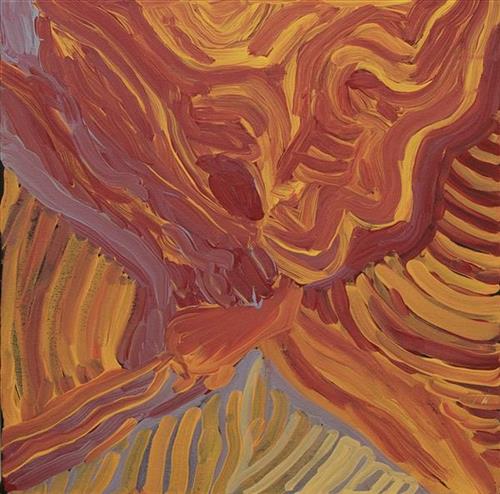
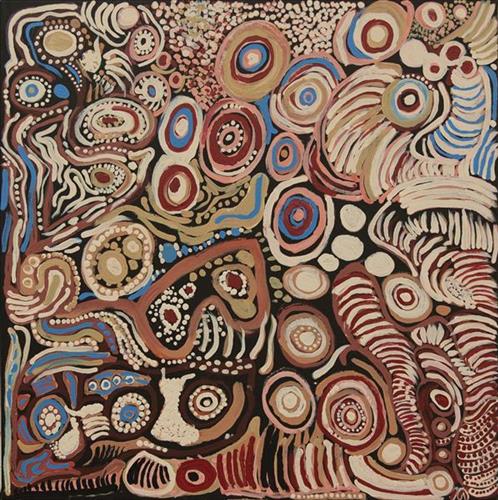
This is Malpiya’s mother’s country near Kanpi on the APY Lands. Malpiya’s mother was born here at one of the waterholes. The kalaya (emu) is the creation being that formed this land. Malpiya’s design is a depiction of the kalaya walking around looking for mai (food) and water in the rockholes.

221282359100


Tjukurpa Mulayangu / Atipalku’s Story

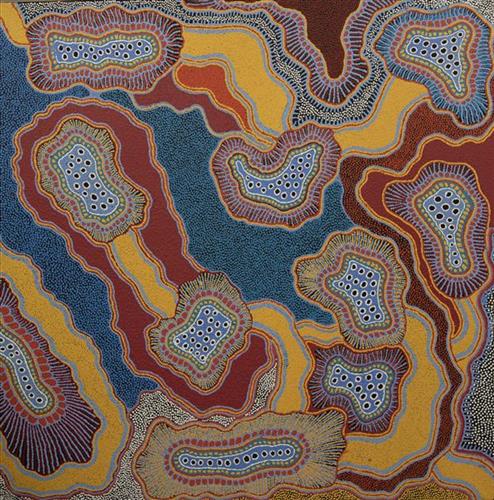
Tjukurpa Mulayangu is a men’s law place. This is Atipalku’s father’s country in the western part of the Aṉangu Pitjantjatjara Yankunytjatjara (APY) Lands in South Australia. Mulayangu was a wanampi (water snake) who travelled all over this area creating rockholes.

In 2020 Atipalku and her family travelled to this area and stayed at their homeland, Tangkana, for the first time in many years. Atipallku was able to show her children and grandchildren this special place and share stories with them that had been passed down to her.

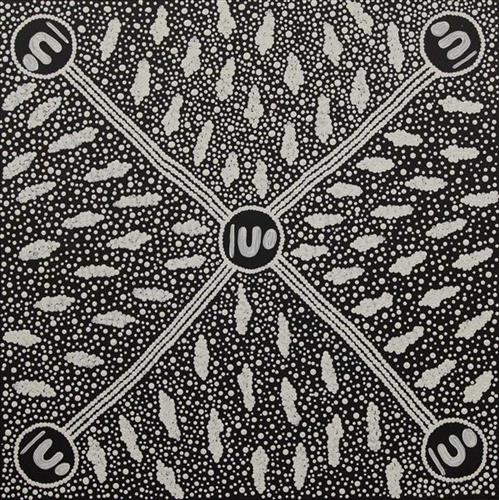
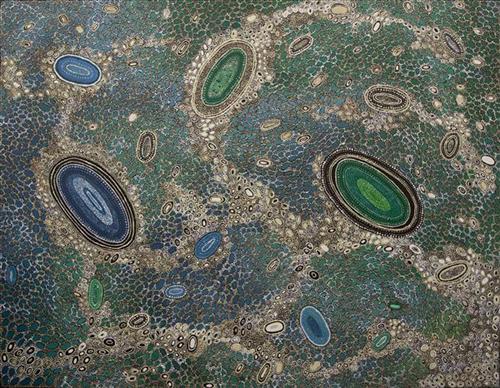
This painting depicts Atipalku’s father’s country with tjanpi (grass) and many tjukula (waterholes).

221282359095


Michelle’s Tjala Dreaming (Honey Ant)

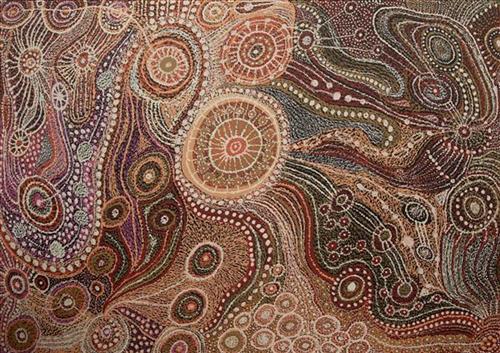
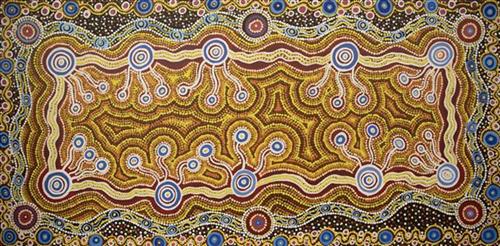
Michelle’s father’s country is tjala tjukurpa (honey ant dreaming). Michelle and her family still visit this country where she pays special attention to the natural elements on the land which are then represented in her paintings:

I am painting the landscape from above, as you might see it from an airplane or as a bird looking down. It is beautiful country both from on the ground and up above.

In Michelle’s work she creates how the tjala (honey ants) tunnel though the sandy soil. She also depicts the waterholes, the assemblages of trees and shrubs and the country that is ‘quiet’.

Tjala or honey ants live in nests about a metre underground beneath mulga trees, and they are a highly favoured food source. The tjala tunnels that lead down to the ants’ nests are called nyinantu, and the larvae are called ipilyka-ipilyka. After the rain when the ground is soft the women go digging for tjala by looking for the drill holes under the trees. They then use shovels and crowbars to dig down following the tunnels to find the tjala inside. Anangu suck the delicious rich honey-like liquid from the distended abdomen of the tjala. The story of the tjala is told across the Northern Territory into South Australia and is an important link between Anangu mythology and inter-dependence on the environment.

221282359093


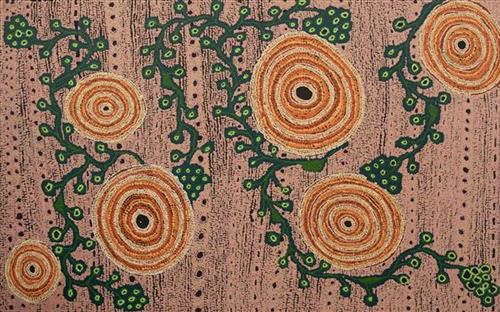
Tjukuḻa – Waterholes Makinti’s Story

A long time ago when I was about ten years old I went with my mum and dad to visit family at Areyonga in the Northern Territory.  We travelled back to Ernabella, walking with two donkeys and blankets (not swags) for about three weeks.

We arrived near Mulga Park and I remember we came along a short cut from Mulga Park to the New Well area, Mum and Dad knew the place. It was getting dark and they knew there was a rock hole in some low rocks in the middle of the trees.

My aunty Niningka was also with us and they knew that place. There was a rock with many holes, all full of water. We got there at about 10pm and Mum and Dad lit the fire. I was only a little girl. I went with the billycan to find the water. My mum had a cup and we got the water.

We stayed over night and the next day we travelled to New Well, Young’s Well and all the way to Ernabella. I always remember this special place.
221282359011


Tjakura Tjukurpa – Lexie’s Story

This Tjukurpa is from Lexie’s grandfather’s homeland called Kunytjanu, located just south of Pipalyatjara near the SA border with WA. It’s a story about tjakura, the great desert skink, a small orange lizard found across the APY Lands. 

 Tjakura has a lot of grandchildren looking after him. One day, a long time ago, he saw too many strangers, an army coming from Mutitjulu. They came and found the tjakura and they killed him. All the kids made a cemetery there for the tjakura. This is a really big story that goes from Kunytjanu to Aralya.

221282359009


Minyma Kutjara

There is a story of deep significance to women which contains metaphorical references to female cycles. It tells of two women travelling north. The pair meet with a group of women, including Kutungu, who are caring for a man who then passes away. They then travel to the area known as Mantaruta, near Uluru, where they chase a curious wanampi (serpent) deep into the ground while trying to catch him. They burn their body hair to attract him and hit him on the head and run away. From afar they throw a manguri/traditional head-ring for carrying which also hits him. He then comes and hits the women who travel on bleeding and hurt.

221282359006


Margaret’s Father’s Country

My father’s place is Mt. Liebe, sandhill country.  The Wanapi rests there under the surface of the creek.  When we go to visit that country, the Wanapi stirs underneath the ground and bubbles rise up in the water.  He is there to protect that place.  We speak to that Wanapi in our language and he knows then that it is us. It’s okay for us to be there and the bubbles settle back down.  Close to this creek is where the Arkaryi women are sitting.  This is an important women’s site.  I can’t speak too much about that, as it would be dangerous to disturb those women.

11454007991


Status: Stock


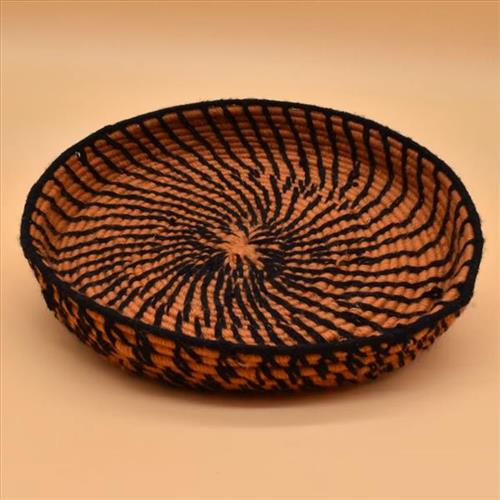
Woven Bowl

Decorative Hand-woven bowl.

Artefacts are made locally by artists and craftspeople, many of whom are Mangkaja artists. Keep an eye out for their paintings in our artwork section.