220982374065


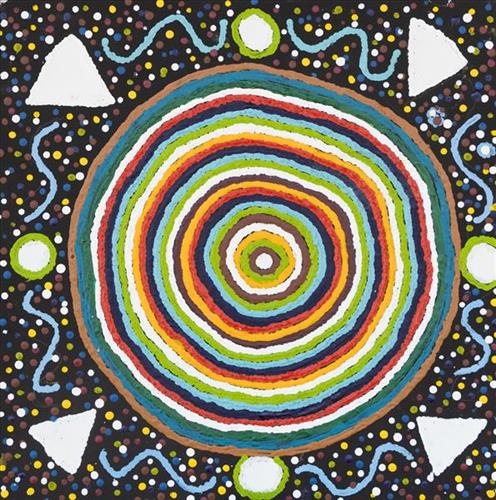
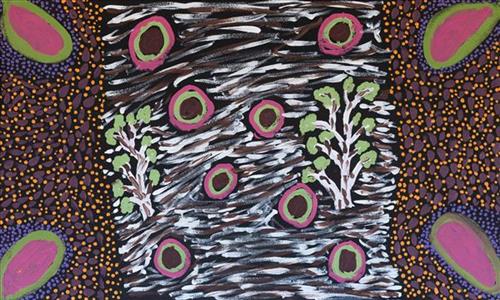
Kwanty Penh (After the Rain)

We paint the bush medicine, bush tucker and bush flowers that are most personal and meaningful to us. 

While we work we have big talks about community matters, old time stories and bush tucker stories, how the blackberries would be out soon and how delicious they are kwanty penh (after the rain).

We go out bush after rain to hunt, the flowers all bloom, all the big berries are everywhere and the bush medicine grows all green.The colours are everywhere, it shows us that summer is coming, this time of year makes everyone very happy


220982374064


Kwanty Penh (After the Rain)

We paint the bush medicine, bush tucker and bush flowers that are most personal and meaningful to us. 

While we work we have big talks about community matters, old time stories and bush tucker stories, how the blackberries would be out soon and how delicious they are kwanty penh (after the rain).

We go out bush after rain to hunt, the flowers all bloom, all the big berries are everywhere and the bush medicine grows all green.The colours are everywhere, it shows us that summer is coming, this time of year makes everyone very happy


220982374063


Kwanty Penh (After the Rain)

We paint the bush medicine, bush tucker and bush flowers that are most personal and meaningful to us. 

While we work we have big talks about community matters, old time stories and bush tucker stories, how the blackberries would be out soon and how delicious they are kwanty penh (after the rain).

We go out bush after rain to hunt, the flowers all bloom, all the big berries are everywhere and the bush medicine grows all green.The colours are everywhere, it shows us that summer is coming, this time of year makes everyone very happy


220982374062


Kwanty Penh (After the Rain)

We paint the bush medicine, bush tucker and bush flowers that are most personal and meaningful to us. 

While we work we have big talks about community matters, old time stories and bush tucker stories, how the blackberries would be out soon and how delicious they are kwanty penh (after the rain).

We go out bush after rain to hunt, the flowers all bloom, all the big berries are everywhere and the bush medicine grows all green.The colours are everywhere, it shows us that summer is coming, this time of year makes everyone very happy


220982374054


Kwanty Penh (After the Rain)

We paint the bush medicine, bush tucker and bush flowers that are most personal and meaningful to us. 

While we work we have big talks about community matters, old time stories and bush tucker stories, how the blackberries would be out soon and how delicious they are kwanty penh (after the rain).

We go out bush after rain to hunt, the flowers all bloom, all the big berries are everywhere and the bush medicine grows all green.The colours are everywhere, it shows us that summer is coming, this time of year makes everyone very happy


111582374408


Jila-Jila

“Rockholes, camps, creeks, seedlings. Creeks going towards the camp” – Judith Aspro Jila-jila is one of several soaks located close to Punmu Aboriginal Community, and on the eastern edge of Kumpupirntily (Kumpupintily, Lake Disapointment). During the pujiman (traditional, desert dwelling) period, Martu would traverse very large distances annually in small family groups, moving seasonally from water source to water source, and hunting and gathering bush tucker as they went. At this time knowledge of water sources was critical for survival and today Martu Country is still defined in terms of the location and type of water. Each of the hundreds of claypans, rockholes, waterholes, soaks and springs found in the Martu desert homelands is known by name, location, quality and seasonal availability through real life experience and the reacounting of Jukurrpa (Dreaming) narratives.

111582374326


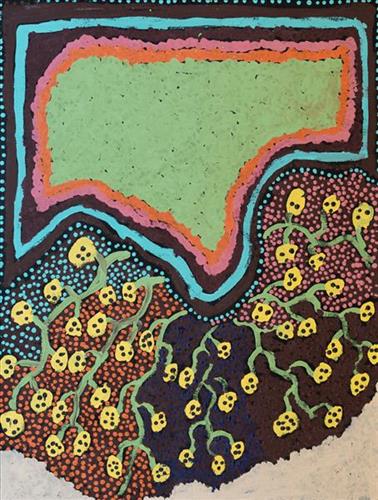
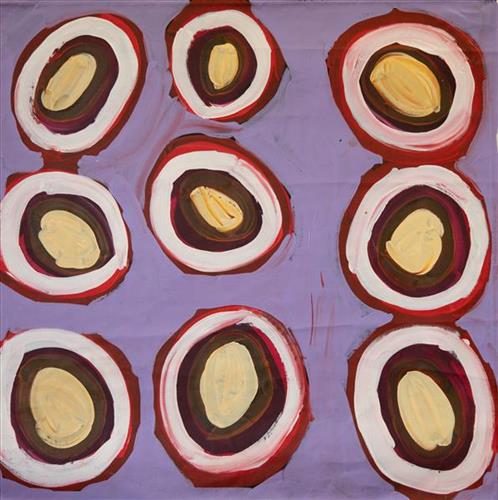
Pirrkili

“We camped there, lots of water in that claypan. Old people camp, passing through, going to Karlamilyi. Warman people passing through. From this place they go to Mulunyjarra (rockhole)”

– Elizabeth Toby

Pirrkili is a claypan surrounded in all directions by permanent tali (sandhills), located east of Nyayartakujarra (Lake Dora) and south of Punmu Aboriginal Community. Linyji (claypans) such as Pirrkili were traditionally visited more often during the wantajarra (wet season) when they were filled with water. Also depicted in this work are wamurla (bush tomatoes), a spherical yellow bush fruit harvested from small prickly shrubs. Wamurla are a favoured bush tucker amongst the Martu, popular for their sweet taste and of the relative ease with which they are foraged. The shrubs prolifically produce purple flowers before fruiting and require fire burning followed by rains in the months preceding their growth. The fruit is high in vitamin C content, and has a taste likened to banana, passionfruit and rockmelon. Wamurla can be eaten raw or dried, though only the thick outer rind is eaten; the black seeds and the thin inner part of the fruit are very bitter and inedible. Typically wamurla is collected in large quantities and then eaten or stored for later consumption. During the pujiman (traditional, desert dwelling) period, Martu would traverse very large distances annually in small family groups, moving seasonally from water source to water source, and hunting and gathering bush tucker as they went. Whilst desert life has moved away from mobile hunter-gatherer subsistence throughout the course of the twentieth century, bush tucker continues to be a significant component of the modern Martu diet. Hunting and gathering bush tucker remains equally valuable as an important cultural practice that is passed on intergenerationally.

111582374321


Pirrkili

“We camped there, lots of water in that claypan. Old people camp, passing through, going to Karlamilyi. Warman people passing through. From this place they go to Mulunyjarra (rockhole)”

– Elizabeth Toby

Pirrkili is a claypan surrounded in all directions by permanent tali (sandhills), located east of Nyayartakujarra (Lake Dora) and south of Punmu Aboriginal Community. Linyji (claypans) such as Pirrkili were traditionally visited more often during the wantajarra (wet season) when they were filled with water. During the pujiman (traditional, desert dwelling) period, Martu would traverse very large distances annually in small family groups, moving seasonally from water source to water source, and hunting and gathering bush tucker as they went. At this time knowledge of water sources was critical for survival and today Martu Country is still defined in terms of the location and type of water. Each of the hundreds of claypans, rockholes, waterholes, soaks and springs found in the Martu desert homelands is known by name, location, quality and seasonal availability through real life experience and the reacounting of Jukurrpa (Dreaming) narratives.

111582374110


Puntawarri Waterhole

“We drink water at Puntawarri. We clean and dig that waterhole. This Country is Puntawarri. My nanna, Dadda, taught me to paint this Country. Puntawarri is important because it is my pop’s, my nannas’ husband’s, place. They camped there and went hunting for goanna or anything, kangaroo or turkey. At Puntawarri there are all the waterholes. Good hunting this Country. There is still some Rabbit Proof Fence there.”

 – Judith Anya Samson

Puntawarri is an important cultural area located on the middle stretches of the Canning Stock Route and east of the Jigalong Mission (now Jigalong Aboriginal community), where Judith grew up with her grandmother and renowned Martumili Artist, Dadda Samson (dec.). Puntawarri is also the site of an abandoned community, a waterhole, creek and lake. Puntawarri’s close proximity to Jigalong Mission made it a popular site for Martu to visit during the ‘mission days’.

While growing up at Jigalong Mission in the 1960’s, Dadda would return to Puntawarri every weekend to hunt and camp. Dadda has been teaching Judith to paint for a number of years, sharing the knowledge and Jukurrpa (Dreaming) stories associated with her ngurra (home Country, camp). 

For many Martu, like Dadda and her family, Jigalong Mission was the site where their pujiman (traditional, desert dwelling) lifestyle came to an end from the late 1940s as they transitioned to a life as stockmen and women working in cattle stations in the Pilbara region and beyond. In the wake of the extreme and prolonged drought of the 1960s, the last of the remaining pujimanpa (desert dwellers) were forced to move to missions like Jigalong, where a supply of food and water was assured. There, many Martu were reunited with family members that had already moved in from the desert.

The waterhole at Puntawarri is said to be populated by several kinds of ancestral jila (snake), however the site is best known for its association with the Ngayurnangalku, fearsome ancestral cannibal beings. During the Jukurrpa the Ngayurnangalku came together from all over the desert, first stopping near Puntawarri on their travels to Kumpupirntily (Kumpupintily, Lake Disappointment). At Kumpupirntily, they had a big meeting to debate whether or not they would continue to live as cannibals, and eventually came to the decision to stop eating people. That night, a female baby cannibal was born to the eastern Ngayurnangalku on the red sandhills at Puntawarri, where she continues to live today as the ‘big mummy’ Ngayurnangalku. Following protocol, the baby also had to be consulted by the group. She determined that the Ngayurnangalku should continue to eat people. Her decision divided the group, and from this point the group from the east continued to live as ‘bad’ cannibals at Kumpupirntily, while the group from the west became ‘good’, thereafter consuming only animals.