221382380835


Billabong Brim

Djilpin Arts is a not for profit Aboriginal Corporation that promotes the maintenance, development and transmission of traditional cultural knowledge systems.

Djilpin Arts specialises in art, live cultural performance, digital media, and produced the popular performance event – the Walking With Spirits Festival as well as Concerts on Country.

Djilpin Arts operates the Ghunmarn Culture Centre – home of the Blanasi Collection and offers fine arts & crafts for sale. Djilpin Arts operates an outlet in Katherine – Shed 5, where all works are sourced from Ghunmarn Culture Centre. Ghunmarn Culture Centre is in the Wugularr (Beswick) community of South East Arnhem Land.

All artworks are made by local artists living in the community. Artwork reflects the traditional songs and stories that have been passed down through the generations with a contemporary edge.  Fibre art is a special feature of Djilpin Arts as is its Gapu Series of fine art prints.

221382380824


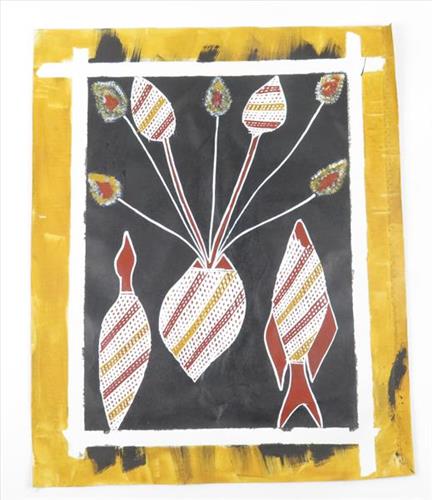
Billabong Daga

Djilpin Arts is a not for profit Aboriginal Corporation that promotes the maintenance, development and transmission of traditional cultural knowledge systems.

Djilpin Arts specialises in art, live cultural performance, digital media, and produced the popular performance event – the Walking With Spirits Festival as well as Concerts on Country.

Djilpin Arts operates the Ghunmarn Culture Centre – home of the Blanasi Collection and offers fine arts & crafts for sale. Djilpin Arts operates an outlet in Katherine – Shed 5, where all works are sourced from Ghunmarn Culture Centre. Ghunmarn Culture Centre is in the Wugularr (Beswick) community of South East Arnhem Land.

All artworks are made by local artists living in the community. Artwork reflects the traditional songs and stories that have been passed down through the generations with a contemporary edge.  Fibre art is a special feature of Djilpin Arts as is its Gapu Series of fine art prints.

221382380821


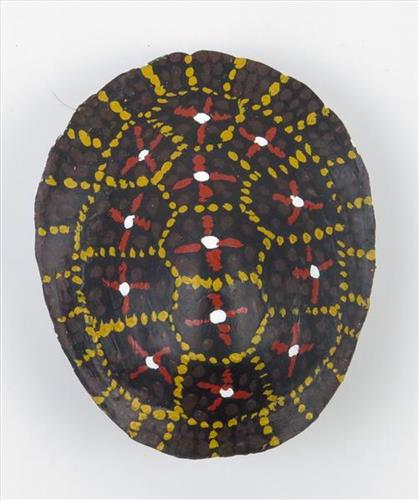
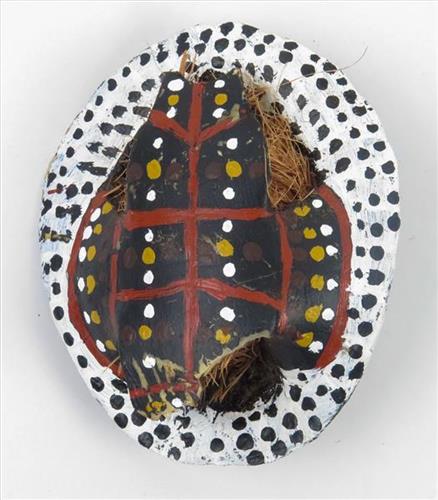
Painting on Short Neck Turtle Shell

Djilpin Arts is a not for profit Aboriginal Corporation that promotes the maintenance, development and transmission of traditional cultural knowledge systems.

Djilpin Arts specialises in art, live cultural performance, digital media, and produced the popular performance event – the Walking With Spirits Festival as well as Concerts on Country.

Djilpin Arts operates the Ghunmarn Culture Centre – home of the Blanasi Collection and offers fine arts & crafts for sale. Djilpin Arts operates an outlet in Katherine – Shed 5, where all works are sourced from Ghunmarn Culture Centre. Ghunmarn Culture Centre is in the Wugularr (Beswick) community of South East Arnhem Land.

All artworks are made by local artists living in the community. Artwork reflects the traditional songs and stories that have been passed down through the generations with a contemporary edge.  Fibre art is a special feature of Djilpin Arts as is its Gapu Series of fine art prints.

111982380819


Mun-dirra (fish fence)

Mun-dirra, in Burarra language, means “fish fence”. Mun-dirra were traditionally made by men using coastal sedge grass called gurdagarra and were designed to fence in schools of fish in ocean shallows or riverbeds. They were used in conjunction with conical traps, called an-gujechiya, which are woven with mirlarl, a hardy jungle vine, and burdaga, the sinewy inner bark from Kurrajong trees. 

Fish traps and fish fences have been used throughout west and central Arnhem Land by various language groups; in Kuninjku, people call them kunkarlewabe (fish fence) and mandjabu (fish trap).

Artist Doreen Jinggarrabarra explains, “In the old days, they didn’t have any casting nets, [so] they made a fish trap and a long fence net, [put] them side to side, and put the fish trap in the middle. Then the fish came and went in the fish trap.”

To make a fish trap (an-gujechiya), jungle vine (mirlarl) is soaked in water for one night to make it soft. Then, the structural form of the fishtrap would be worked on, with hibiscus (bardainy) rings fashioned inside to keep the fish trap’s shape. Kurrajong string (burdaga) would be made to attach the inner rings and to tie the conical end of the fish trap closed. This fish trap is used in both saltwater and freshwater.

 The fish fences (mun-dirra) would be set up across rivers and creeks, with the fish trap (an-gujechiya) placed in the middle of the two fences. Sticks, rocks, mud and grass would be used to hold the fences in position and funnel the fish into the trap. This ingenious system could catch fish like saltwater barramundi (rajarra), freshwater barramundi (janambal), small black freshwater catfish (buliya), bonefish (an-guwirrpiya), and sand bass (dalakan).

Doreen remembers seeing the traps in riverbeds around Maningrida when she was young: “The older ladies and the older men [would] usually go down, say about seven or eight o’clock, to go and check the trap. Maybe seven fish can go in, crabs and catfish,” she recalls.

Today, people generally use fishing lines and casting nets for fishing, but the woven traps and fences continue to be made as works of art. Women are now considered the knowledge holders, and are leaders in the development of sophisticated examples of woven design and material culture.

 *Maningrida Arts & Culture acknowledges the work of many academic and non-academic voices when writing on this topic. It is important to note Anna Freeland and Myles Russell-Cook, whose writing have informed this text.
221382380810


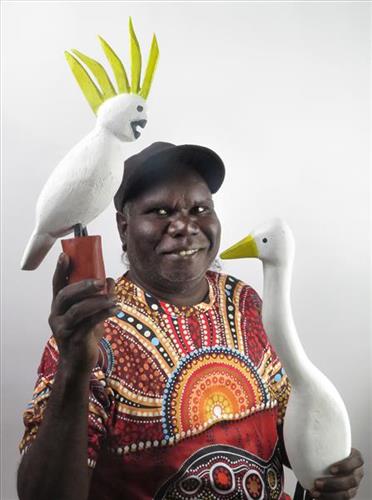
Cockatoo

Wood carving has always been part of Aboriginal culture and Djilpin artists continue this tradition. Men carved wood for many purposes – tools for hunting or gathering food, axes and knives for building shelters, spears and clubs for protection of their lives and territory, objects for ceremony and to mark sacred sites.

Hunting implements include the boomerang, woomera and spear. The woomera is a lever which helps to increase the speed and distance the spear travels. Clapsticks are used as percussion instruments by the Songmen to accompany dancing along with the didgeridoo (mago).

As well as the more functional carvings, artists portray animals and birds in wood, and these carvings are often painted. Ceremonial carvings include spirit creatures including mukuy (devil devils) and mimi.

Some fine mimi figures have been cast in bronze.

111982380809


Mun-dirra (fish fence)

Mun-dirra, in Burarra language, means “fish fence”. Mun-dirra were traditionally made by men using coastal sedge grass called gurdagarra and were designed to fence in schools of fish in ocean shallows or riverbeds. They were used in conjunction with conical traps, called an-gujechiya, which are woven with mirlarl, a hardy jungle vine, and burdaga, the sinewy inner bark from Kurrajong trees. 

Fish traps and fish fences have been used throughout west and central Arnhem Land by various language groups; in Kuninjku, people call them kunkarlewabe (fish fence) and mandjabu (fish trap).

Artist Doreen Jinggarrabarra explains, “In the old days, they didn’t have any casting nets, [so] they made a fish trap and a long fence net, [put] them side to side, and put the fish trap in the middle. Then the fish came and went in the fish trap.”

To make a fish trap (an-gujechiya), jungle vine (mirlarl) is soaked in water for one night to make it soft. Then, the structural form of the fishtrap would be worked on, with hibiscus (bardainy) rings fashioned inside to keep the fish trap’s shape. Kurrajong string (burdaga) would be made to attach the inner rings and to tie the conical end of the fish trap closed. This fish trap is used in both saltwater and freshwater.

 The fish fences (mun-dirra) would be set up across rivers and creeks, with the fish trap (an-gujechiya) placed in the middle of the two fences. Sticks, rocks, mud and grass would be used to hold the fences in position and funnel the fish into the trap. This ingenious system could catch fish like saltwater barramundi (rajarra), freshwater barramundi (janambal), small black freshwater catfish (buliya), bonefish (an-guwirrpiya), and sand bass (dalakan).

Doreen remembers seeing the traps in riverbeds around Maningrida when she was young: “The older ladies and the older men [would] usually go down, say about seven or eight o’clock, to go and check the trap. Maybe seven fish can go in, crabs and catfish,” she recalls.

Today, people generally use fishing lines and casting nets for fishing, but the woven traps and fences continue to be made as works of art. Women are now considered the knowledge holders, and are leaders in the development of sophisticated examples of woven design and material culture.

 *Maningrida Arts & Culture acknowledges the work of many academic and non-academic voices when writing on this topic. It is important to note Anna Freeland and Myles Russell-Cook, whose writing have informed this text.
377810582380981


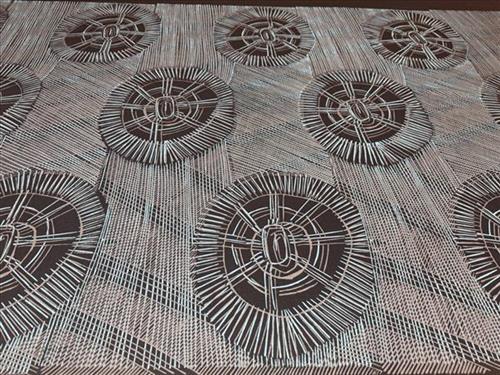
Marebu (Floor Mat)

Deborah Wurrkidj is a Kuninjku artist from the Kurulk clan.

Wurrkidj’ country lies around the outstation of Mumeka in central Arnhem Land. She is an accomplished artist working across mediums including painting, sculpture, weaving and textile design. In her later years, Deborah has focused her efforts on mentoring her niece, Temika Namundja.

Works in fibre from the Maningrida region are widely recognised as some of the finest in Australia. Artists confidently push the boundaries of fibre craft and cultural expression, adapting traditional techniques and forms to produce strikingly inventive and aesthetically exquisite artworks.

Artists weave many different kinds of mats. Conical mats were traditionally used to shield babies from mosquitoes. Long flat mats were used for blocking creeks so that fish would be diverted into fish traps. A small triangular mat made of pandanus fibre used to be worn by women during ceremonial gatherings, tied around their back and covering them at the front. Mats are also used for wrapping and rinsing food in water.

Artists usually use kundayarr, pandanus spiralis, to weave decorative round or oblong mats, as well as the less common triangular and conical shapes. Weaving is physically hard work, now done only by women. They colour the pandanus using natural dyes made from the roots, leaves or flowers of plants within the weaver’s clan estate.

The radial woven patterns of the finest round mats appear to vibrate with colour, sometimes regarded as an aesthetic manifestation of deep cultural meaning, as there is a significant spiritual dimension to pandanus mats.

377810582380980


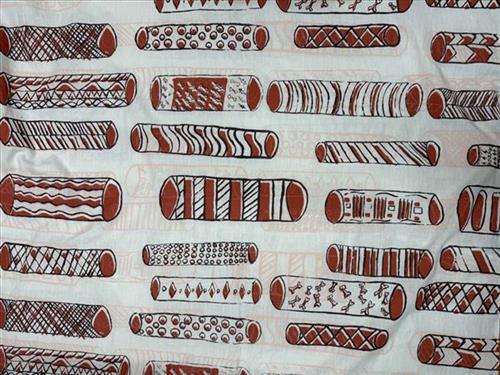
Lorrkkon (Funeral Logs) Marilyn James

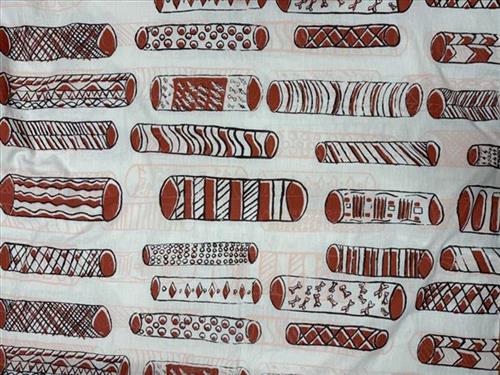
Marilyn’s first screen print design depicts the story of lorrkkon (hollow funeral logs). This the story of her great, great grandfather and grandmother who were bark painters, as well as also sacred lorrkkon painters.

When designing this screen print, Marilyn was remembering her childhood living in a small house on Liverpool river Ngar-wunja (Thompson hole) with other families.

Through the painting process, Marilyn remembered and relived the times when people still lived permanently on remote homelands, living off the land before balanda (non-indigenous people) arrived.

Marilyn recalls “it makes me think back, we did lots of things, some people was hunting, some was weaving, some was painting barks and lorrkkon. As my great, great grandfather and grandmother was painters, I painted this my story for them.”

377810582380978


Lorrkkon (Funeral Logs) Marilyn James

Marilyn’s first screen print design depicts the story of lorrkkon (hollow funeral logs). This the story of her great, great grandfather and grandmother who were bark painters, as well as also sacred lorrkkon painters.

When designing this screen print, Marilyn was remembering her childhood living in a small house on Liverpool river Ngar-wunja (Thompson hole) with other families.

Through the painting process, Marilyn remembered and relived the times when people still lived permanently on remote homelands, living off the land before balanda (non-indigenous people) arrived.

Marilyn recalls “it makes me think back, we did lots of things, some people was hunting, some was weaving, some was painting barks and lorrkkon. As my great, great grandfather and grandmother was painters, I painted this my story for them.”

377810582380977


Lorrkkon (Funeral Logs) Marilyn James

Marilyn’s first screen print design depicts the story of lorrkkon (hollow funeral logs). This the story of her great, great grandfather and grandmother who were bark painters, as well as also sacred lorrkkon painters.

When designing this screen print, Marilyn was remembering her childhood living in a small house on Liverpool river Ngar-wunja (Thompson hole) with other families.

Through the painting process, Marilyn remembered and relived the times when people still lived permanently on remote homelands, living off the land before balanda (non-indigenous people) arrived.

Marilyn recalls “it makes me think back, we did lots of things, some people was hunting, some was weaving, some was painting barks and lorrkkon. As my great, great grandfather and grandmother was painters, I painted this my story for them.”