221282381097


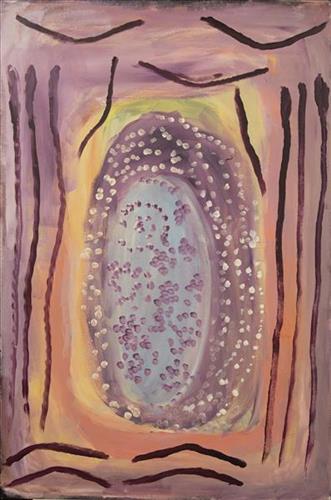
Kulata and Kali (Spear & Boomerang)

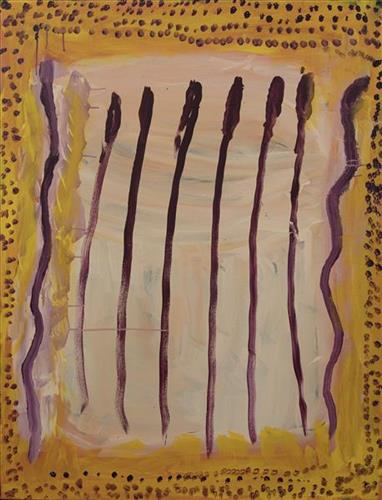
My father told me this story, it’s a dream he had. There was a man who was travelling for a long time. He was travelling with kulata (spear) and kali (boomerang) because someone was waiting there for fighting.

In the middle of the way someone came making problems and trouble. All the kulata gone, all the kali gone. That place is still there and the kangaroo and emu are still drinking there at that waterhole.

This is tjukurpa wiru – a good story. There are some stories I can’t tell you.

221282381096


Ngayuku Walka / My Design

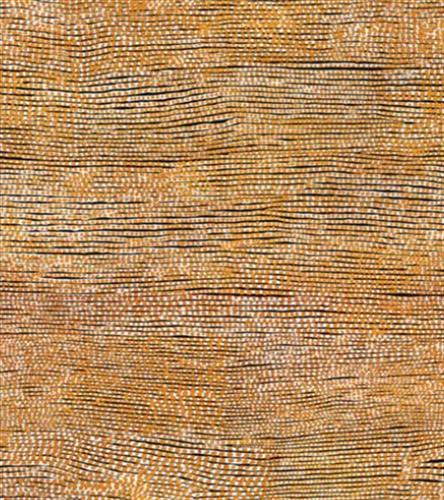
Walka means design or pattern. Artists use this title to describe artworks that are pattern based rather than descriptive or telling a story.

221282381095


Kulata Tjuta – Kungkarangkalpa Freddy’s Story

Kungkarangkalpa means the Seven Sisters. This is an extensive creation story that relates to the Pleiades constellation in the southern hemisphere. The story traverses Australia taking on different forms, however Freddy’s part of the story is from his father’s country west of Atila (Mt Connor). For this part of the story a man called Nyiru is chasing the sisters as he wants to sleep with the oldest sister. All the younger sisters are deeply afraid of him. 

Nyiru makes kulata tjuta (many spears) and leaves them leaning up against a tree. When the sisters are travelling they find the spears resting there and realise that the wati kura (bad man) is nearby. They get frightened and run away. Eventually, to escape Nyiru, the sisters fly into the sky where they turn into stars and form the constellation.

377810582381086


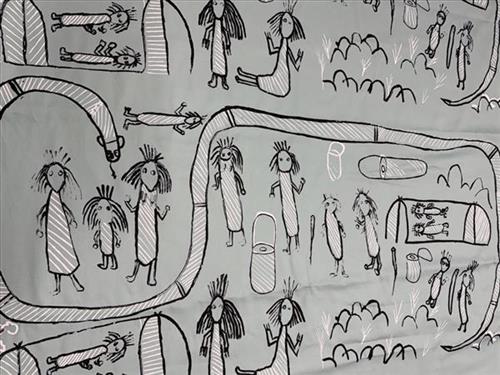
Bawáliba la Ngalyod (Stone Country Mimih and Rainbow Serpent)

‘My Kikka (mother), when she was alive, she would tell me these stories. I was just a little girl and she would tell us the stories in her language Gurrgoni.

In the camps there were boy and girl Bawáliba, and old Bawáliba too. They loved to dance by the firelight, keeping rhythm with a stick. They had lots of hair, they were really tall and skinny, with spots on their bodies. The Bawáliba lived a long time in peace. They were the only spirits on their country and so they were never disturbed.

One day, a long time ago, the Bawáliba were out hunting, and they saw a large snake- they didn’t know then but she was the Rainbow Serpent. They were really scared, they had never seen that. creature before. She was really beautiful- like a normal king brown snake but with a rainbow from the sky on her back. The Rainbow Serpent was really hungry, and she could smell the Bawáliba from a long way away.  She was out looking for food.  The Bawáliba tried to stop Ngalyod coming for them but she was just too quick. She snuck up behind the Bawáliba and before they could get away she ate them up. When she was really full and couldn’t eat anymore Bawáliba she changed the rest of  them into stone. Still till this day, the Bawáliba stay on that same country as stones.’

Lucy Yarawanga

220182381073


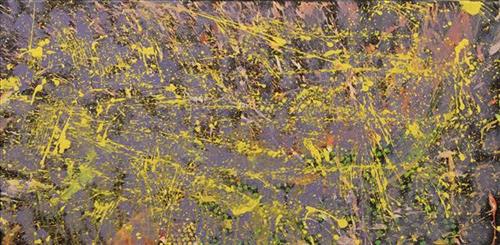
Yalpirakinu

Yalpirakinu is Adrian’s mother’s country. Adrian’s mother is the late Eunice Napangardi, a well known painter herself. His artworks consistently refer to the desert mountains, ridges and trees which are part of Yalpirakinu. Using a restricted colour palette, Adrian’s  brushwork is loaded with energy, drama and memories. He is a deliberate and thoughtful painter; reworking, pushing and pulling the image to completion.

220282381056


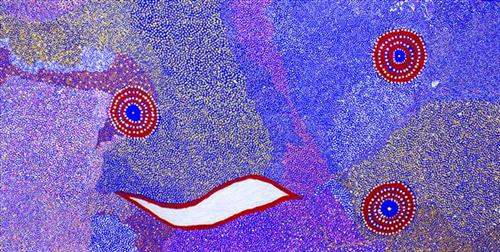
Kakalyalya Tjukurrpa – White Cocky Dreaming

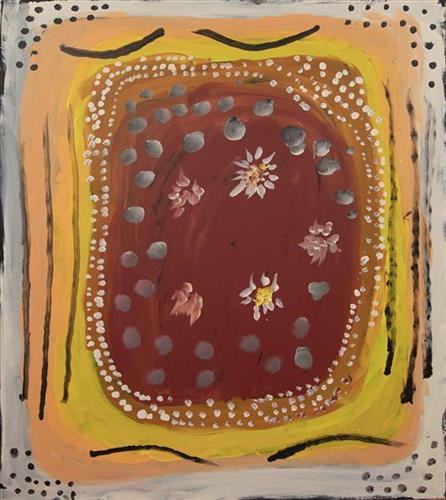
In the artist’s words: This is the story in my father’s country of Pirrupa Kaala. It is the story of the white cocky (circle middle on top) with mako (witchetty grubs) in its mouth. The eagle (left bottom) brought malo (kangaroo) meat (circle left top) for the white cocky as she had a broken wing. But a crow (circle right side bottom) chased the white cocky all over the country because the white cocky had such a big mob of mako. The crow started to hit the white cocky with a nulla nulla and called her greedy. The eagle helped the cocky and chased the crow away. So it happend that the eagle came to stay with white cocky for a little while. But on day he said: ”Oh, I am going home to find another place to stay”, and left the white cocky behind to stay there by herself for good.

The blue colour shows the tracks from the water running into the deep water holes in the sand after the rain. The red colour shows the little mountains where the water comes from and goes into the creek flowing south.

37781064008499


Status: Stock


Apron – Cafe Small -Screen Print

Unique, one off aprons, hand sewn locally in Broome.

Made from screen printed assorted textile prints created by Nagula Jarndu Artists and hand printed in Melbourne.

These are limited edition garments and each apron is unique 

Your purchase of this garment provides income for Aboriginal women artists and helps give them a platform to share their culture and stories.

Nagula Jarndu (Saltwater Woman) is a not-for-profit, 100% Aboriginal owned and governed organisation and the profits from your purchase will go directly to the artist and back into the organisation to fund future projects.

Care and washing guide:
Our designs are hand screen printed onto quality fabric and professionally heat set.
Handwashing your garment in cold water and ironing from the inside-out, will ensure that it is a enjoyed for years to come.

37781064008498


Status: Stock


Apron – Cafe Medium -Screen Print

Unique, one off aprons, hand sewn locally in Broome.

Made from screen printed assorted textile prints created by Nagula Jarndu Artists and hand printed in Melbourne.

These are limited edition garments and each apron is unique 

Your purchase of this garment provides income for Aboriginal women artists and helps give them a platform to share their culture and stories.

Nagula Jarndu (Saltwater Woman) is a not-for-profit, 100% Aboriginal owned and governed organisation and the profits from your purchase will go directly to the artist and back into the organisation to fund future projects.

Care and washing guide:
Our designs are hand screen printed onto quality fabric and professionally heat set.
Handwashing your garment in cold water and ironing from the inside-out, will ensure that it is a enjoyed for years to come.

37781464008474


Status: Stock


Milky Way Bomber Jacket – June (Moonie) Djiagween

The Milky Way is a sacred thing for many different tribes, it means seasons and hunting. You listen to stories of the Milky Way and that inspires me to paint the it, inspired by working with the Elders and artists before me. The color palette that I use in the Milky Way are mainly ochre colors- raw sienna, black, white and greys- the colors of the Country. 

The old people talk about the Milky Way, different stories about it. In the Milky Way, you can see an emu. When the Milky Way turns up in the cold season, it means it’s time for hunting, you know the food will be really fat.   

About the Artist:

June is a strong Yawuru-Bardi Ngarluma-Yindjibarndi woman who expresses her love for country and ancestral dream stories through painting acrylic and ochres on canvas.

June draws her strength and inspirations from all four ancestors’ tribes deep in her blood with historical stories.

From earth, sky, rivers, trees, plants, oceans, islands, animals, spirits, seasons, creation time to connection to country bond by aboriginal sacred laws and culture.

She grew up in Broome, or Rubibi as it is known by Yawaru people. “Broome is my home, where I was grounded and where I was loved by my Dad’s family” 

“My mum is Yindjibarndi-Ngarluma and my dad is Bardi-Djawi and Yawaru. My mum was a very cultural woman, so I’d always end up back out at Warralong and Strelley with the Mardu people. We’d go out for law and culture, and every now and then we’d go past Woodbrook, Roebourne, passing by, following cultural ceremonies. It was an important time. All the elders took their positions very seriously.

By the time I was fourteen I couldn’t read and write because I missed too much school. You know, I was a bush kid. It was very hard for me because mum was trying to keep her culture alive while I went to St Mary’s in Broome with all the nuns and brothers. I was talking three to four different languages – Mardu, Ngarluma, Yindjibarndi and Bardi.

If I spoke them languages at school, they would hit me with sticks and rulers because you had to speak English. Mum would say ‘Don’t speak your language in school.’ But I couldn’t differentiate between speaking the language at home and speaking it in school.

I’ve been coming back and forth from Broome to Roebourne since I was young. Nanna used to live in Roebourne but they left for Port Hedland because all the pastoral companies were putting up fences, stopping people from accessing the land. They removed everyone from Country. Then there was the fighting for equal wages. My uncle, their little son, also passed away. Someone said it was from starvation, but we don’t know what happened.

But they would go back all the time, my grandmother and Judith’s grandmother. They are all sisters you see. Very close. They’re Yindjibarndi, Ngarluma and Kariyarra, so I have connections through all those clans. We would go on Country with our grandparents on the back of an old truck. Everyone used to jump on the back with their swags and the camp dogs. There were always a lot of dogs. Dogs everywhere!

I would also watch my grandfathers sing all the time. Paddy Djiagween, he would sing, sing, sing, all day! He would sing for the rain and for the fish to come. But he was too old when I was young, to do arts and crafts. My other grandfather, Adam Barker, was a lot younger than him. He was a Warnman desert man and he did traditional carvings; boomerangs, shields, spears. He tried to teach us how to do the little animals like blue tongue, snake and goanna. All the animals that you see on Country, he would make them out of carvings, with traditional patterns over the top.

I didn’t end up with that skill but I ended up watching him and transferring those patterns onto canvas, like my jellyfish. I love painting the jellyfish. I’ve been painting them forever. They are very beautiful.

For thousands of years we were hunters and gatherers, simple people. We navigated through the stars, we were engineers. We weren’t conquers or colonisers. From the beginning, we were our own tribes and had our own culture and we have the right to maintain that. 

You can take Aboriginal people, chain them or put them down. You can try to turn them into a white man, but you can never take away their spirit, their culture and connection to Country.”