111582379972


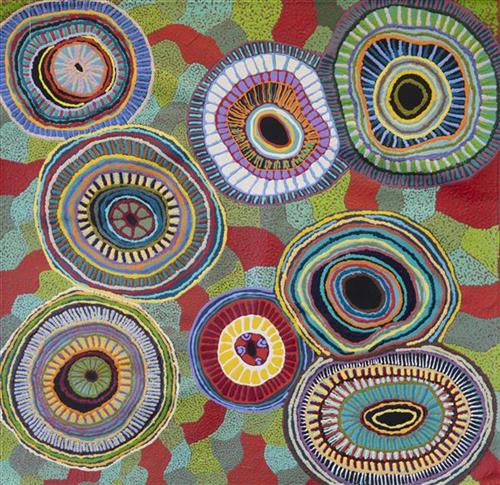
Mungili Claypan

“When I was young, [I would] walk around, play around, slide around on the mud. [At Mungili, there’s a] Big one [claypan] and little ones on the side. And the white gums, [where] we would get witchetty grubs”

– Marlene Anderson

In this work Marlene depicts a claypan located in Mungili, the small outstation community situated just off the Eagle Highway in Western Australia. Mungili lies approximately 430 kilometres northeast of Wiluna and 250 kilometres north of Warburton. Marlene grew up in Mungili, and as such it forms a significant part of her ‘ngurra’ (home Country, camp). Typically Marlene depicts this site with a central large circular form that represents the main claypan, surrounded by smaller circular forms symbolising satellite water bodies.

During the pujiman (traditional, desert dwelling) period, knowledge of water sources was critical for survival, and today Martu Country is still defined in terms of the location and type of water. Each of the hundreds of claypans, rockholes, waterholes, soaks and springs found in the Martu desert homelands is known through real life experience and the recounting of Jukurrpa (Dreaming) narratives by name, location, quality and seasonal availability. This encyclopedic knowledge extends even to the nature and movement of arterial waterways, and sustained Martu as they travelled across their Country, hunting and gathering, visiting family, and fulfilling ceremonial obligations. They would traverse very large distances annually, visiting specific areas in the dry and wet season depending on the availability of water and the corresponding cycles of plant and animal life on which hunting and gathering bush tucker was reliant.

111582379969


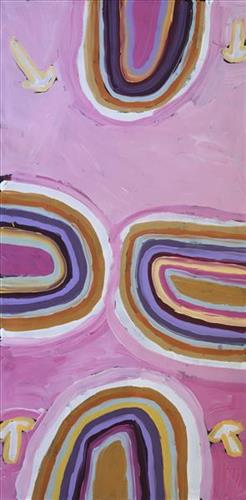
Emu Tracks to Puntawarri

“Emu go to the springs to have a drink of water and then move on to the next one.”

– Judith Anya Samson

Puntawarri is an important cultural area, as well as the site of a now abandoned community, a waterhole, creek and lake. Puntawarri is located on the middle stretches of the Canning Stock Route and east of the Jigalong Aboriginal Community, where Judith grew up with her grandmother and senior Martumili Artist Dadda Samson (dec.). Anya continues to live between Jigalong and Newman today.

Puntawarri lies within Judith’s ngurra (home Country, camp) through her mother’s family, and as a young girl she frequently travelled and hunted with her family in this area, learning the stories for this Country. Depicted in this work are the tracks of a group of emus on their way to Puntawarri waterhole, searching for kapi (water). 

Karlaya (emu) were traditionally hunted during the pujiman (traditional, desert dwelling) era, and they continue to be a favoured bush tucker for Martu today. During the pujiman period, Martu would traverse very large distances annually in small family groups, moving seasonally from water source to water source, and hunting and gathering bush tucker as they went. Jina (tracks, footprints) are used by Martu people when tracking bush tucker. In the absence of an actual animal sighting, tracks act as an identifier that an animal was present, which can then be followed to the animal’s present location. Besides providing information on location, Martu are able to interpret from tracks the passage of time since the tracks were imprinted, as well as the corresponding animal species and its size.

The softer and more extensive the ground surface, the easier it is to locate and follow tracks, thus certain conditions are favoured for tracking. Tuulparra (spring) and yalijarra (hot time) are preferred over wantajarra (winter), when south easterly tradewinds blow strongly to obscure tracks. Tracks and burrows are also more readily visible in early growth lands, such as nyurnma (freshly burnt Country) and waru-waru (growth of new shoots and young plants). For this reason, fire burning is an important tool in animal tracking. Small burns are lit to clear vegetation, expose burrows, and to allow for access to walk and track readily in exposed sands, while simultaneously providing diverse regenerating habitats.

225182379967


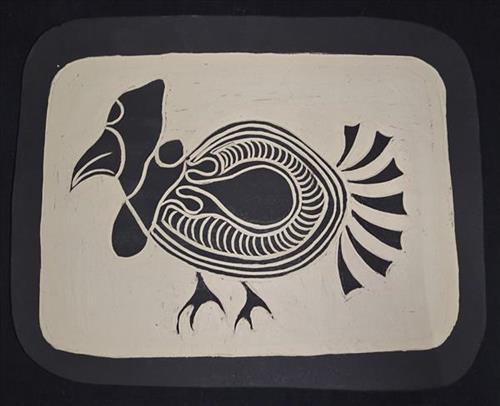
Diwan (Scrub Turkey)

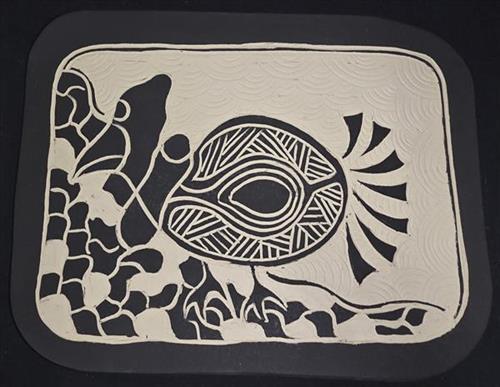
Many years ago, our ancestors lived in harmony with the rainforest and other parts of the land, they knew many different ways of hunting and gathering for food. Diwan (Scrub Turkey) was an important food source for us. The women used to collect the eggs in a special way. They danced around the big nests while other women dived into the big nest with their arms. The eggs are found very deep down, in the warmest area of the nest. Diwan (Scrub turkey) is deeply connected with the Kuku Yalanji clans. It is an important Totem that is still sung and danced in public ceremonies today.

225182379964


Diwan (Scrub Turkey)

Many years ago, our ancestors lived in harmony with the rainforest and other parts of the land, they knew many different ways of hunting and gathering for food. Diwan (Scrub Turkey) was an important food source for us. The women used to collect the eggs in a special way. They danced around the big nests while other women dived into the big nest with their arms. The eggs are found very deep down, in the warmest area of the nest. Diwan (Scrub turkey) is deeply connected with the Kuku Yalanji clans. It is an important Totem that is still sung and danced in public ceremonies today.

225182379963


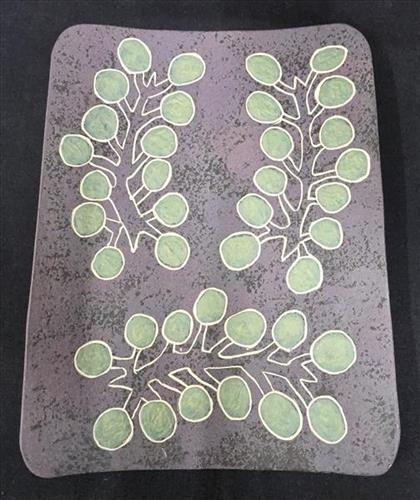
Janbal (Quandong)

Janbal (Quandong) is good bush tucker. We gather the fruit from August to January when they are sweet and soft. The kernel of the fruit is very pretty and we often use it to make body adornments such as necklaces and earrings.

225182379941


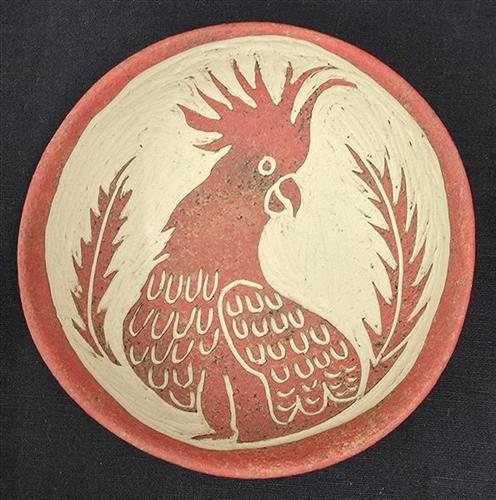
Birmba (White Cockatoo)

Birmba (White Cockatoo) is my family totem. It has been passed down from generation to generation. They always remind me of my grandfather, my sister and other family members who have passed on. White Cockatoos are like protective spirits for me and my family. They will give you signs. Good signs and signs of danger. They will let you know when to move on.
When I’m out with my grandchildren and there is a white cockatoo, I might say, “that is your grandmother, my sister who is watching us”.

At other times, the spirits of other family members visit us in form of white cockatoos. The White Cockatoo keeps our living and past family connected to each other and to our country. When I’m alone, I know they are around. I speak to their spirit and they give me strength.

225182379939


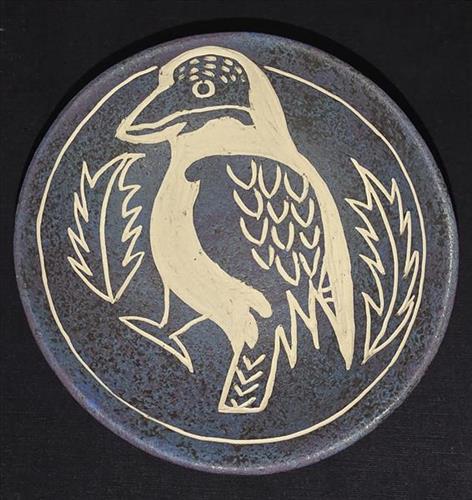
Yindili (Kingfisher)

The Kingfisher, known as Yindili in Kuku Yalanji language, is according to our culture one of the significant messenger birds.  The Kingfisher will let us know when to expect a visit from families living in another community, And when we see a Kingfisher close by, we know that something good will soon happen in our personal life.

221282379938


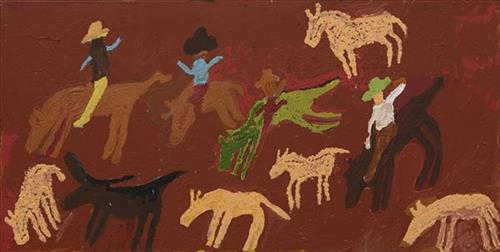
Pulukangka (Stockman)

Mr Jack was a stockman. He likes to tell stories about his time as a stockman on nearby cattle stations and as a young fella working on the sheep station at the Ernabella Mission. Mr Jack says about those days ‘good memories! good times! a time staying strong in my heart’. His artwork pays tribute to the stockmen sitting around a campfire drinking a kapati (cup of tea) and telling stories like Mr Kulyuru’s time at the rodeo in Alice Springs or Mr Ingkatji on his horse and cart.