221382377935


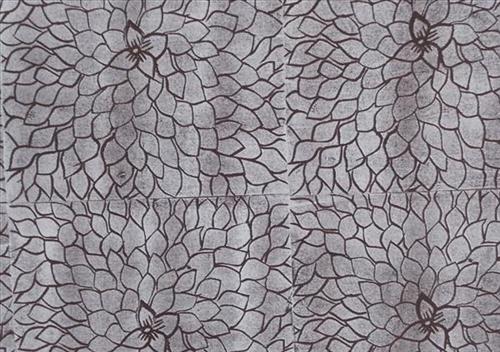
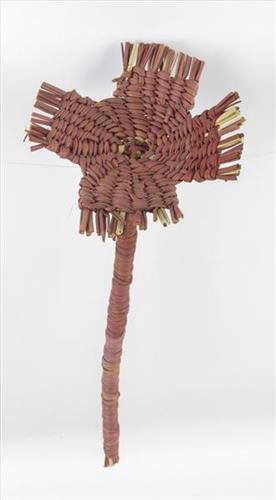
Flower

Fibre Art is an ancient Aboriginal women’s craft that is still made today using the same techniques as their ancestors. Making fibre art is labour intensive and much care and fine needlework is required to ensure the finished object is both functional and beautiful. Fibre art from Ghunmarn Culture Centre includes dilly bags, floor mats, bush fans, woven creatures found in the landscape, plants such as yams (bush potato), baskets, place mats, and spirit figures such as mermaids and Mukuys. Natural pandanus fibre (Mukarra), is used to make much of the fibre art produced by the artists of Djilpin Arts. Women collect the pandanus by pulling from the top of the pandanus tree, then stripping and drying the leaves before they are dyed with natural bush colour collected from the Beswick surrounds.
221382377933


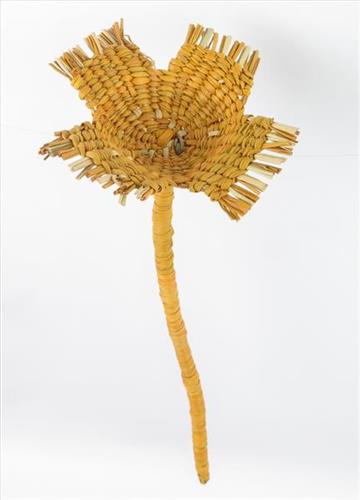
Flower

Fibre Art is an ancient Aboriginal women’s craft that is still made today using the same techniques as their ancestors. Making fibre art is labour intensive and much care and fine needlework is required to ensure the finished object is both functional and beautiful. Fibre art from Ghunmarn Culture Centre includes dilly bags, floor mats, bush fans, woven creatures found in the landscape, plants such as yams (bush potato), baskets, place mats, and spirit figures such as mermaids and Mukuys. Natural pandanus fibre (Mukarra), is used to make much of the fibre art produced by the artists of Djilpin Arts. Women collect the pandanus by pulling from the top of the pandanus tree, then stripping and drying the leaves before they are dyed with natural bush colour collected from the Beswick surrounds.
377810582378033


Mandjabu

Kuninjku people traditionally make two sorts of conical fish traps. One is called mandjabu and is made from a strong, durable vine called milil, and a smaller one is called manylik mandjabu, and made from the grass manylik. The mandjabuconical fish trap is bigger and stronger and used in tidal reaches of creeks to catch large fish. The smaller, lighter manyliktrap is used in freshwater flowing creeks to catch smaller fish and freshwater prawns. In earlier times, only men were involved in the construction of the large fish traps, but children would often crawl inside and assist.

To make mandjabu, weavers firstly harvest milil (burney vine, Malaisia scandens) and put it in water overnight to make it soft. Then they start weaving it; they make rings for the inside to keep the fish trap’s shape. People also make string from the bark of burdaga (kurrajong) to attach the bardainy (hibiscus) rings and to tie the conical end of the fish trap. It’s hard work and it can take three or four weeks to make a fish trap. People also use fish-net fences called kunkarlewabe. They would put the kunkarlewabe  across rivers and creeks. In the middle they would place the mandjabu. They also used small things like sticks, rocks, mud and grass to block the fish from going through. This way we would catch fish such as saltwater barramundi rajarra, ngaldadmurrng (freshwater barramundi), small black freshwater catfish (buliya), bonefish (an-guwirrpiya), and sand bass (dalakan) in the mandjabu.

377810582378032


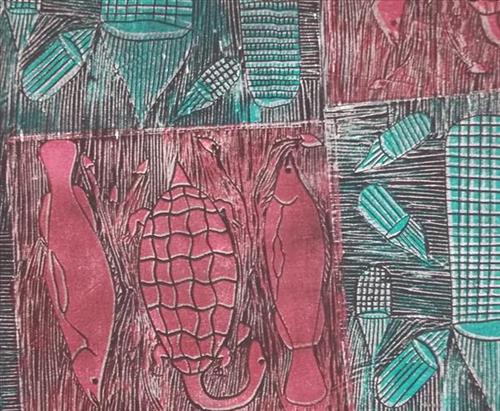
Long neck turtle and fish

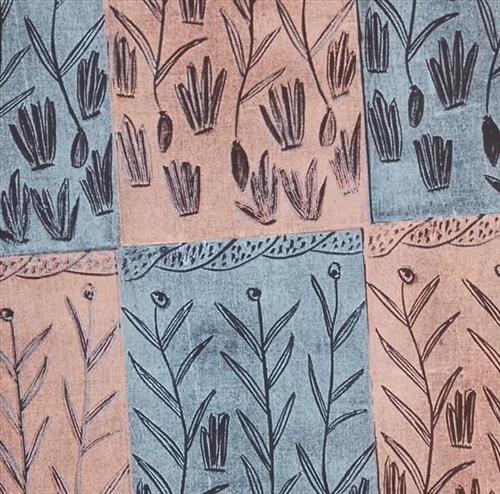
This fabric was created using the linocut fabric printing technique, which has been refined at Bábbarra Women’s Centre since it was introduced in the mid-1990s.

The Lino tile is carved by the artist at Bábbarra Designs. It is printed on fabric by hand using a variety of colours and layers. The linocut technique ensures each textile is a one-off, limited edition piece.

The fabric is colour-safe and can be thrown into a washing machine. Repeated use will soften the fabric, and some fading will occur over time. 

Bábbarra Women’s Centre supports the economic independence of Indigenous women in the Arnhem Land community of Maningrida, Northern Territory, Australia. Designs created by the women at Bábbarra reflect strong cultural knowledge, which is passed down to younger generations through their textile design practice.

‘Themes in our artwork almost exclusively come from our Country and cultural connection. Our deep relationship with the land and seas of our customary clan estates strongly defines and governs the social, cultural, spiritual and territorial aspects of our lives.’

Bábbarra Designs Artist Statement

377810582378031


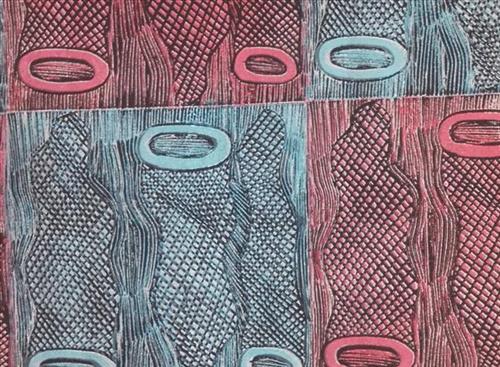
Karrbarda (Long Yam)

“This design is about collecting karrbarda (yams). The old people use these kungarrndutj (digging sticks) to dig the yams from under the ground. They carry the kunmatj (dilly bags) on their heads for collecting bush food. These yams are purple on the saltwater side of country and inland they are white.” – Deborah Wurrkidj

Deborah Wurrkidj is a Kuninjku artist from the Kurulk clan whose country lies around the outstation of Mumeka in central Arnhem Land. In this design, she has depicted Kun-madj (dilly bag) and karrbarda (long yam). Women dig up long yams with kungarrndutj (digging sticks) and they are then cooked in the ashes of the fire to be eaten.

Kun-madj, or dilly bag, is a large woven collecting basket. These large bags are often made from the vine ‘Malasia scandens’, a strong pliable plant that grows along the floor and into the canopy of monsoon vine thickets. The bags are used to collect heavy foods, such as fish caught in conical fish traps or large collections of yams. They can also be made from Pandanus spiralis, a plant that grows in many areas of Arnhem Land.

377810582378030


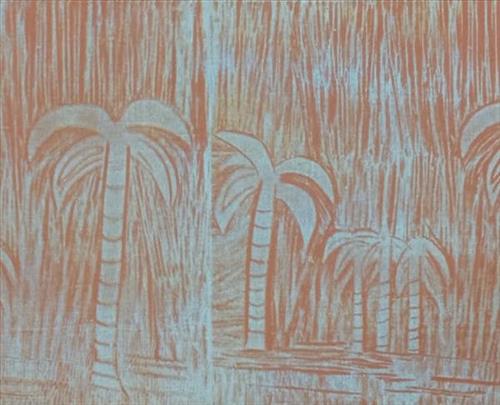
Ngarndúma (palm tree)

Ngarndúma  2022

This is a kind of tall palm tree with one straight trunk growing in Arnhem Land. 

From Njamed.com:

Kentia palm. Gronophyllum ramsayi; Carpentaria acuminata. Gender: djíya; Moiety: Yírriddjanga. N A. Karlakkalóddjarra márdba ka-rénjdjeya. The new shoot is sweet. The growing tip of young palms eaten raw; large palms are not eaten. The fruits are toxic to people but eaten by fruit pigeons. 

377810582378029


Wayuk (Waterlily)

Wayuk (Waterlily) Nymphaea violacea. 

The stem of wayuk is a popular bushfood and the beautiful flower is enjoyed across Arnhem Land. 

This fabric was created using the linocut printing technique. The lino tile has been carved by the artist in Maningrida, and has been printed by hand using a variety of colours and layers. The linocut technique ensures each textile piece is a one-off, limited edition piece. Bábbarra Women’s Centre supports the economic independence of Indigenous women in the Arnhem Land community of Maningrida, Northern Territory, Australia. Designs created by the women at Bábbarra reflect strong cultural knowledge, which is passed down to younger generations through their textile design practice.

225182378004


SJB: “Ngayu kuku balkan” (my story). Black State.

Kuku Yalanji (talk of this place) – pronounced Guh-guh Yell-an-gee

Ngayu kuku balkan (my story) – pronounced ngay-yuh guh-guh bul-gun

Wurarr-wurarr (dragonfly) – pronounced oo-rard-oo-rard


Kuku Yalanji people are the Traditional Owners of the celebrated Daintree Region.

Where the rainforest meets the reef and has one of the oldest living Cultures in the creation.

Traditional Lands extends from south of Port Douglas, northbound to the south of Cooktown area and west to the Great Dividing Range.

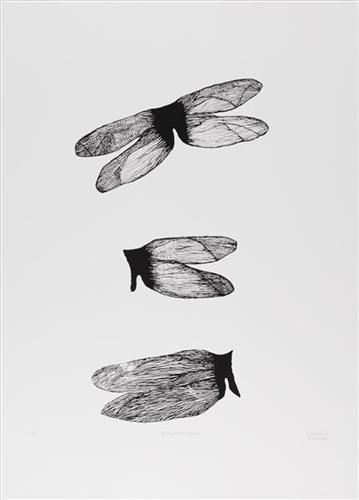
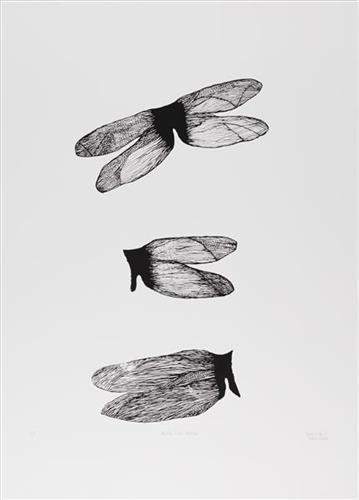
My artwork depicts that this is a portion of ngayu kuku balkan and that each wurarr-wurarr in this artwork represents my transformation.  

For many years a lot of my artwork was created interpreting the dragonfly.  Through my pieces you see how I have changed as a person over time and how the dragonfly has transformed with me; however in this piece I am the dragonfly.   My affiliation with the dragonfly never faded and I am relaxed with the feeling of a peaceful connection when creating it.  

Sheryl J Burchill ©

Printed on Arches BFK Rives 300gsm paper is made in France at the Arches paper mill. The paper is mould-made and crafted from 100% cotton fibers. 

225182378003


SJB: “Ngayu kuku balkan” (my story). Black State.

Kuku Yalanji (talk of this place) – pronounced Guh-guh Yell-an-gee

Ngayu kuku balkan (my story) – pronounced ngay-yuh guh-guh bul-gun

Wurarr-wurarr (dragonfly) – pronounced oo-rard-oo-rard


Kuku Yalanji people are the Traditional Owners of the celebrated Daintree Region.

Where the rainforest meets the reef and has one of the oldest living Cultures in the creation.

Traditional Lands extends from south of Port Douglas, northbound to the south of Cooktown area and west to the Great Dividing Range.

My artwork depicts that this is a portion of ngayu kuku balkan and that each wurarr-wurarr in this artwork represents my transformation.  

For many years a lot of my artwork was created interpreting the dragonfly.  Through my pieces you see how I have changed as a person over time and how the dragonfly has transformed with me; however in this piece I am the dragonfly.   My affiliation with the dragonfly never faded and I am relaxed with the feeling of a peaceful connection when creating it.  

Sheryl J Burchill ©

Printed on Arches BFK Rives 300gsm paper is made in France at the Arches paper mill. The paper is mould-made and crafted from 100% cotton fibers. 

225182378002


SJB: “Ngayu kuku balkan” (my story). Black State.

Kuku Yalanji (talk of this place) – pronounced Guh-guh Yell-an-gee

Ngayu kuku balkan (my story) – pronounced ngay-yuh guh-guh bul-gun

Wurarr-wurarr (dragonfly) – pronounced oo-rard-oo-rard


Kuku Yalanji people are the Traditional Owners of the celebrated Daintree Region.

Where the rainforest meets the reef and has one of the oldest living Cultures in the creation.

Traditional Lands extends from south of Port Douglas, northbound to the south of Cooktown area and west to the Great Dividing Range.

My artwork depicts that this is a portion of ngayu kuku balkan and that each wurarr-wurarr in this artwork represents my transformation.  

For many years a lot of my artwork was created interpreting the dragonfly.  Through my pieces you see how I have changed as a person over time and how the dragonfly has transformed with me; however in this piece I am the dragonfly.   My affiliation with the dragonfly never faded and I am relaxed with the feeling of a peaceful connection when creating it.  

Sheryl J Burchill ©

Printed on Arches BFK Rives 300gsm paper is made in France at the Arches paper mill. The paper is mould-made and crafted from 100% cotton fibers.