220282371101


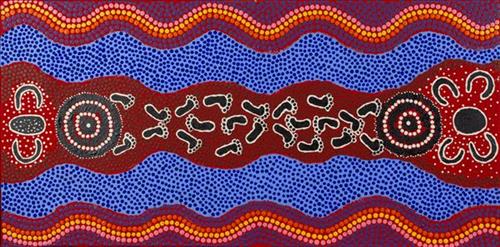
Two Tjangalas

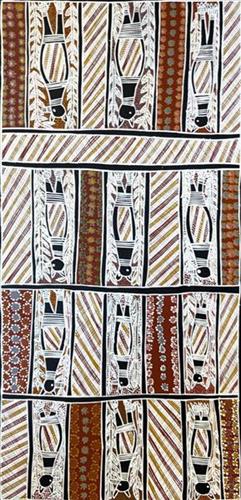
“Two Tjangalas who travelled from North to South, from Tjantuwari Watiyawanu-one to Mount Leibig Watiyawanu-two. The Tjantuwari Watiyawanu-one place is east of Mt Theo/Mt Patricia. They travelled from North, came to Tjantuwari Watiyawanu-one to Mount Leibig, Watiyawanu-two. Came and collected all the seeds. As you can see the people sitting, and the circle, means that’s where their main place and the camp is, The Tjantuwari Watiyawanu-one. You can see the tracks from the two tjanagalas travelling North. The second circle, with the two people, is the main community, the camp, the place, Mount Leibig Watiyawanu-two. They have been collecting seeds. They remain there in Watiyawanu-two, Mount Leibig, as two trees. The wavy blue is the creeks, they have been travelling a long distance, through Tali, Karru, Puli, Tjata, Tjanpi, Watiya, everything. Seeing places. Travelling. And they stopped and ended up in Watiyawanu-two, Mount Leibig. Two Tjangalas.” – Joyce Dixon
115682371033


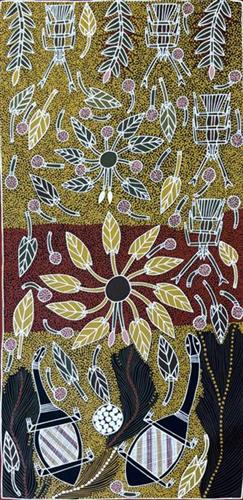
Raypiny Dhawu (Fresh Water Story)

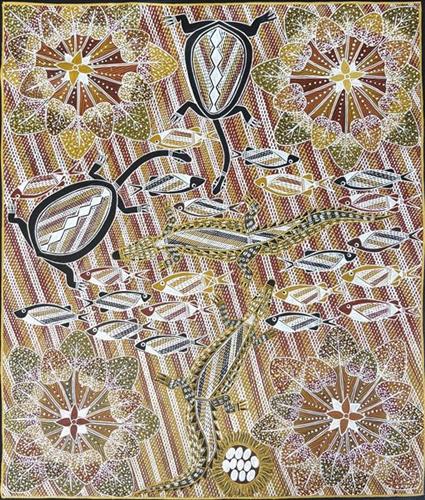
All Aboriginal people originate from a spiritual source, fixed in a particular place in their land or the sea. These ‘spiritual reservoirs’ are often in the form of special waterholes made by Wangarr (creative spirits) that were created long ago close to the beginning of time. These creator beings moved across the countryside, shaping the land and implanting in each tract of country, the spiritual life force for the people who were to own it. These creative spirits took many forms and when they gave the land to each group, they also gave songs, dances, ceremony, the associated laws and language.


The creation story for Ganalbingu people took place near the middle section of the Glyde River where it becomes the Goyder River. Their land, Ngaliyindi, sits astride the Arafura Swamp in Central Arnhem Land. Many Ganalbingu artists paint totemic species significant to their clan. These can include baru (crocodile), banda (long necked turtle), buliya (catfish), yalman (waterlilies), gumang (magpie geese), dakawa (fresh water yabby), ratjuk (barramundi), warrnyu (flying fox) and more.


115682370990


Raypiny Dhawu (Fresh Water Story)

All Aboriginal people originate from a spiritual source, fixed in a particular place in their land or the sea. These ‘spiritual reservoirs’ are often in the form of special waterholes made by Wangarr (creative spirits) that were created long ago close to the beginning of time. These creator beings moved across the countryside, shaping the land and implanting in each tract of country, the spiritual life force for the people who were to own it. These creative spirits took many forms and when they gave the land to each group, they also gave songs, dances, ceremony, the associated laws and language.


The creation story for Ganalbingu people took place near the middle section of the Glyde River where it becomes the Goyder River. Their land, Ngaliyindi, sits astride the Arafura Swamp in Central Arnhem Land. Many Ganalbingu artists paint totemic species significant to their clan. These can include baru (crocodile), banda (long necked turtle), buliya (catfish), yalman (waterlilies), gumang (magpie geese), dakawa (fresh water yabby), ratjuk (barramundi), warrnyu (flying fox) and more.


115682372319


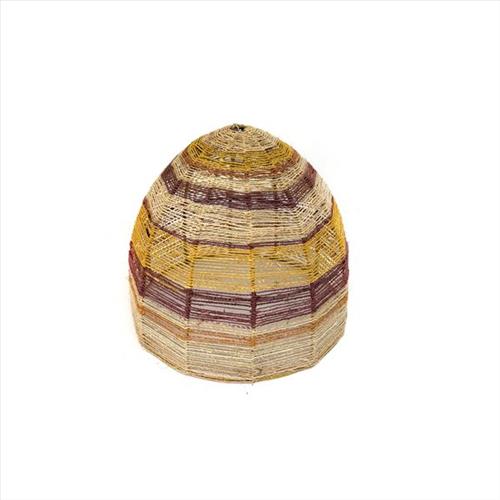
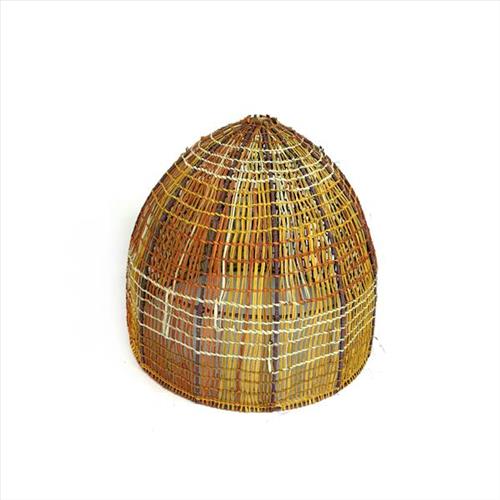
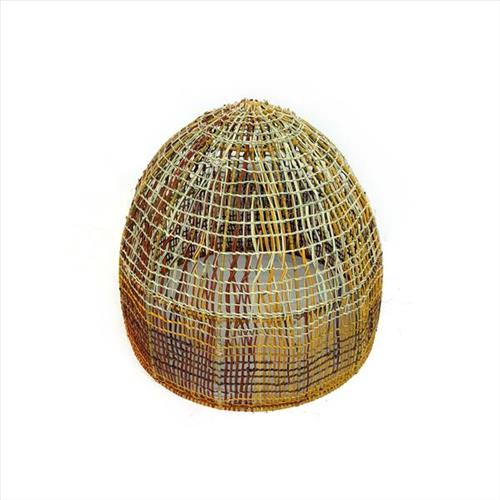
Koskela Lampshade

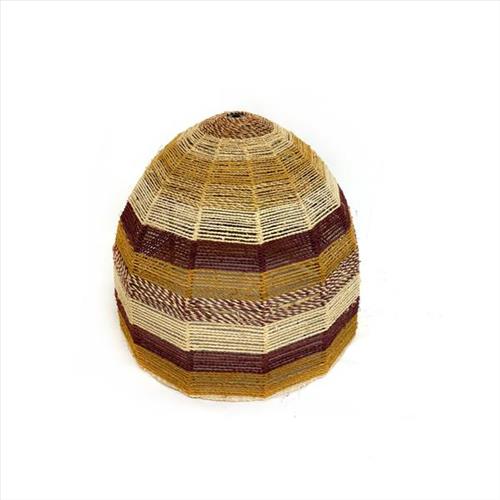
This beautiful lampshade is made with traditional Bush string made from the fibres between the bark and the trunk of the kurrajong tree. Once harvested from the jungle the fibres are dyed with roots, barks, leaves or fruits making the natural dyes. They are then rolled into this strong symmetrical handmade string and woven and knotted using techniques which originally bound together traditional Yolngu objects such as string bags and fishing nets and traps and used to make handles for carrying woven bags or used in ceremonial objects.

The weavers of Ramingining in Northeast Arnhem Land usually create traditional ceremonial and ritual objects working together as a group to harvest materials and develop work yet each with their own contemporary colourful and unique designs. This is one of the first times they have embraced making objects which are not traditional Yolngu objects and the strength of their identity as late career Yolngu Artists is distilled in these lampshades.

Exquisite craftsmanship manually transferred from Grandmothers, Mothers and Aunties is used to create these stunning lampshades which look amazing with lighting projecting the rhythms and patterns or without lighting to appreciate the colour, the intricacies and detail of the design.

115682372187


Koskela Lampshade

This beautiful lampshade is made with traditional Bush string made from the fibres between the bark and the trunk of the kurrajong tree. Once harvested from the jungle the fibres are dyed with roots, barks, leaves or fruits making the natural dyes. They are then rolled into this strong symmetrical handmade string and woven and knotted using techniques which originally bound together traditional Yolngu objects such as string bags and fishing nets and traps and used to make handles for carrying woven bags or used in ceremonial objects.

The weavers of Ramingining in Northeast Arnhem Land usually create traditional ceremonial and ritual objects working together as a group to harvest materials and develop work yet each with their own contemporary colourful and unique designs. This is one of the first times they have embraced making objects which are not traditional Yolngu objects and the strength of their identity as late career Yolngu Artists is distilled in these lampshades.

Exquisite craftsmanship manually transferred from Grandmothers, Mothers and Aunties is used to create these stunning lampshades which look amazing with lighting projecting the rhythms and patterns or without lighting to appreciate the colour, the intricacies and detail of the design.

115682372173


Koskela Lampshade

This beautiful lampshade is made with traditional Bush string made from the fibres between the bark and the trunk of the kurrajong tree. Once harvested from the jungle the fibres are dyed with roots, barks, leaves or fruits making the natural dyes. They are then rolled into this strong symmetrical handmade string and woven and knotted using techniques which originally bound together traditional Yolngu objects such as string bags and fishing nets and traps and used to make handles for carrying woven bags or used in ceremonial objects.

The weavers of Ramingining in Northeast Arnhem Land usually create traditional ceremonial and ritual objects working together as a group to harvest materials and develop work yet each with their own contemporary colourful and unique designs. This is one of the first times they have embraced making objects which are not traditional Yolngu objects and the strength of their identity as late career Yolngu Artists is distilled in these lampshades.

Exquisite craftsmanship manually transferred from Grandmothers, Mothers and Aunties is used to create these stunning lampshades which look amazing with lighting projecting the rhythms and patterns or without lighting to appreciate the colour, the intricacies and detail of the design.

115682372172


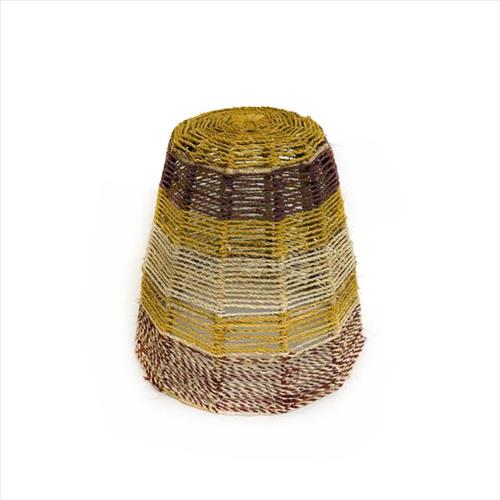
Koskela Lampshade

This beautiful lampshade is made with pandanus. Once harvested from the jungle, the fibres are dyed with roots, barks, leaves or fruits making the natural dyes. 

The weavers of Ramingining in Northeast Arnhem Land usually create traditional ceremonial and ritual objects working together as a group to harvest materials and develop work yet each with their own contemporary colourful and unique designs. This is one of the first times they have embraced making objects which are not traditional Yolngu objects and the strength of their identity as late career Yolngu Artists is distilled in these lampshades.

Exquisite craftsmanship manually transferred from Grandmothers, Mothers and Aunties is used to create these stunning lampshades which look amazing with lighting projecting the rhythms and patterns or without lighting to appreciate the colour, the intricacies and detail of the design.

115682372460


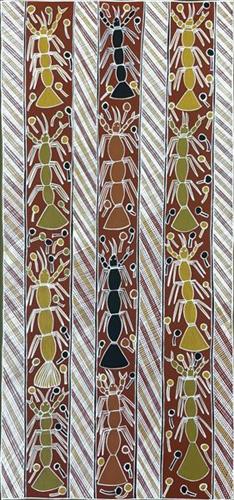
Raypiny Dhawu (Fresh Water Story)

All Aboriginal people originate from a spiritual source, fixed in a particular place in their land or the sea. These ‘spiritual reservoirs’ are often in the form of special waterholes made by Wangarr (creative spirits) that were created long ago close to the beginning of time. These creator beings moved across the countryside, shaping the land and implanting in each tract of country, the spiritual life force for the people who were to own it. These creative spirits took many forms and when they gave the land to each group, they also gave songs, dances, ceremony, the associated laws and language.


The creation story for Ganalbingu people took place near the middle section of the Glyde River where it becomes the Goyder River. Their land, Ngaliyindi, sits astride the Arafura Swamp in Central Arnhem Land. Many Ganalbingu artists paint totemic species significant to their clan. These can include baru (crocodile), banda (long necked turtle), buliya (catfish), yalman (waterlilies), gumang (magpie geese), dakawa (fresh water yabby), ratjuk (barramundi), warrnyu (flying fox) and more.


115682372435


Warrnyu Dhawu (Flying Fox Story)

Back in the Creation time, Warrnyu (Flying Foxes) once lived, like men, in the cave at the place called Kurrki Warrnyu Yirri Djaringal (they also lived in caves called Wadatilmurr & Gurngurmirrngu). Warrnyu lived in these caves for many years and then one day Djanyarr (The Dog), an ancestral being in the form of a man, came along. He was looking around for a place to live. Djanyarr heard the sound of a Flying Fox screaming. He went down to the cliff and pushed the rock and the water came out at the Ganalbingu place called Gurrkawakarrmurr. He then went into the cave and into the sacred hole, frightening all the Flying Fox away. When he went into the hole he left his dilly bag in the tree and went out on the other side of the sacred cave and leaving his spear and woomera. He sat there for a long time. The Dog made three streams and the water went inside the cave. Two of these streams are good drinking water. In the middle it is a sacred water. No-one drinks from the middle of the stream. Children, men, women, young boys or girls are not allowed to drink from the middle of the stream. If they drink the water from the middle of the stream they will go grey too early.

At Kurrki Warrnyu Yirri Ngilaya Djaringal, the Flying Fox made himself into a young man… that’s what Aboriginal people do today. They have ceremonies and dances to make the young boys into men. The songs are called Yirrarwu, Gulumu, Rruburra and Burryun. Dhapi (initiation ceremony) happen today because the Warrnyu (Flying Fox) people performed them a long time ago before the Yolngu people. It was the Warrnyu people who first performed circumcision of the young boys to make them into men. It all happened at Kurrki Warrnyu Yirri Ngilaya Djaringal, this is how this place got its name.

Leaving behind the cave at Kurrki Warrnyu Yirri Djaringal, the Dog travelled west across the Arafura Swamp and came to Djalkulmurr (Mount Delight). From there he travelled north and came to Dunganda (a hill situated a few kilometres east of Ramingining). There he met a female Dog, then they both headed north and came to a place called Garanydjirrmurr where they spoke the Mildjingi language. From Garanydjirrmurr they changed their direction and went west through Guliny’barra, Burgumara and onto the plains. When they reached the plains they smelled something cooking, way up in the north – at Wessel Islands. The aroma they smelt was so enticing that they decided to go there. Lungurrma (the north-east wind) was carrying the smell. One Dog headed north again, but the other Dog decided not to go with him and went back the opposite way. The first Dog that went to Malwanatharra (Sandy Point) went into the sea following its nose to wherever the smell was coming from. It is believed that this Dog still lives in the sea…

115682372430


Koskela Lampshade

This beautiful lampshade is made with pandanus. Once harvested from the jungle, the fibres are dyed with roots, barks, leaves or fruits making the natural dyes. 

The weavers of Ramingining in Northeast Arnhem Land usually create traditional ceremonial and ritual objects working together as a group to harvest materials and develop work yet each with their own contemporary colourful and unique designs. This is one of the first times they have embraced making objects which are not traditional Yolngu objects and the strength of their identity as late career Yolngu Artists is distilled in these lampshades.

Exquisite craftsmanship manually transferred from Grandmothers, Mothers and Aunties is used to create these stunning lampshades which look amazing with lighting projecting the rhythms and patterns or without lighting to appreciate the colour, the intricacies and detail of the design.