111982386253


Djamo (dog)

The djamo (dog) holds special mythological as well as practical significance for people of Central Arnhem land, particularly women. The men used to go hunting with a spear and the women with a dog. If the men didn’t catch a kangaroo, the women would catch a goanna. If neither caught anything, then they could catch fish. If there was neither kangaroo nor goanna, then they would eat sugarbag. This is how it was long ago – sugarbag, lily root, yam, goanna, sand goanna, fish and more were part of the regular diet. “Don’t forget that long ago we didn’t know European food, we knew bush food. We used to grow from bush food.” Rembarrnga women have literally and metaphorically brought together strands from their country and the mythology of their heritage to produce three dimensional fibre creatures filled with mystical significance. Dog, mermaid, rainbow serpent, blue tongue and fish multiplication spirits: each creature plays an important role in the clan’s cultural landscape. Materials for this camp dog comes from the clan estate. Dayarr (pandanus) and rulk (grass) are the twines used for the creature’s bodies. Warlppurrunggu (bush turkey) and nganarrngh (black cockatoo) feathers provide bulkkan-na (hair). Marnarr (red), gamununggu (white), garlba (yellow) ochres and roerroe (black) ashes are then carefully mixed and applied for colour. The use of local materials provides an integral link between the mythological nature of the creatures, which inhabit the country and their physical form.
111982386252


Djamo (dog)

The djamo (dog) holds special mythological as well as practical significance for people of Central Arnhem land, particularly women. The men used to go hunting with a spear and the women with a dog. If the men didn’t catch a kangaroo, the women would catch a goanna. If neither caught anything, then they could catch fish. If there was neither kangaroo nor goanna, then they would eat sugarbag. This is how it was long ago – sugarbag, lily root, yam, goanna, sand goanna, fish and more were part of the regular diet. “Don’t forget that long ago we didn’t know European food, we knew bush food. We used to grow from bush food.” Rembarrnga women have literally and metaphorically brought together strands from their country and the mythology of their heritage to produce three dimensional fibre creatures filled with mystical significance. Dog, mermaid, rainbow serpent, blue tongue and fish multiplication spirits: each creature plays an important role in the clan’s cultural landscape. Materials for this camp dog comes from the clan estate. Dayarr (pandanus) and rulk (grass) are the twines used for the creature’s bodies. Warlppurrunggu (bush turkey) and nganarrngh (black cockatoo) feathers provide bulkkan-na (hair). Marnarr (red), gamununggu (white), garlba (yellow) ochres and roerroe (black) ashes are then carefully mixed and applied for colour. The use of local materials provides an integral link between the mythological nature of the creatures, which inhabit the country and their physical form.
114182386595


The boy who turned into wind (pirriya) at Walu rockhole

This story is about a young boy who had no parents and was neglected.

There were two men (the boy’s uncles) and one young boy camping at Walu Rockhole, an important water site in the Gibson Desert, northwest of the tri-state border between Western Australia, the Northern Territory and South Australia. 

The men went hunting and the boy stayed behind waiting. The men returned with an emu and pulled out its heart. The boy was holding the heart and blood spilt out onto the rocks. He ran away with the heart and turned into a big whirlwind. The big whirlwind. came up and swept the families away. Today you can still see the emu’s blood trail where it stained the rocks.

Walu rock hole is a special place north of Papulankutja (Blackstone) where traditionally Yarnangu families would gather when water was available in the holes found in a flat rocky area.

114182386594


Walu

There was a small boy who had no parents and was neglected. One day the families caught an emu and prepared to cook it and eat it. This little boy ran in and took the emu’s heart and ran off with it. Big willie willies came up afterwards and swept the families away.

111582386589


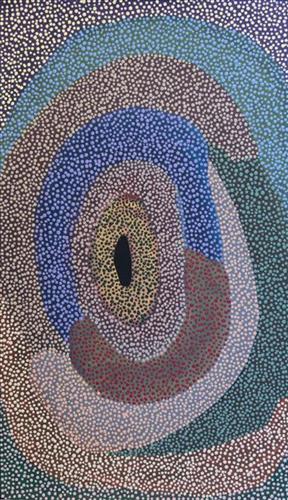
Kunawarritji (Canning Stock Route Well 33)- Debra Thomas

“We went to Kunawarritji. We went out to see the waterholes with Kumpaya [Girgirba], my aunty – my dad’s sister. It’s the first time I went in a chopper to see the waterholes. Kumpaya take me to show me the waterholes, show me my father’s Country. It was good. I went first to see the waterholes and then I start painting. The waterholes are my father’s Country.

We go out there sometimes, but now I’m doing a lot of painting there in Punmu. I was learning to make a painting now, with the old people. But they all passed away now. And they told me, “You can do your own Country, your dad’s Country.” And I made a couple of paintings of my father’s Country. They were telling me, “Just do your father’s Country, Kunawarritji.”

– Debra Thomas


Kunawarritji is an important site in the Great Sandy Desert where multiple stories and histories intersect. Originally a spring water and major Martu pujiman (traditional, desert dwelling) camping site, at the turn of the 20th century Kunawarritji was converted into a well along the Canning Stock Route. Each year throughout the 1930-50s, the well became a site of contact between the drovers, their cattle, and desert families. 

Long before colonial history entered this Country, however, other stories dominated the site. Primarily, Kunawarritji features in the Minyipuru (Jakulyukulyu, Seven Sisters Jukurrpa (Dreaming). Minyipuru is a central Jukurrpa narrative for Martu, Ngaanyatjarra, Pitjantjatjara and Yankunytjatjara people that is associated with the seasonal Pleiades star constellation. Beginning in Roebourne on the west coast of Western Australia, the story morphs in its movement eastward across the land, following a group of women as they walk, dance, and even fly from waterhole to waterhole. As they travelled the women left markers in the landscape and create landforms that remain to this day. During the entirety of their journey the women are pursued by a lustful old man, Yurla, although interactions with other animals, groups of men, and spirit beings are also chronicled in the narrative.

The Minyipuru travelled to Kunawarritji from Nyipily (Nyipil, Nibil, Canning Stock Route Well 34), and transformed themselves into a distinctive group of trees that remain in the area between these two sites. From Kunawarritji Yurla followed the sisters to Pangkapirni, where he finally caught one of the women. 

Today, Kunawarritji is a site of return, a place where people came back to continue their life in the desert with the formation of Kunawarritji Aboriginal community in the early 1980s. The community’s cultural significance endures, with the population swelling up to 1000 during cultural business.

111582386588


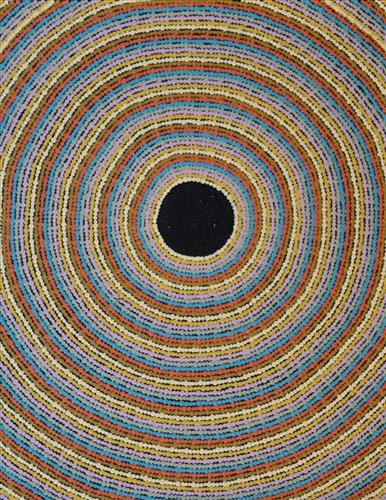
Punmu

“This area here is our Country. It’s our Country right here. We returned to our Country with a Toyota and a grader that made the road. A grader right up to here. Punmu is a good place. It’s a happy place to live. My spirit feels good living here. In pujiman (traditional, desert dwelling) time we lived in this area now. I’m happy with this life now, happy because I feel grounded by my Country. It’s important to hold onto the legacy of the ancestors. It’s up to the young people to carry it on now. For the ancestors past and present.”

– Minyawe Miller as translated by Kanyirninpa Jukurrpa


Punmu refers to a region and an Aboriginal community within its vicinity, located 670km North-East of Newman. Created during the return to Country movement of the 1980s, with the recognition of Martu land rights and native title, the community was named after a nearby Jukurrpa (Dreaming) story.

Punmu Aboriginal community sits on the edge of a large salt lake known as Nyayartakujarra, or Lake Dora. The lake runs south into Karlamilyi River (Rudall River). Surrounding Punmu are numerous fresh water soaks and the red tali (sandhills) typical of the area. The most frequently visited yinta (permanent springs) around Punmu include Wirlarra, Rawa, Yilyara, Jila-jila and Tuu-tuu.

The Country around Punmu features in several Jukurrpa stories. Of particular importance is the story of the Jila Kujarra (Two Snakes), one of the key Jukurrpa narratives for the Martu. Though the story belongs to Warnman people, it is shared across the Western Desert with several other language groups. The narrative centres on the travels of two snakes as they are pursued by the Niminjarra, spiritual ancestors of the Warnman people. 

Before transforming themselves into snakes, the Jila Kujarra were young brothers. As snakes, they began travelling home to their mother, but were intercepted by the Niminjarra, who tracked the Jila Kujarra to Paji, east of Nyayartakujarra (Lake Dora). Though the Jila Kujarra eluded their pursuers here by escaping under the lake at Paji, they were soon after speared and injured by two Pukurti (initiates with bundled hair) at Nyayartakujarra, who returned with the Niminjarra to cook the snakes at the site of Kumpupirntily (Kumpupintily, Lake Disappointment). As the Niminjarra cut down the length of the Jila Kujarra, the snake’s bladders were pierced, causing an explosion of scalding hot urine in which the Niminjarra all perished and became black rocks at the site. The spirits of the Jila Kujarra returned to their mother at Nyayartakujarra, where the mother and her sons entered the ground below Nyayartakujarra and remain to this day.

111582386587


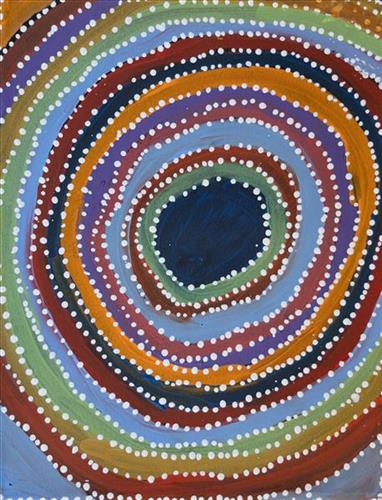
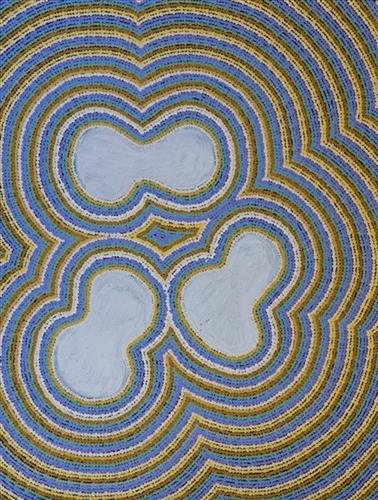
Punmu Waterholes

Punmu refers to a region and an Aboriginal community within its vicinity, located 670km North-East of Newman. Created during the return to Country movement of the 1980s, with the recognition of Martu land rights and native title, the community was named after a nearby Jukurrpa (Dreaming) story.

Punmu community sits on the edge of a large salt lake known as Nyayartakujarra, or Lake Dora. The lake runs south into Karlamilyi River (Rudall River). Surrounding Punmu are numerous fresh water soaks and the red tali (sandhills) typical of the area. The most frequently visited water sources around Punmu include Wirlarra, Rawa, Yilyara, Jila-jila, Tuu-tuu, Pirrkili, Jurnu, Wilurr, and Wala- Wala. Further south are Juturrpa, Wawul, and Tarl. 

During the pujiman (traditional, desert dwelling) period, Martu would traverse very large distances annually in small family groups, moving seasonally from water source to water source, and hunting and gathering bush tucker as they went. At this time knowledge of water sources was critical for survival, and today Martu Country is still defined in terms of the location and type of water. Each of the hundreds of claypans, rockholes, waterholes, soaks and springs found in the Martu desert homelands is known by name, location, quality and seasonal availability through real life experience and the recounting of Jukurrpa narratives.

111582386586


Punmu

“This area here is our Country. It’s our Country right here. We returned to our Country with a Toyota and a grader that made the road. A grader right up to here. Punmu is a good place. It’s a happy place to live. My spirit feels good living here. In pujiman (traditional, desert dwelling) time we lived in this area now. I’m happy with this life now, happy because I feel grounded by my Country. It’s important to hold onto the legacy of the ancestors. It’s up to the young people to carry it on now. For the ancestors past and present.”

– Minyawe Miller as translated by Kanyirninpa Jukurrpa


Punmu refers to a region and an Aboriginal community within its vicinity, located 670km North-East of Newman. Created during the return to Country movement of the 1980s, with the recognition of Martu land rights and native title, the community was named after a nearby Jukurrpa (Dreaming) story.

Punmu Aboriginal community sits on the edge of a large salt lake known as Nyayartakujarra, or Lake Dora. The lake runs south into Karlamilyi River (Rudall River). Surrounding Punmu are numerous fresh water soaks and the red tali (sandhills) typical of the area. The most frequently visited yinta (permanent springs) around Punmu include Wirlarra, Rawa, Yilyara, Jila-jila and Tuu-tuu.

The Country around Punmu features in several Jukurrpa stories. Of particular importance is the story of the Jila Kujarra (Two Snakes), one of the key Jukurrpa narratives for the Martu. Though the story belongs to Warnman people, it is shared across the Western Desert with several other language groups. The narrative centres on the travels of two snakes as they are pursued by the Niminjarra, spiritual ancestors of the Warnman people. 

Before transforming themselves into snakes, the Jila Kujarra were young brothers. As snakes, they began travelling home to their mother, but were intercepted by the Niminjarra, who tracked the Jila Kujarra to Paji, east of Nyayartakujarra (Lake Dora). Though the Jila Kujarra eluded their pursuers here by escaping under the lake at Paji, they were soon after speared and injured by two Pukurti (initiates with bundled hair) at Nyayartakujarra, who returned with the Niminjarra to cook the snakes at the site of Kumpupirntily (Kumpupintily, Lake Disappointment). As the Niminjarra cut down the length of the Jila Kujarra, the snake’s bladders were pierced, causing an explosion of scalding hot urine in which the Niminjarra all perished and became black rocks at the site. The spirits of the Jila Kujarra returned to their mother at Nyayartakujarra, where the mother and her sons entered the ground below Nyayartakujarra and remain to this day.

111582386585


Punmu Waterholes

Punmu refers to a region and an Aboriginal community within its vicinity, located 670km North-East of Newman. Created during the return to Country movement of the 1980s, with the recognition of Martu land rights and native title, the community was named after a nearby Jukurrpa (Dreaming) story.

Punmu community sits on the edge of a large salt lake known as Nyayartakujarra, or Lake Dora. The lake runs south into Karlamilyi River (Rudall River). Surrounding Punmu are numerous fresh water soaks and the red tali (sandhills) typical of the area. The most frequently visited water sources around Punmu include Wirlarra, Rawa, Yilyara, Jila-jila, Tuu-tuu, Pirrkili, Jurnu, Wilurr, and Wala- Wala. Further south are Juturrpa, Wawul, and Tarl. 

During the pujiman (traditional, desert dwelling) period, Martu would traverse very large distances annually in small family groups, moving seasonally from water source to water source, and hunting and gathering bush tucker as they went. At this time knowledge of water sources was critical for survival, and today Martu Country is still defined in terms of the location and type of water. Each of the hundreds of claypans, rockholes, waterholes, soaks and springs found in the Martu desert homelands is known by name, location, quality and seasonal availability through real life experience and the recounting of Jukurrpa narratives.

111582386584


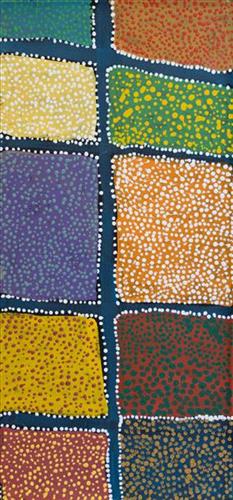
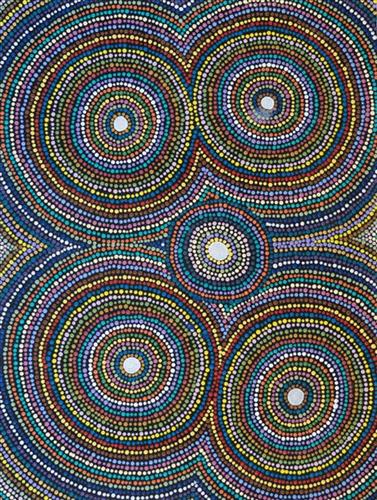
Punmu waterholes – Marianne Burton

“Punmu, I went there when I was a young girl, a teenager with my mother and father before my mother passed. Big mob of people was there. No building, just little cubby houses [bough shelters]. Long time I been there. 

These here are the waterholes around Punmu; Rawa spring- Rawa means ‘long time’, Tuu-tuu, Jila-jila, Wirlarra and Yilyara. That is my ngurra (home Country, camp). We grew up in Punmu around all these water holes. I still live here with my grandkids, [we share the] same stories for all these places.” 

 – Marianne Burton


Punmu refers to a region and an Aboriginal community within its vicinity, located 670km North-East of Newman. Created during the return to Country movement of the 1980s, with the recognition of Martu land rights and native title, the community was named after a nearby Jukurrpa (Dreaming) story. As described by Marianne, Punmu is her ngurra; she grew up in this region with her parents. 

Punmu community sits on the edge of a large salt lake known as Nyayartakujarra, or Lake Dora. The lake runs south into Karlamilyi River (Rudall River). Surrounding Punmu are numerous fresh water soaks and the red tali (sandhills) typical of the area. The most frequently visited yinta (permanent springs) around Punmu include Wirlarra, Rawa, Yilyara, Jila-jila and Tuu-tuu.

The Country around Punmu features in several Jukurrpa stories. Of particular importance is the story of the Jila Kujarra (Two Snakes), one of the key Jukurrpa narratives for the Martu. Though the story belongs to Warnman people, it is shared across the Western Desert with several other language groups. The narrative centres on the travels of two snakes as they are pursued by the Niminjarra, spiritual ancestors of the Warnman people. 

Before transforming themselves into snakes, the Jila Kujarra were young brothers. As snakes, they began travelling home to their mother, but were intercepted by the Niminjarra, who tracked the Jila Kujarra to Paji, east of Nyayartakujarra (Lake Dora). Though the Jila Kujarra eluded their pursuers here by escaping under the lake at Paji, they were soon after speared and injured by two Pukurti (initiates with bundled hair) at Nyayartakujarra, who returned with the Niminjarra to cook the snakes at the site of Kumpupirntily (Kumpupintily, Lake Disappointment). As the Niminjarra cut down the length of the Jila Kujarra, the snake’s bladders were pierced, causing an explosion of scalding hot urine in which the Niminjarra all perished and became black rocks at the site. The spirits of the Jila Kujarra returned to their mother at Nyayartakujarra, where the mother and her sons entered the ground below Nyayartakujarra and remain to this day.