115682383562


Raypiny Dhawu (Fresh Water Story)

All Aboriginal people originate from a spiritual source, fixed in a particular place in their land or the sea. These ‘spiritual reservoirs’ are often in the form of special waterholes made by Wangarr (creative spirits) that were created long ago close to the beginning of time. These creator beings moved across the countryside, shaping the land and implanting in each tract of country, the spiritual life force for the people who were to own it. These creative spirits took many forms and when they gave the land to each group, they also gave songs, dances, ceremony, the associated laws and language.


The creation story for Ganalbingu people took place near the middle section of the Glyde River where it becomes the Goyder River. Their land, Ngaliyindi, sits astride the Arafura Swamp in Central Arnhem Land. Many Ganalbingu artists paint totemic species significant to their clan. These can include baru (crocodile), banda (long necked turtle), buliya (catfish), yalman (waterlilies), gumang (magpie geese), dakawa (fresh water yabby), ratjuk (barramundi), warrnyu (flying fox) and more.

 

377810582385746


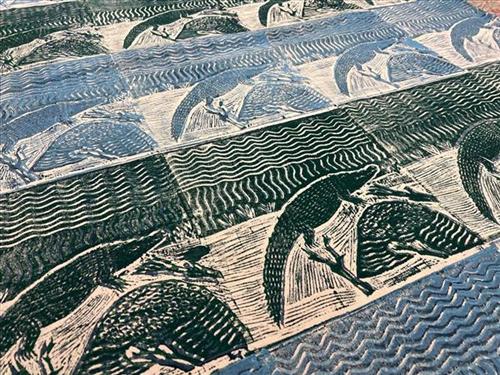
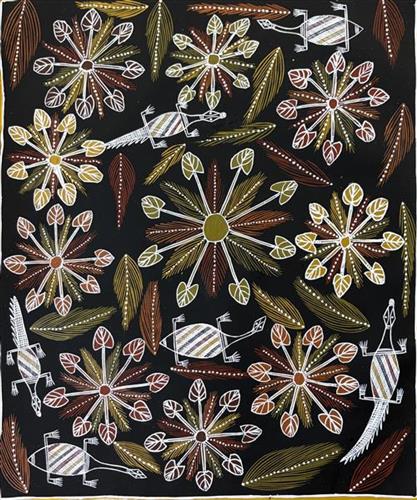
Ginga (crocodile)

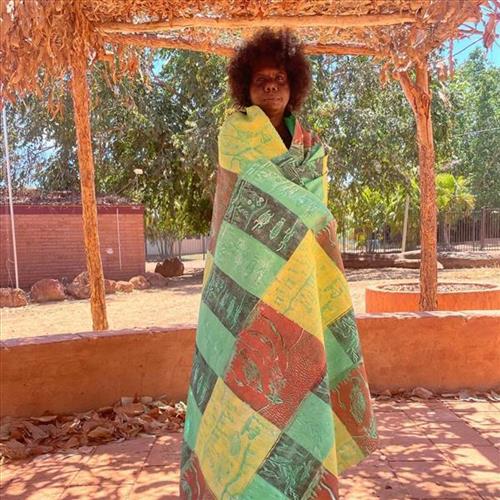
This fabric was created using the linocut fabric printing technique, which has been refined at Bábbarra Women’s Centre since it was introduced in the mid-1990s.

The Lino tile is carved by the artist at Bábbarra Designs. It is printed on fabric by hand using a variety of colours and layers. The linocut technique ensures each textile is a one-off, limited edition piece.

The fabric is colour-safe and can be thrown into a washing machine. Repeated use will soften the fabric, and some fading will occur over time. 

Bábbarra Women’s Centre supports the economic independence of Indigenous women in the Arnhem Land community of Maningrida, Northern Territory, Australia. Designs created by the women at Bábbarra reflect strong cultural knowledge, which is passed down to younger generations through their textile design practice.

‘Themes in our artwork almost exclusively come from our Country and cultural connection. Our deep relationship with the land and seas of our customary clan estates strongly defines and governs the social, cultural, spiritual and territorial aspects of our lives.’

Bábbarra Designs Artist Statement

377810582385745


Namurre Boko (Two Brothers Fighting)

A two colour screen print design from 2022. Jay’s first large format design to join the Bábbarra Designs Collection.

‘This is my first one, I’m really happy, I’m proud. It’s just a songline for everybody. This story is from my great great grandfather on my fathers side. The songline was made by my second father. The mimihs tell the story. The painting took a long time, a few weeks to finish.’ Jay Jurrupula Rostron

‘Bini-murreko means two brothers – big brother and little brother.

Two brothers were really strong leaders and good hunters, sharing animals with different tribes.
With those different tribe there were jealousy going on.
Little brother went walkabout and heard the different tribe was talking about his tribe.
They said ngarribin manre djed-djedme bokko
Meaning: will make spear for them
Ngarrbin danj-bun, ngarrbinbun
Meaning: will spear them kill them
little brother turn around went back tell his brother
Namurre bokko kadi marne djed-djedme Karre wonens, kardi-djal danjbun
Meaning: they making spear for us, they gonna spear us
Couple of months they saw different tribe
They changed their attitude
They been bringing lots of animals to them and start asking for women
And that tribe realise that’s how those brothers died.
They kill them
This Why? They got jealous because two brothers was a good hunter.

This story written on the rock art and it stays forever.’

377815582385727


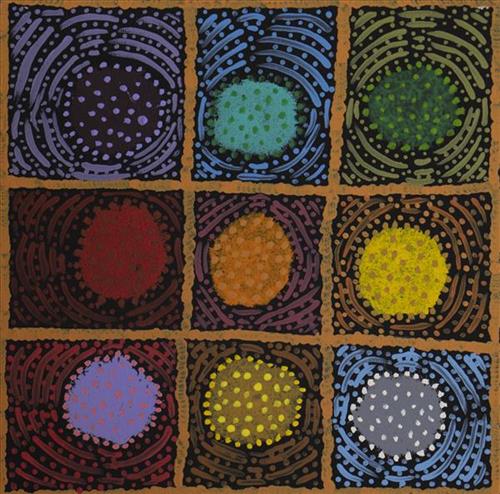
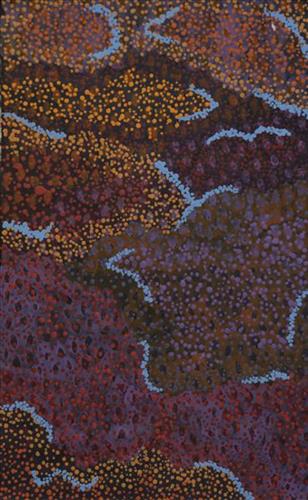
Untitled

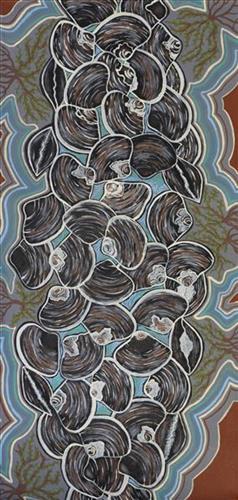
 This artwork showcases the artist’s skillful use of colour, texture, and technique, reflecting a deep connection to their environment and culture. Each detail embodies the unique identity of Bidyadanga Artists, where the original five language groups—Nyangumarta, Mangala, Yulparija, Juwaliny, and Karrajarri—come together to create art that speaks to the heart of Country. Over time, the community and Art Centre has grown to include people from other Kimberley tribes, fostering a space where diverse cultural knowledge and practices come together. Situated where the desert meets the sea, artists draw inspiration from their ancestral Country and personal journeys. The artist captures the vibrant beauty of both desert and coastal landscapes, blending earthy reds, deep blues, and intricate patterns distinctive to their cultural heritage. The themes and composition invite viewers into the artist’s world, offering a glimpse of the rich, intertwined histories and the enduring connection to land and spirit that define the Bidyadanga community.

377815582385724


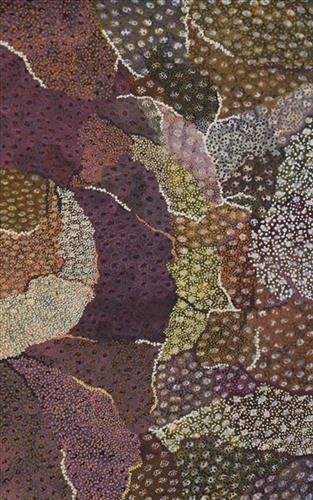
Kulyakartu

This painting is about all the rocks and kurru (creeks) all around Kulyakartu and Kirriwirri.

We went camping there for to two weeks, we went to Wirnpa first and then to Kirriwirri. We camped in the nice flat ground in the open when we got to Kulyakartu. We visited the waterholes and soaks, cleaned them out, and made sure there were no dead animals. It was typical ranger work—making sure the animals and Country were surviving. We listened to Muuki and my grandfather talk about how they walked around trying to find waterholes, how my grandfather finally came to Bidyadanga, and how he met my grandmother.


I painted these paintings at home in Bidyadanga, near the ocean. The paintings are of Kulyakartu, which is in the Great Sandy Desert. There is a lot of spinifex, sandhills, wildlife, and little flowers like frangipanis—blue, red, and pink flowers just along the road when you’re driving.

When I’m not in the desert, I feel like I want to paint about it, and painting makes me feel like I want to be there. I think about Muuki and his brothers’ wishes for us to see the Country and be there. It’s important to paint about the Country because our Elders looked after the Country long before us.

When you look out of a plane, you can see lots of different colours, but I chose blues and greens because that’s how I want to express how I see the landscape.

When people see my paintings, they might say, “That could be the ocean,” but I say, “No, that’s Kulyakartu, the desert.” Blues and greens make me feel comfortable. For me, I like to keep colours separate and not mix them together.

377815582385718


Kulyakartu

This painting is about all the rocks and kurru (creeks) all around Kulyakartu and Kirriwirri.

We went camping there for to two weeks, we went to Wirnpa first and then to Kirriwirri. We camped in the nice flat ground in the open when we got to Kulyakartu. We visited the waterholes and soaks, cleaned them out, and made sure there were no dead animals. It was typical ranger work—making sure the animals and Country were surviving. We listened to Muuki and my grandfather talk about how they walked around trying to find waterholes, how my grandfather finally came to Bidyadanga, and how he met my grandmother.


I painted these paintings at home in Bidyadanga, near the ocean. The paintings are of Kulyakartu, which is in the Great Sandy Desert. There is a lot of spinifex, sandhills, wildlife, and little flowers like frangipanis—blue, red, and pink flowers just along the road when you’re driving.

When I’m not in the desert, I feel like I want to paint about it, and painting makes me feel like I want to be there. I think about Muuki and his brothers’ wishes for us to see the Country and be there. It’s important to paint about the Country because our Elders looked after the Country long before us.

When you look out of a plane, you can see lots of different colours, but I chose blues and greens because that’s how I want to express how I see the landscape.

When people see my paintings, they might say, “That could be the ocean,” but I say, “No, that’s Kulyakartu, the desert.” Blues and greens make me feel comfortable. For me, I like to keep colours separate and not mix them together.