111582384681


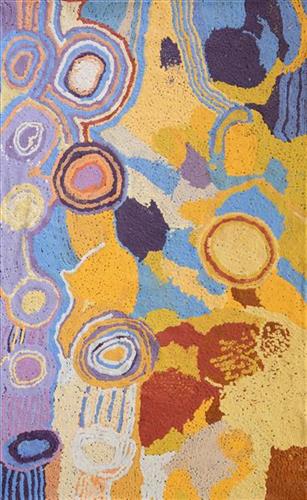
Untitled

This is Mayiwalku’s Country- her ‘ngurra’ (home Country, camp). People identify with their ngurra in terms of specific rights and responsibilities, and the possession of intimate knowledge of the physical and cultural properties of one’s Country. Painting ngurra, and in so doing sharing the Jukurrpa (Dreaming) stories and physical characteristics of that place, has today become an important means of cultural maintenance. 

Mayiwalku’s ngurra encompasses the Country that she and her family walked in the pujiman (traditional, desert-dwelling) era. Mayiwalku was born at Yirnangarri. She grew up, walked and hunted primarily around the Country extending across the Punmu, Kunawarritji (Canning Stock Route Well 33) and Karlamilyi (Rudall River) regions. Following the death of both their parents, Mayiwalku and her sisters travelled alone between Punmu and Kunawarritji, occasionally meeting with other family groups. They continued to live nomadically before eventually deciding to move to Jigalong Mission along with many other relatives following an extreme and prolonged drought in the 1960s. 

Portrayed in this work are features of Mayiwalku’s ngurra, such as the dominant permanent red tali (sandhills), warta (trees, vegetation), and the individually named water sources she and her family camped at. These include Januwa, Jilankujarra, Karlajarntu, Kartungu, Kularti, Kumpupajanu, Kunalimpi, Kunarra, Marnakarti, Pangkapirni, Wilunganinya, Wurur-wururna, Yilyara, and Yirrajarra Rock holes, waterholes, soaks and springs were all extremely important sites for Martu people during the pujiman period, and are generally depicted with circular forms. 

The encyclopaedic knowledge of the location, quality and seasonal availability of the hundreds of water bodies found in one’s Country sustained Martu as they travelled across their Country, hunting and gathering, visiting family, and fulfilling ceremonial obligations. They would traverse very large distances annually, visiting specific areas in the dry and wet season depending on the availability of water and the corresponding cycles of plant and animal life on which hunting and gathering bush tucker was reliant. As they travelled and hunted they would also burn areas of Country, generating a greater diversity of plant and animal life.

111582384676


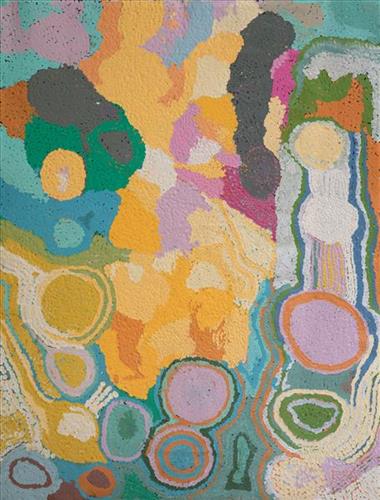
Untitled

This is Mayiwalku’s Country- her ‘ngurra’ (home Country, camp). People identify with their ngurra in terms of specific rights and responsibilities, and the possession of intimate knowledge of the physical and cultural properties of one’s Country. Painting ngurra, and in so doing sharing the Jukurrpa (Dreaming) stories and physical characteristics of that place, has today become an important means of cultural maintenance. 

Mayiwalku’s ngurra encompasses the Country that she and her family walked in the pujiman (traditional, desert-dwelling) era. Mayiwalku was born at Yirnangarri. She grew up, walked and hunted primarily around the Country extending across the Punmu, Kunawarritji (Canning Stock Route Well 33) and Karlamilyi (Rudall River) regions. Following the death of both their parents, Mayiwalku and her sisters travelled alone between Punmu and Kunawarritji, occasionally meeting with other family groups. They continued to live nomadically before eventually deciding to move to Jigalong Mission along with many other relatives following an extreme and prolonged drought in the 1960s. 

Portrayed in this work are features of Mayiwalku’s ngurra, such as the dominant permanent red tali (sandhills), warta (trees, vegetation), and the individually named water sources she and her family camped at. These include Januwa, Jilankujarra, Karlajarntu, Kartungu, Kularti, Kumpupajanu, Kunalimpi, Kunarra, Marnakarti, Pangkapirni, Wilunganinya, Wurur-wururna, Yilyara, and Yirrajarra Rock holes, waterholes, soaks and springs were all extremely important sites for Martu people during the pujiman period, and are generally depicted with circular forms. 

The encyclopaedic knowledge of the location, quality and seasonal availability of the hundreds of water bodies found in one’s Country sustained Martu as they travelled across their Country, hunting and gathering, visiting family, and fulfilling ceremonial obligations. They would traverse very large distances annually, visiting specific areas in the dry and wet season depending on the availability of water and the corresponding cycles of plant and animal life on which hunting and gathering bush tucker was reliant. As they travelled and hunted they would also burn areas of Country, generating a greater diversity of plant and animal life.

111582384675


Wantili (Warntili, Canning Stock Route Well 25)

“Wantili (Warntili, Canning Stock Route Well 25) area, close to Parnngurr. My ngurra (home Country, camp), my jamu’s (grandfather’s) Country, my father’s daddy, Jakayu [Biljabu’s] daddy and my daddy’s Country. Jakayu been bury her father there. In pujiman (traditional, desert dwelling) days, my family and Jakayu’s family been walking round there together. Big sandhills here. Sandhill, sandhill, sandhill everywhere. Claypan there, in the middle. Good place for swimming and drinking, for hunting little kangaroo. When no water [we would] go to [the adjacent Canning Stock Route] well. When there [was] rain we stay there at Wantili. Everywhere, we been walking everywhere.       

Near to Wantili, road [Canning Stock Route] going kayili (north). Long time [ago] only horses and cattle [travelled along that road], going Meekatharra and back in the cold time, gone right up to GJ (Georgia) Bore. Half way, when he see water at Wantili, that mob would camp one night, bullock eating all the grass and men’s drinking water. One Martu been working with that mob, droving bullock. Every time he been give us meat, all the pujimanpa (desert dwellers).”

– Ngamaru Bidu


Wantili is a large round jurnu (soak) and linyji (claypan) near Well 25 on the Canning Stock Route. The Wantili region is dominated by claypans surrounded by tuwa (sandhills), and Nyilangkurr, a prominent yapu (hill) is located close to the eastern edge of the claypan. Following rain the typically dry claypans are filled with water, with the overflow from nearby waterholes flowing to Wantili. At that time, Wantili becomes an important place for obtaining fresh water for drinking and bathing. Wantili is significant for the fact that at this site Kartujarra, Manyjilyjarra, Putijarra and Warnman people would all come together for ceremonies during the pujiman era. Many jiwa (stones used by women for grinding seeds) from these times, including those used by Ngamaru’s family, can still be found there today.

Wantili lies within Ngamaru’s ngurra (home Country, camp) through her grandfather and father. As described in her account, Wantili was one of the sites Ngamaru knew intimately and travelled extensively with her family and other family groups, such as the Biljabu family. During the pujiman period Martu would traverse very large distances annually, moving seasonally from water source to water source, and hunting and gathering bush tucker as they went. Knowledge of water sources was critical for survival, and today Martu Country is still defined in terms of the location and type of water. 

As Ngamaru recounts, Wantili also held significance for her as a site of contact between her family and kartiya (white people); drovers with their cattle travelling along the Canning Stock Route. The establishment of the route by Alfred Canning and his team in 1910 resulted in first contact with Europeans for many Martu, including Ngamaru and her family. Increasingly, Martu followed the route to newly established ration depots, mission and pastoral stations. They were drawn to the route in search of food, by a sense of curiosity, or by loneliness. By the late 1950s and early 1960s, most of the desert family groups had left the desert. Eventually, these factors combined with an extreme and prolonged drought in the 1960s to prompt the few remaining pujimanpa to move in from the desert. 

Culturally, Wantili is an incredibly important site in two central Jukurrpa (Dreaming) stories. The first relates to the world’s creation. In this narrative, the world was initially dark, and people were like rocks, with no arms or legs. Following the sun’s first rising, life-forms become increasingly complex while particular features in the land are created. Beyond these details much of the narrative is ngurlu (sacred, taboo), and only for Martu, but the site is open, and anyone can go there. 

Wantili is also one of the many sites featured in the epic Minyipuru (Jakulyukulyu, Seven Sisters) Jukurrpa story. Minyipuru is a central Jukurrpa narrative for Martu, Ngaanyatjarra, Pitjantjatjara and Yankunytjatjara people that is associated with the seasonal Pleiades star constellation. Relayed in song, dance, stories and paintings, Minyipuru serves as a creation narrative, a source of information relating to the physical properties of the land, and an embodiment of Aboriginal cultural laws. The story follows the movement of a group of women travelling all the way across the desert, beginning at Roebourne on the coast of Western Australia, as they are pursued by Yurla, a lustful old man. As the women travelled, they stopped to rest at many sites to eat, dance, rest and sing, on the way leaving behind an assortment of articles that became formations in the land, such as groupings of rocks and trees, grinding stones and seeds. The sisters rested at Wantili before throwing seeds, then continued their journey far to the east and beyond Martu Country, stopping at various sites through central and South Australia.

111582384674


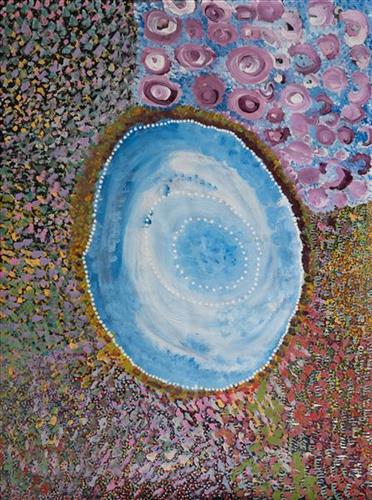
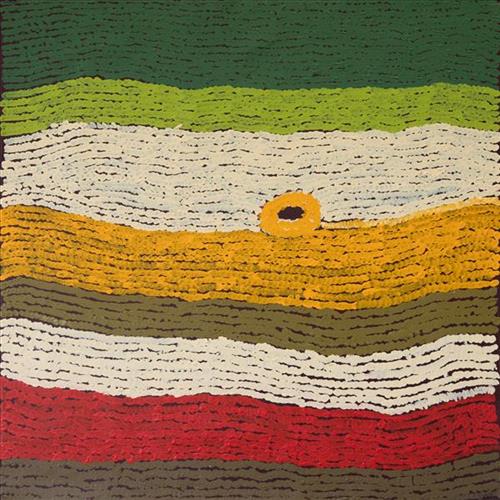
Kumpupirntily (Kumpupintily, Lake Disappointment)

“Clouds here. It’s dry, no water, but still flowers grow.” 

 – Helen Dale Samson

Kumpupirntily (Kumpupintily, Lake Disappointment) is a stark, flat and unforgiving expanse of blinding salt lake surrounded by sand hills, located in the Little Sandy and Gibson Desert of Western Australia. Kumpupirntily translates to ‘bladder burst’; the lake was formed when the bladder of the Jila Kujarra (Two Snakes) burst here. Jila Kujarra is one of the key Jukurrpa (Dreaming) narratives for the Martu. Though the story belongs to Warnman people, it is shared across the Western Desert with several other language groups. The narrative centres on the travels of two snakes as they are pursued by the Niminjarra, spiritual ancestors of the Warnman people. 

Later in the Jukurrpa period the Ngayurnangalku (cannibal beings) made Kumpupirntily their home, where they continue to remain today. For this reason Kumpupirntily is considered one of the most sacred and dangerous sites of the Western Desert. The Ngayurnangalku are fearsome ancestral cannibal beings said to resemble people in their appearance, except for their fangs and long, curved, knife like fingernails they use to catch and hold their human victims. Coming from Natawalu (Canning Stock Route Well 40) in the north, Mundiwinti (Mundawindi) in the west, and from the Country around Kiwirrkurra in the east, the Ngayurnangalku travelled across the desert, stopping near Puntawarri, at Jilukurru (Killagurra Springs, Canning Stock Route Well 17) and at Kupayura (Savory Creek) before finally reaching Kumpupirntily.

At Kumpupirntily, the Ngayurnangalku had a meeting to debate whether or not they would continue to live as cannibals, and eventually came to the decision to stop eating people. That night, a female baby cannibal was born. Following protocol, the baby also had to be consulted by the group. She determined that the Ngayurnangalku should continue to eat people. Her decision divided the group, and from this point the group from the east continued to live as ‘bad’ cannibals at Kumpupirntily, while the group from the west became ‘good’, thereafter consuming only animals. 

The cannibal Ngayurnangalku still live beneath the crust of Kumpupirntily lake in an underground world lit by their own sun. They surface only to feed on human flesh, coming in and out of the world we see through a small hill that acts as a gateway between worlds; Yapu Maparnpa (magical hill). Stored with the Ngayurnangalku in their underground world is an arsenal of maparnpa (holding power for sorcery) weapons, as well as deposits of pujurrpa (red ochre) that the Ngayurnangalku use to paint themselves with when they dance.

Several phenomena at Kumpupirntily act as a warning of the imminent appearance of the Ngayurnangalku; still skies, wilany (boomerang-shaped clouds), and the emergence of the parla-parla (type of lizard), smacking their mouths. The vigilance of the Martu as they travel in the Country around Kumpupirntily is so great that several other precautions are followed; fires are not lit, planes and helicopters are not flown directly over the area, and digging in the lake is strongly discouraged. All of these activities are believed to disturb the Ngayurnangalku, causing them to rise from their underground world. 

111582384673


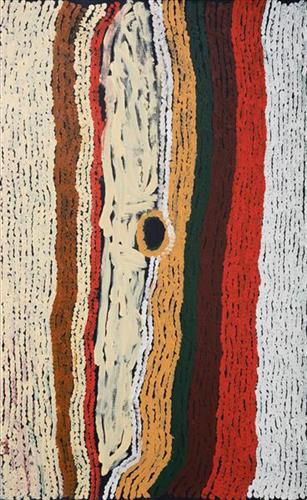
Nyinyir

“Nyinyiri, that’s my father’s ngurra (home Country, camp). Daddyku, Pitu (My father’s name was Pitu). Nyinyiri soak, near to Pitu, that’s Daddy’s ngurra.

I been see him. Plenty warta (trees, vegetation), sandhill, good kapi (water) for drinking. Every day up and down, up and down. Good hunting there, pussycat and mala (wallaby species), kuwiyi (meat).  I been walking everyway. That’s my ngurra.”

 – Ngamaru Bidu


Represented in this work is Nyinyiri soak, a small soak yulparirra (south) of Juntu-juntu (Canning Stock Route Well 30). As Ngamaru described, the soak is also close to Pitu (Separation Well), an important cultural site and large soak. Ngamaru’s family name, ‘Bidu’, derives from this place name.

Both sites lie within Ngamaru’s ngurra (home Country, camp), the area which she knew intimately and travelled extensively with her family in her youth. The Western Desert term ‘ngurra’ is hugely versatile in application. Broadly denoting birthplace and belonging, ngurra can refer to a body of water, a camp site, a large area of Country, or even a modern house. People identify with their ngurra in terms of specific rights and responsibilities, and the possession of intimate knowledge of the physical and cultural properties of one’s Country. This knowledge is traditionally passed intergenerationally through family connections. Painting ngurra, and in so doing sharing the Jukurrpa (Dreaming) stories and physical characteristics of that place, has today become an important means of cultural maintenance. Physical maintenance of one’s ngurra, like cultural maintenance, ensures a site’s wellbeing, and is a responsibility of the people belonging to that area.

22024008546


Status: Stock


Yalka at Karrkurutinytja by Daphne Marks, in Cream and Pinks on Maroon, Cotton.

This beautiful fabric features Daphne Marks’ ‘Yalka at Karrkurutinytja’ design. Daphne was passed down the right to paint the Yalka Tjukurrpa at Karrkurutinytja (Bush onion dreaming at Lake Macdonald) from her grandmother, Narputta Nangala Jugadai. Narputta, who was a founding member of Ikuntji art centre and a prolific painter, was born close to this sight.

Daphne says,

 “My grandmother, Narputta used to make that painting. She told me that story. I used to work here (Ikuntji Women’s Centre) as a cook. I came to learn here. I saw my grandma painting. I learnt from her. She told me that story…Yalka…Bush food…For a long time those old ladies have been looking for Yalka, digging for Yalka, taking the fruit, cooking it in the fire. We cook them just a little bit, like Maku (witchetty grub). I have been looking for that Yalka with my grandmother.”

Yalka Tjukurrpa, as told by Narputta,

“Creek bed at Karrkurutinytja. Two old women, two Nungurrayi, came across from Pulpa and started Gathering bush  onions, putting them into coolamons. They went on a journey west. They approached a group of men and watched them, whilst hiding in the bushed at Pimarrpa (Soakage near Kiwirrkura). There was another lady, Alkiljarra Nakamarra, who came along on their tracks. She saw them where they had gathered bush onions. She became upset that they’d gathered them all up and there were none left. The Nakamarra started walking and came across the creek, where she started collecing mungilpa (a staple seed food for the Pintupi people).  She came across two Tjangalas (Mungilnga and Tiwilgna). Next to them was a rockhole and Atjakalya Nakamarra, who was making damper for them. Mungilnga had the smaller damper. The two Tjangalas ate their damper then she flew off and became a rock there at Kurultu.”

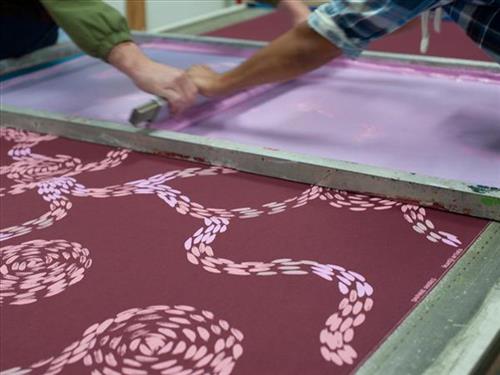
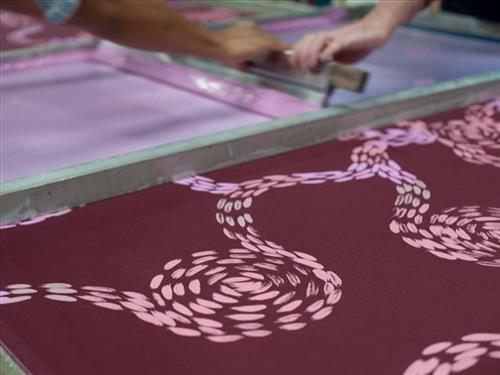
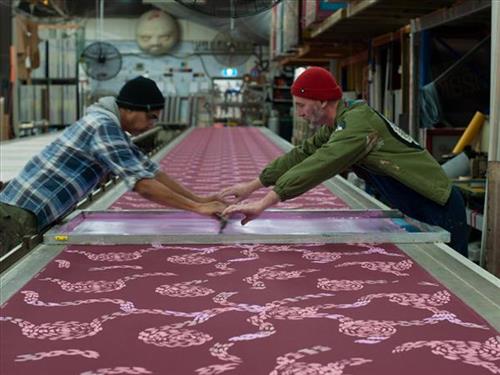
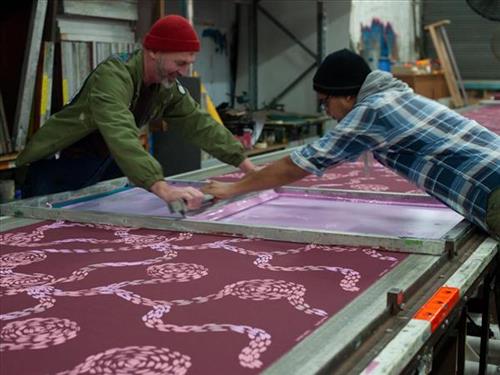
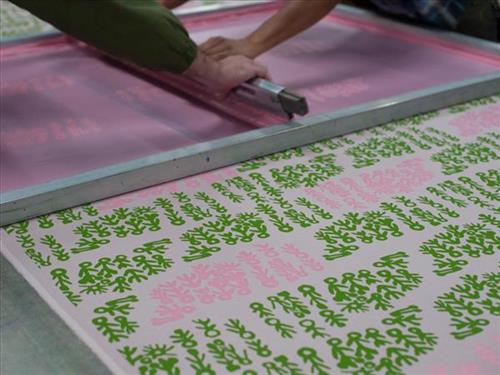
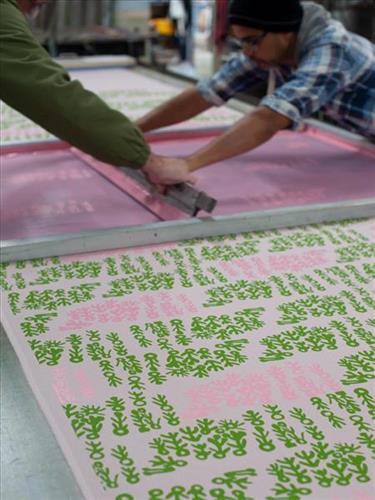
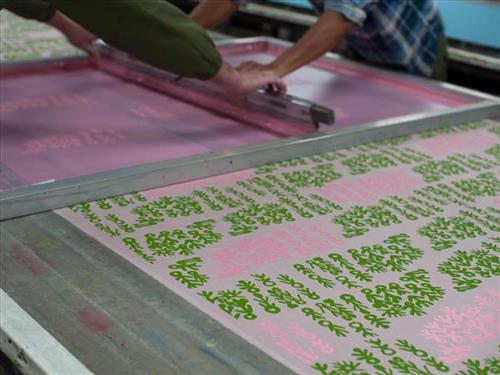
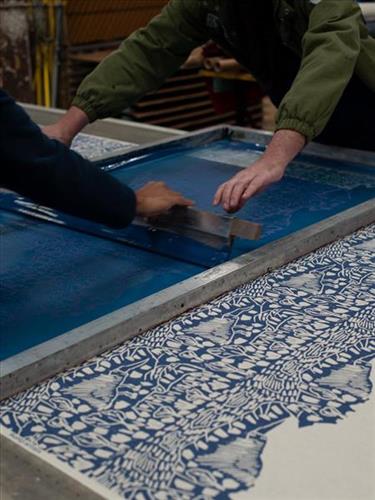
This fabric has been screen printed by hand by Published Textiles and Papers, ensuring the highest quality and longevity.

About the printers:

Publisher Textiles & Papers is one of Australia’s leading print houses. Focused on producing original patterns through traditional hand-screen printing methods we create bold and colourful textiles, hand printed wallpaper, clothing and fabric.

Fabric details:

This fabric is by continuous metreage going up in 50cm increments, priced at $110 per metre.

For 1m, please add 2 x 50cm to your cart and it will be cut as a continuous length ($110 for 1m).

For 2m, please add 4 x 50cm to your cart and it will be cut as a continuous length ($220 for 2m).

For 3m, please add 6 x 50cm to your cart and it will be cut as a continuous length ($330 for 3m).

Fabric Care Instructions:

Hand wash, line dry, do not bleach, wash separately, warm iron, do not soak, dry cleanable (P). The ink has been heat set for longevity, however please take care when washing (wash garments inside out if possible).

22024008545


Status: Stock


Sisters at Watarru by Noreen Dixon, in 3 colour blend on cotton.

In this design, Noreen Dixon depicts the story of two female ancestors, sisters, in the Watarru area in South Australia.
These sisters are fleeing a man who is pursuing them, hiding in rockholes and caves amid the sandy desert plains. The hypnotising background patterns of lines and dots represent the vast sands of the desert. The younger sister is pregnant; this is indicated by the large symbol of concentric circles,
which is the design painted onto pregnant women’s bellies for ceremony. The motif of two smaller circles connected by strong lines represents the body paint of the older sister, whose chest would be painted with this design. The oldest sister is caring for her younger sister and helping to keep them hidden from the man pursuing them.

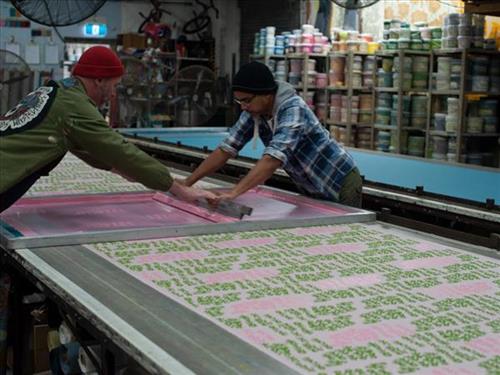
This fabric has been screen printed by hand by Published Textiles and Papers, ensuring the highest quality and longevity.

About the printers:

Publisher Textiles & Papers is one of Australia’s leading print houses. Focused on producing original patterns through traditional hand-screen printing methods we create bold and colourful textiles, hand printed wallpaper, clothing and fabric.

Fabric details:

This fabric is by continuous metreage going up in 50cm increments, priced at $110 per metre.

For 1m, please add 2 x 50cm to your cart and it will be cut as a continuous length ($110 for 1m).

For 2m, please add 4 x 50cm to your cart and it will be cut as a continuous length ($220 for 2m).

For 3m, please add 6 x 50cm to your cart and it will be cut as a continuous length ($330 for 3m).

Fabric Care Instructions:

Hand wash, line dry, do not bleach, wash separately, warm iron, do not soak, dry cleanable (P). The ink has been heat set for longevity, however please take care when washing (wash garments inside out if possible).

22024008544


Status: Stock


Kuruyultu Flowers, Green and pink on pink, cotton.

This design by Eunice depicts her father’s Tjukurrpa (Dreaming). It shows the country at Kuruyultu, near Tjukurrla in Western Australia.

Eunice Napanangka Jack says about the artwork:

‘This is my country. I can’t remember how it all happened, because it happened before I was born. I have a scar on my back from it. My grandfather speared a wallaby at Kuruyultu. That night he ate that wallaby. At the same time my mother could feel me moving inside her. She was heavily pregnant with me. That next morning, after my grandfather had speared the wallaby, killed it and eaten it, I was born. I was born at Kuruyultu, near the rockhole there. I can’t remember my grandfather or my grandmother. I was still a little baby. We left that place, Kuruyultu. My father, my mother, my big sister and my father’s brother, we all left together and went to Haasts Bluff. I grew up in Haasts Bluff. I have been back to Kuruyultu for visits but I never lived there again in my country. I think about it every day. Only my father knows all the stories for that country and he painted them too… all the men’s stories. I know the story of the wallaby mother and daughter which left me with a birthmark. That’s what I paint: the wallaby mother and daughter.’ 

About the printers:

Publisher Textiles & Papers is one of Australia’s leading print houses. Focused on producing original patterns through traditional hand-screen printing methods we create bold and colourful textiles, hand printed wallpaper, clothing and fabric.

Fabric details:

This fabric is by continuous metreage going up in 50cm increments, priced at $110 per metre.

For 1m, please add 2 x 50cm to your cart and it will be cut as a continuous length ($110 for 1m).

For 2m, please add 4 x 50cm to your cart and it will be cut as a continuous length ($220 for 2m).

For 3m, please add 6 x 50cm to your cart and it will be cut as a continuous length ($330 for 3m).

Fabric care instructions: Gentle cold/ warm hand wash. Do not bleach, warm rinse well, do not tumble dry, cool iron only, dry cleanable (P).

22024008543


Status: Stock


Echidna fabric, by Daisy Jugadai, Blue on Natural linen.

This design comes from a lino-print made by Daisy Jugadai! It depicts Echidnas.

This fabric has been screen printed by hand by Publisher Textiles and Papers, ensuring the highest quality and longevity.

About the printers:

Publisher Textiles & Papers is one of Australia’s leading print houses. Focused on producing original patterns through traditional hand-screen printing methods we create bold and colourful textiles, hand printed wallpaper, clothing and fabric.

Our fabric is printed in small batches and is cut to order.

Fabric details:

This fabric is by continuous metreage going up in 50cm increments, priced at $110 per metre.

For 1m, please add 2 x 50cm to your cart and it will be cut as a continuous length ($110 for 1m).

For 2m, please add 4 x 50cm to your cart and it will be cut as a continuous length ($220 for 2m).

For 3m, please add 6 x 50cm to your cart and it will be cut as a continuous length ($330 for 3m).

Fabric care instructions: Gentle cold/ warm hand wash. Do not bleach, warm rinse well, do not tumble dry, line dry out of direct sunlight, warm iron, Wash dark colours separately.