377810582393491


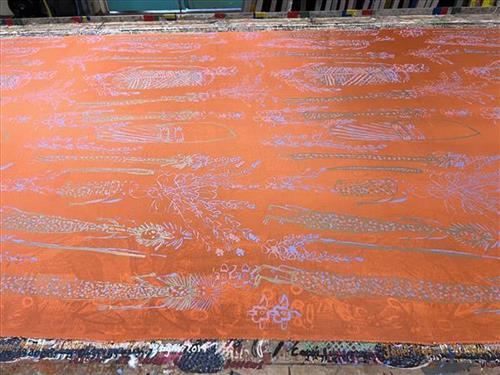
Kunwarrde (Stone Country) – Collection 3 – NFS

Country to Couture 2023

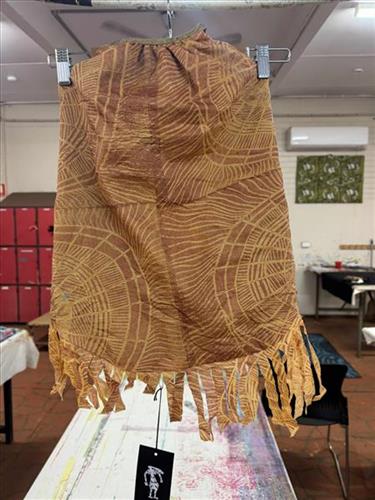
That kundalk (sedge/grass) it grows in the water in that black mud, it holds fast to that mud. Wet season time, that kunwarrde (stone country) covered by leaves and grass and mud. When it rains the fish come through. You can see that grass, under the river, in that black mud. When that water is flowing fast the fish can jump to other river. When it dries up, no fish, only sand and little bit of water. This area is from Mankorlord, that’s kunwarrde. (Janet Marawarr 2024)

377810582393489


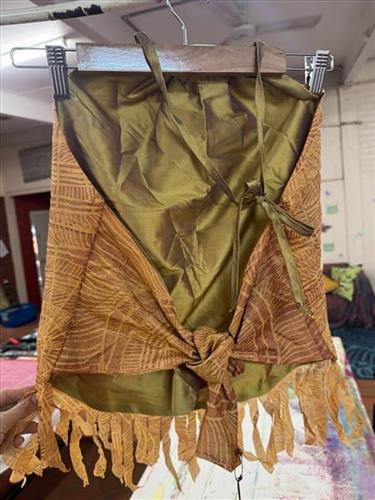
Marebu (Floor Mat) – Top- Collection 3 NFS

Deborah Wurrkidj is a Kuninjku artist from the Kurulk clan.

Wurrkidj’ country lies around the outstation of Mumeka in central Arnhem Land. She is an accomplished artist working across mediums including painting, sculpture, weaving and textile design. In her later years, Deborah has focused her efforts on mentoring her niece, Temika Namundja.

Works in fibre from the Maningrida region are widely recognised as some of the finest in Australia. Artists confidently push the boundaries of fibre craft and cultural expression, adapting traditional techniques and forms to produce strikingly inventive and aesthetically exquisite artworks.

Artists weave many different kinds of mats. Conical mats were traditionally used to shield babies from mosquitoes. Long flat mats were used for blocking creeks so that fish would be diverted into fish traps. A small triangular mat made of pandanus fibre used to be worn by women during ceremonial gatherings, tied around their back and covering them at the front. Mats are also used for wrapping and rinsing food in water.

Artists usually use kundayarr, pandanus spiralis, to weave decorative round or oblong mats, as well as the less common triangular and conical shapes. Weaving is physically hard work, now done only by women. They colour the pandanus using natural dyes made from the roots, leaves or flowers of plants within the weaver’s clan estate.

The radial woven patterns of the finest round mats appear to vibrate with colour, sometimes regarded as an aesthetic manifestation of deep cultural meaning, as there is a significant spiritual dimension to pandanus mats.

377810582393414


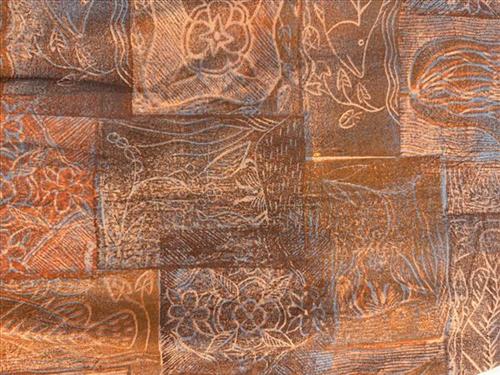
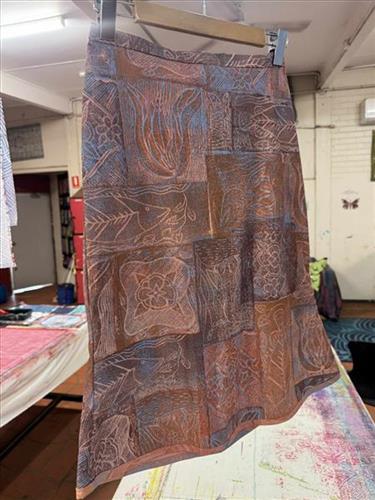
Manbirrbbirr (small bush flowers) – Collection 3 NFS

In Kuninjku the name manbirrbbirr is used for a number of densely flowering shrubs and small trees including Verticordia cunninghamii, yellow-flowering Austromyrtus species and also Acacia platycarpa which also has dense white flowers.

A multicoloured cloth with interlocking designs in a patchwork repeat. This cloth was printed by hand using the linocut technique. 


377810582393407


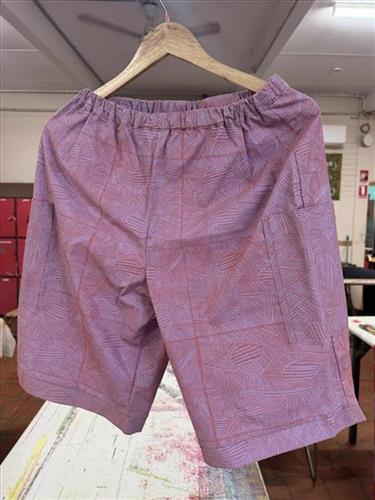
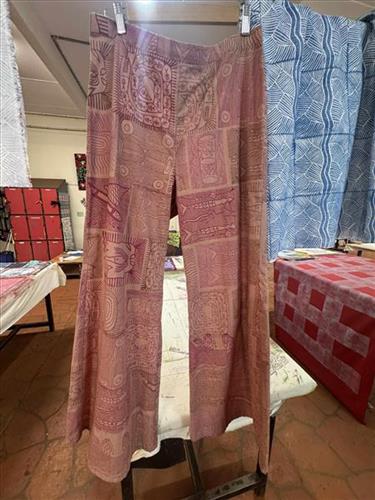
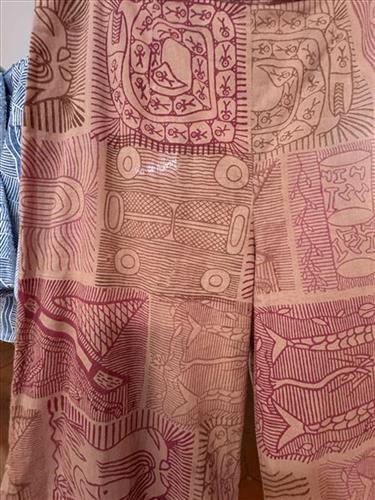
Woodblock pant by Babbarra x Tharangini – Collection 3 NFS

Woodblock print on cotton, extract print with organic dyes, 100% Silk

Co-created by Bábbarra Women’s Centre, Maningrida and Tharangini Studio, India

Printed by artisans at Tharangini Studio 

Design brief by Bábbarra Women’s Centre Artists

Woodblock carving by Shri C.H. Sreeram and Shri S.K. Rajak

Sewn by Jo Dunne – Darwin 2025

This fabric may feature the following woodblock designs. 

  • Kunred (Country) byJanet Kalidjan Marawarr 
  • Kundalk (Grasses) by Deborah Wurrkidj
  • Ngaldjorlhbo (Mother of Everything) by Janet Kalidjan Marawarr 
  • Yawyyawk (young woman spirit) by Deborah Wurrkidj
  • MANDJABU (FISHTRAP) byJanet Kalidjan Marawarr 
  • MAREBU (PANDANUS MAT) by Janet Kalidjan Marawarr 
  • KUNRED MANKORLOD (MANKORLOD COUNTRY) by Janet Kalidjan Marawarr 
  • ROLK (MAGGOT) KUNWARDDE(ROCKS) by Janet Kalidjan Marawarr 
  • NGALDJORLHBO (MOTHER OF EVERYTHING) by Janet Kalidjan Marawarr 
  • KUNRONJ (FRESH WATER) by Janet Kalidjan Marawarr 
  • NGALYOD (RAINBOW SERPENT) by Janet Kalidjan Marawarr 
  • MANDJABU (FISH TRAP) by Raylene Bonson
  • STINGRAY by Jocelyn Bangardijan Koyole
  • RARRK (CROSS HATCH) by Susan Belinj Marawarr
  • WAK WAK (BLACK CROW DREAMING) A Susan Belinj Marawarr
  • WAK WAK (BLACK CROW DREAMING) B Susan Belinj Marawarr
  • KARRBARDA (CHEEKY YAM) by Deborah Kamanj Wurrkidj
  • MANBIRRBBIRR (FLOWERS OF VERTICORDIA CUNNINGHAMII) by Deborah Kamanj Wurrkidj
  • KUNDALK (NATIVE GRASS) by Deborah Kamanj Wurrkidj
  • WAYUK (WATERLILY) by Deborah Kamanj Wurrkidj
  • NGALDADMURRNG (SARATOGA) by Carol Kamanj Liyawanga-Campion
  • MERLE MERLE (BUTTERFLY) by Carol Kamanj Liyawanga-Campion
  • BOLUNG (RAINBOW SERPENT) by Jay Belinj Jurrupula-Rostron
  • DILLY BAGS by Nancy Gununwanga
  • WATERHOLE by Nancy Gununwanga

“I’m excited to see my Lino design made into a woodblock. We are going to spend Saturday printing with Tharangini Studio. We are going to learn woodblock printing. I’ve been working Bábbarra Women’s Centre for 37 years since it started. I’ve been printing Lino on fabric.” Janet Marawarr 2023

“Tomorrow we do printing Yawkyawk (mermaid spirit) and Ngalyod (rainbow serpent). My design is together with my sister. Together, we started working at the Women’s Centre and Maningrida Arts and Culture, taught by our mother and grandmother. My sister is a sick one, and she passed on her story to me – Ngalyod (rainbow serpent). I help my sister, I help carry the knowledge for her. That’s why we both have designs being made into woodblock.” Deborah Wurrkidj 2024

BACKGROUND

Bábbarra Women’s Centre is located in the Djelk area of Arnhem Land, in a town known as Maningrida and was established in 1987. We represent over 50 women artists from 12 languages and operate under the First Nations-owned Bawinanga Homelands Aboriginal Corporation. The artists at Bábbarra Women’s Centre design screen printed and lino print textiles that illustrate the djang or rich cultural narratives, histories and powerful creation stories of West Arnhem Land. The tradition of lino printing began in the mid-1990s as a way for women to become economically empowered.

Tharangini Studio was established in 1977 in Bangalore by artist and textile enthusiast Lakshmi Srivathsa. Today, it is managed by Srivathsa’s daughter, Padmini Govind, whose global corporate career in technology and defence has led to ingenious eco-friendly printing practices within the lush tropical locale. Under Padmini’s leadership, Tharangini is the only artisan studio with a NEST Ethical Seal of Compliance (fair trade). As the last surviving heritage block print studio in Bangalore, Tharangini is home to one of the largest private archives of vintage woodblocks in India

“Karri-djarrk-durrkmirri means “We work together” in the Kuninjku language of West Arnhem Land and it’s more than cultural exchange with India, it is two way learning.

Tharangini’s skilled artisans worked closely with Babbarra in 2023-2025 to hand-carve some of Babbarra’s old linocut designs into woodblocks. This initiative was supported by the Centre for Australia-India Relations, Maitri Cultural Partnerships Fund 2023.

The creative relationship not only serves art but it also informs a practical and critical archival outcome for Babbarra Women’s Centre. The walls of Tharangini Studio were neatly lined with boxes of durable woodblocks and many over 200 years old and still being printed. At Bábbarra, we house cupboards and shelves of historic and vulnerable lino tiles, some 30 years old but no longer able to be printed. Tharangini Studio specialises in woodblocks carved out of teak by master artisans, creating a solid medium for textile printing. For Bábbarra Women’s Centre artists, this had the added benefit of preserving the original lino designs. Many lino sheets are crumbling and decaying, a process hastened by the kudjewk (wet season) and humid kurrung (build up).

Combining the cultural authority to share djang and print-making practices at Bábbarra Women’s Centre with the tradition of woodblock printing in India, the project exchanges many thousands of years of knowledge across the globe. The Bábbarra artists, as custodians of these designs, must receive permission from their djungkays (ritual manager through the maternal line) to share their stories.

This connection will undoubtedly sustain a lasting and significant impact on the legacy and longevity of Bábbarra Women’s Centre. The story doesn’t end here in honour of the generosity shown by Tharangini Studio, Padmini Govind will join Babbarra Women’s Centre artists in Maningrida for a workshop in June 2025.” 

Extract taken from Karri-djarrk-durrkmirri catalogue essay, Jessica Stalenberg 2025

377810582393397


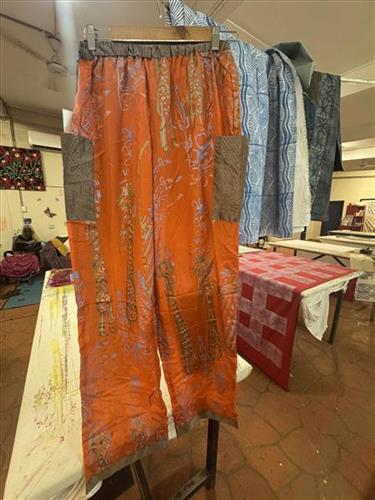
Bawáliba and Bush Flower Pant – Collection 3 NFS

This new design from workshops held in 2022 depicting Bawáliba (stone country mimihs) and dilly bags against a background of loosely placed bush flowers. Lucy has depicted her Bawáliba with werrkno (skin) textures. 

‘Bawáliba is the djang (Dreaming) of my mother and my uncles. They are good spirits, they protect us and they recognise families. They are really tall- just like human beings, like us. They dance late at night and have a lot of hair.

In olden times, long long long time ago Bawáliba were here, before people were on the land. Bawáliba used to go out hunting and care for country. They hunt carrying fish traps and digging sticks, near the homeland Djinkarr. They go out hunting on the floodplains with dilly bags and digging sticks. They collect a lot of bush foods, and sleep together with one bark shelter.
Sometimes now they still come alive when we sleep, they might come to our houses and peep through the window. At night, they cover themselves with white clay and red cloth tied around their waist. If we hear them, we jump out of bed and get up to look -but they have disappeared, they’re just too quick. Bawáliba might knock on the window to remind us they are there looking out for us.If you listen deeply you can hear them whisper, sometimes they talk about us and might say, ‘why are those people making camp here?’ then they realise ‘Oh they are family from here, it’s ok, they are just sleeping here for the night’.

During the day they always turn into stone and they sleep. We still know that green rock covered in moss near Djinkarr, that’s Bawáliba sleeping.
Some of my ancestors used to speak the same language as the Bawaliba, but all those old people are passed away now. It’s a little bit sad for us, because no one now can speak that Bawaliba language anymore.’ Lucy Yarawanga 2019

111582393504


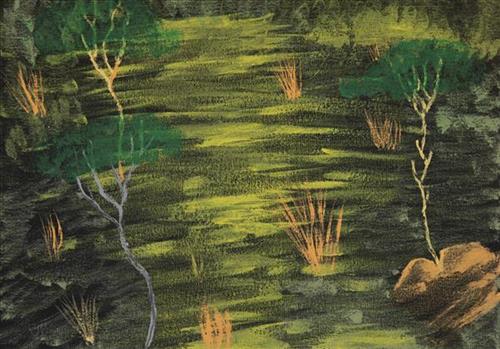
Travelling along the road

This work portrays an area known to the artist, painted here from memory. During the pujiman (traditional, desert dwelling) era one’s survival depended on their intimate knowledge of the location of resources; thus physical elements of Country, such as sources of kapi (water), tali (sandhills), and different varieties of warta (trees, vegetation) were carefully observed and remembered. Today, this relationship with Country remains equally strong, despite the movement of Martu out of the desert and into remote Aboriginal communities, towns and cities.

Also visible may be traces of life cycles based around kalyu (rain, water) and waru (fire). A thousands of year old practice, fire burning continues to be carried out as both an aid for hunting and a means of land management today. As the Martu travelled and hunted they would burn tracts of land, ensuring plant and animal biodiversity and reducing the risk of unmanageable, spontaneous bush fires. The patchwork nature of regrowth is visible in many landscape works, with each of the five distinctive phases of fire burning visually described with respect to the cycle of burning and regrowth.  

Finally, metaphysical information relating to a location may also be recorded; Jukurrpa (Dreaming) narratives chronicle the creation of physical landmarks, and can be referenced through depictions of ceremonial sites, songlines, and markers left in the land. 

111582393462


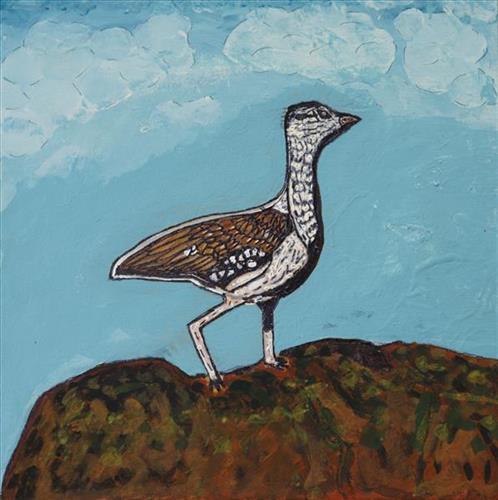
Kipara (Australian bustard, bush turkey)

Kipara (Australian Bustard, bush turkey) are ground-dwelling, large, speckled grey-brown birds found in the plains of the Western Desert and across northern Australia. Kipara fly long distances in the search of food, and were once widespread among the plains of Australia. However, following colonisation they have become increasingly rare. Kipara often travel in groups, and walk slowly, picking at food such as jinyjiwirrily (wild gooseberry, desert raisin), and are usually found at twilight and after dark. 

Kipara are known by Martu to be attracted to burn areas in the nyurnma (freshly burnt) and waru-waru (green shoots and young plants are sprouting from burnt areas) stages. Traditionally, kipara were stalked and then wounded whilst taking off using a karli (boomerang). Today, kipara are generally hunted with rifles from vehicles, enabling a close range approach. 

During the pujiman (traditional, desert dwelling) period, Martu would traverse very large distances annually in small family groups, moving seasonally from water source to water source, and hunting and gathering bush tucker as they went. Whilst desert life has moved away from mobile hunter-gatherer subsistence throughout the course of the twentieth century, bush tucker continues to be a significant component of the modern Martu diet. Hunting and gathering bush tucker remains equally valuable as an important cultural practice that is passed on intergenerationally. Though hunting and gathering implements have been modernised, methods of harvesting, tracking and the use of fire burning to drive animals from their retreats are still commonly practiced today. 

111582393447


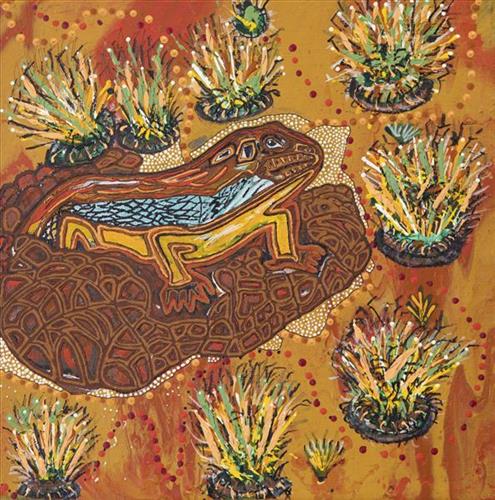
Mulyamiji

The Mulyamiji or Great Desert Skink is a large burrowing skink found across Martu country, with reddish-brown scales and a yellow underbelly. Traditionally a food source during pujiman (traditional, desert dwelling) times and deeply connected with lore and Jukurrpa (Dreamtime) stories, mulyamiji are now a threatened species. Martu work extensively across the Western Desert through the KJ (Kanyirninpa Jukurrpa) ranger program to monitor, survey and preserve mulyamiji along with many other threatened species.

111582393446


Bidyadanga Reef

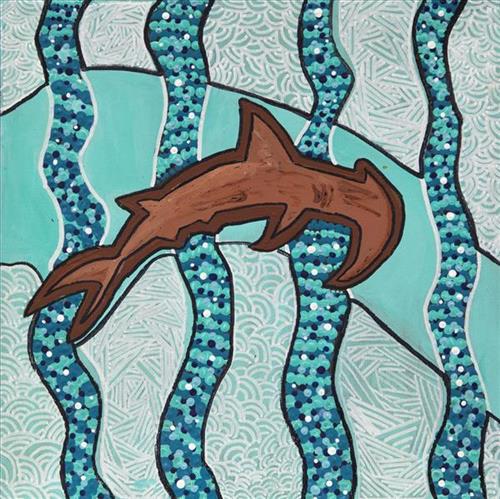
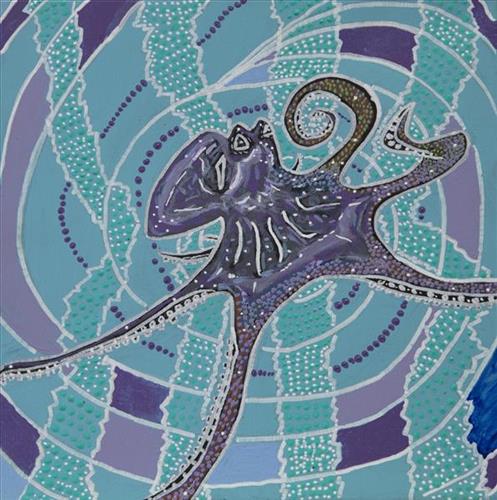
Bidyadanga is a community located on the Kimberley coast in Western Australia, where the Great Sandy Desert meets the sea. The word Bidyadanga is derived from pijarta/ bidyada (emu watering hole).

111582393445


Bidyadanga Reef

Bidyadanga is a community located on the Kimberley coast in Western Australia, where the Great Sandy Desert meets the sea. The word Bidyadanga is derived from pijarta/ bidyada (emu watering hole).