111582404191


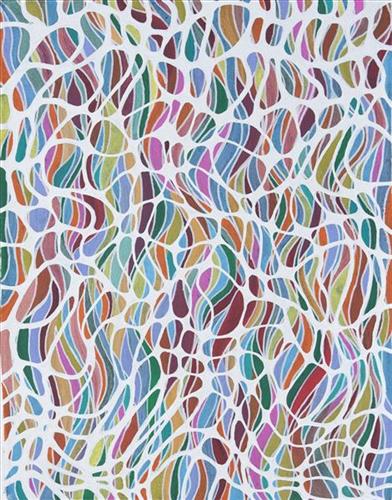
Spinifex

“When I went back to County, I thought how beautiful the spinifex was. How the sun glazed against the spinifex. The County that I speak of is Jilukurru, my grandfather’s country.”

– Kathleen Maree Sorenson

Martu Country is dominated by striking permanent tali (sandhills) covered with spinifex, gums, and other trees and shrubs. Spinifex is a pale green, spiky grass that grows in clumps throughout the Central and Western Deserts of Australia. Some varieties yield edible seeds and another contains a resin. 
111582404190


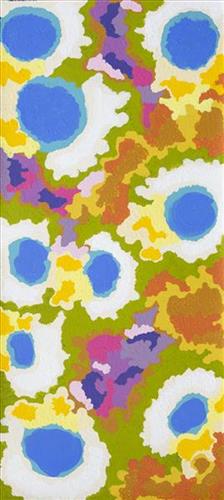
Tuwa (Sandhills)

‘’Went with Martumili. Old Jigalong. Judith’s nanna Country, where Judith nanna was born. Went from old Jigalong to Jigalong to right through Parnngurr, Camped the night and then Judith’s pop went to pick him up. His name is Mr Rowlands and I call him brother. He showing me where my nanna’s Country started from Parnngurr towards Lake Disappointment. We camped the night. Judith’s nanna was getting cheeky bossing him (Mr Rowland) around; “we not married anymore that’s why I left him.” Between Lake Disappointment and Durba Springs (Pinpi) there were these beautiful rolling sand hills, we winding through them over top, we stopped half way and I looked out to the sunset saw all the glistening spinifex. The orange from the sunset lit the sand dunes up. When I do the Tuwa paintings I think of that day.’’

– Kathleen Sorensen

The traditional lands of the Martu people encompass the Great Sandy Desert and Rudall River regions of Western Australia, an enormous tract dominated by distinctive red tali, or tuwa (sandhills). These sandhills present an unforgiving landscape; sparse vegetation covers a seemingly never ending expanse of dunes, and yet these lands and the location of resources within them was known intimately by its pujiman (traditional, desert dwelling) inhabitants. At this time, Martu traversed very large distances annually in small family groups, moving from water source to water source through the harsh desert landscape with incredible stamina and resourcefulness. Travel was often undertaken at night, and when travelling during the day, Martu wore yakipiri (woven bark sandals) to protect their feet from the hot desert sand.

111582404189


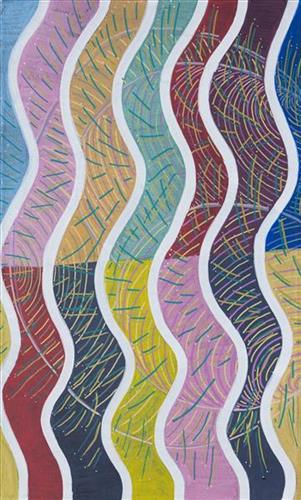
Untitled

Martumili Artists work with over three hundred artists from remote Martu Aboriginal communities, including Punmu, Parnngurr, Kunawarritji, Jigalong, Irrungadji (Nullagine), and Warralong, as well as from the Parnpajinya (Newman) gallery and studio spaces. Known for their diverse, energetic, and unmediated painting styles, their works reflect the dramatic geography and scale of their homelands. Each artist, however, brings a unique approach to their craft.

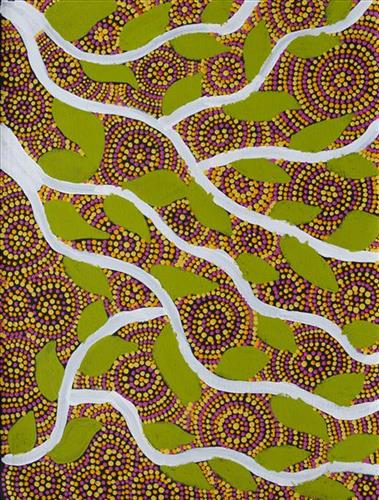
Younger Martu artists often start painting alongside their parents, grandparents, and extended family, which fosters an organic learning process. This not only involves mastering painting techniques but also understanding specific locations, family histories, traditional ways of life, bush tucker, and Jukurrpa (Dreaming). Over time, with encouragement from their peers, they develop their own distinct styles and explore unique painting techniques and subject matter. In this work the artist brings a contemporary, evolving perspective to their work.

111582404187


Bush Medicine

Traditional Martu knowledge of plant properties was encyclopedic, and saw plants used for purposes as diverse as food resources, carving implements, tobacco, firewood, shelter construction, and bush medicines. Depicted in this work are types of bush medicines, their habitats, and the processes used in their preparation. 

Physical ailments treated with plant based poltices, body washes, drinks, rubs and pastes included fever, congestion, headache, skin sores, aching limbs, and digestive problems. More serious health issues were often treated with a combination of bush medicine and maparn (magic healing/ healer).

Plants still prepared to make bush medicines today include warlji (desert bloodwood), kalpari (Dysphania Kalpari) and nayju (green crumbweed), which can be soaked in a water solution to make a skin wash. One of the most popular types of bush medicine still used today is wanta (red sap), collected from the mijarrpa (bloodwood) tree and brewed as a tea to ease heart pains and other body aches.

225182404160


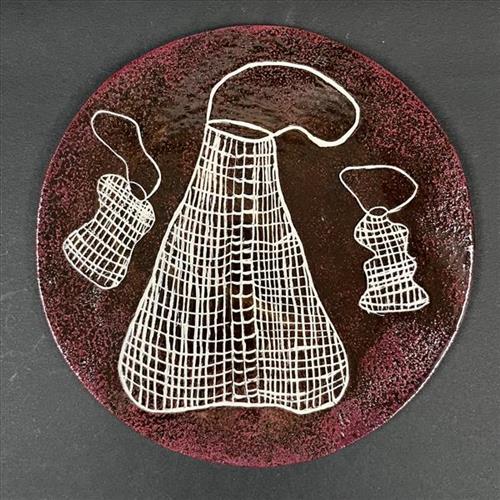
Kakan (Black Palm) Dillybag.

Our ancestors used Kakan (Black Palm) dilly bags to carry food when out hunting and gathering or soak bitter yams in creeks before cooking them. They were also used to hold personal items.

When I was a young girl my grandmother would teach me how to make Black Palm dillybags. We used to set up camp with other Kuku Yalanji women at a creek near Helenvale. It is very hard work. The men would help us cutting down the palm trees and separate the crownshaft from the trunk and the leaves. Then the women used to peel away the outer leaves until they felt strong threads they could pull out. They cleaned these threads from pulp with a mussel shell. When we moved away from Helenvale I forgot how to make them. Luckily years later I asked a relative of mine, Wilma Walker, who is great weaver, if she could refresh my memories. From then on I kept making dillybags as long as my health allowed it. I really enjoyed making them.

225182404159


Mossman River Design

The Mossman River is very important to me and my family. Laurence, my partner and the father of our 5 children, is one of the Traditional Owners of this area. We both grew up along the river and Laurence’s grandparents used to live in a hut next to the river. In the hot season, we used to camp there with our families. Laurence would teach me and later our children how to dive for turtle and fish. We would cross the river to hunt and collect bush food. Back at the camp, we would make fire, cook our damper and fish in an earth oven and share with our families.

225182404158


Mossman River Design

The Mossman River is very important to me and my family. Laurence, my partner and the father of our 5 children, is one of the Traditional Owners of this area. We both grew up along the river and Laurence’s grandparents used to live in a hut next to the river. In the hot season, we used to camp there with our families. Laurence would teach me and later our children how to dive for turtle and fish. We would cross the river to hunt and collect bush food. Back at the camp, we would make fire, cook our damper and fish in an earth oven and share with our families.

225182404155


Kunjuri (Rainforest Shield)

Traditional shields were carved from a single piece of timber cut from side of the buttress root of a rainforest fig-tree. The kidney shaped shields are unique to the rainforest Bama of Far North Queensland. They were decorated with clan, totem or moiety designs using natural ochres and a water, fat or blood binder.

Shields were primarily used for deflecting spears in tribal fighting in conjunction with large rainforest swords.

Shields were usually made and painted by senior men and were a significant personal possession of adult males.