221281624143


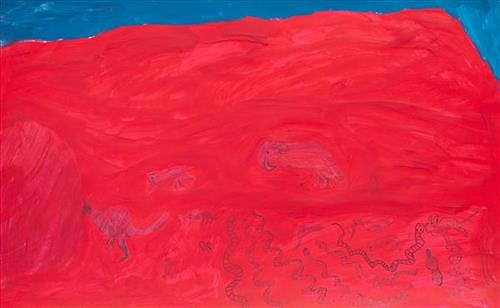
A true story

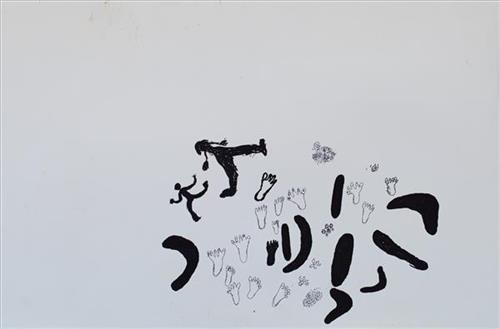
This is a true story about a whitefella stockman from the missionary days. He was living in a tent minding his own business on Anangu land. One day three Anangu men went into the stockman’s tent and stole his flour, tea and sugar, they ran quickly away, scared they would get caught. The stockman grabbed his rifle and followed the Anangu tracks to a cave. He started to shooting into the cave and the Anangu retaliated with their spears which one pierced the stockman’s leg. Somehow the Anangu escaped, two went one way, and one went to what is now known as Amata.  The stockman found some other Anangu and they helped him with bush medicine and took him to Mimili because there was a Toyota. The Toyota took the stockman to Oodnadatta, and then he took the train to the Port Augusta hospital. In hospital, he thought about those three men stealing his stuff so he talked to the police, and they spotted the one Anangu from Amata and he got arrested and put into gaol in Port Augusta. The other two escaped and are family members of people still living in Pukatja today.

111581900575


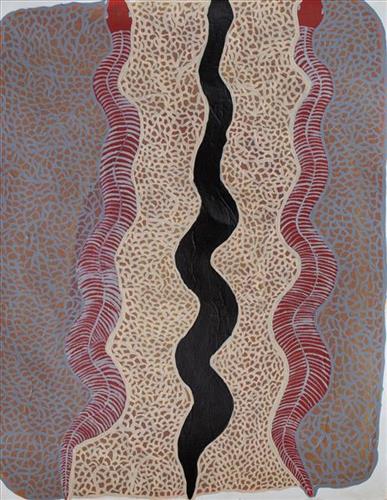
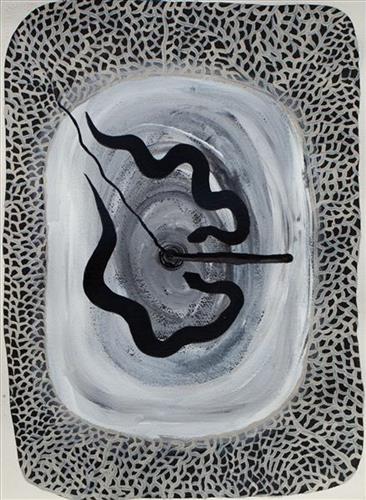
Niminjarra

“Niminjarra is the two brothers transforming into a snake so they can go back home to Ngayartakujarra (Lake Dora). They were in training for ceremony, those two brothers, but they were kept too long and nobody was there to release them. They waited then they decided to transform into snakes to travel back to where they came from, because their mother was waiting for them. This is Jukurrpa (Dreaming story)”

– Desmond Taylor


111581905556


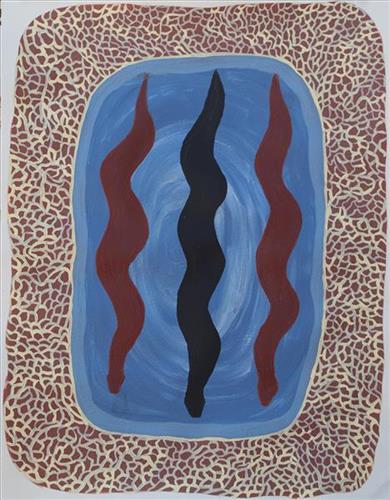
Niminjarra (home camp)

“Niminjarra is the two brothers transforming into a snake so they can go back home to Ngayartakujarra (Lake Dora). They were in training for ceremony, those two brothers, but they were kept too long and nobody was there to release them. They waited then they decided to transform into snakes to travel back to where they came from, because their mother was waiting for them. This is Jukurrpa (Dreaming story).

“The mother is guiding and caring for two sons, the Jila Kujarra, in the underground world where they live. This place is very sacred to the Niminjarra ancestors- the Warnman people.”

– Desmond Taylor

The term jukurrpa is often translated in English as the ‘dreaming’, or ‘dreamtime’. It refers generally to the period in which the world was created by ancestral beings, who assumed both human and nonhuman forms. These beings shaped what had been a formless landscape; creating waters, plants, animals, and people. At the same time they provided cultural protocols for the people they created, as well as rules for interacting with the natural environment. At their journey’s end, the ancestral beings transformed themselves into important waters, hills, rocks, and even constellations. 

Jila Kujarra (Two Snakes) is one of the key jukurrpa narratives for the Martu. Though the story belongs to Warnman people, it is shared across the Western Desert with several other language groups. The narrative centres on the travels of two snakes as they are pursued by the Niminjarra, spiritual ancestors of the Warnman people. Before transforming themselves into snakes, the Jila Kujarra were young brothers waiting to be released from ceremony at the boundary of Mukurtu, west of Mamunara (Canning Stock Route Well 28). They began travelling home to their mother in the west, but were intercepted by the Niminjarra as they hunted and hurled their spears in front of them. Suddenly the spears of the Niminjarra stuck in the ground and swayed in the air, alerting the Niminjarra to the tracks of the Jila Kujarra.

The Niminjarra started to track the Jila Kujarra, but stopped with their many weapons at Jantuwurujul (or Janturuly) to hunt for wild game. The Jila Kujarra continued to flee, reaching Paji, east of Nyayartakujarra (Lake Dora) before they were again intercepted by the Niminjarra. The Niminjarra believed the snakes had hidden in a cave north of Paji, and tried to smoke them out. Again, the Jila Kujarra eluded their pursuers, this time escaping under the lake at Paji and at the same time creating many small decoy snakes to lead the Niminjarra astray. 

Meanwhile, from a nearby hill, two Pukurti (initiates with bundled hair) prophesied that the Niminjarra would kill the Jila Kujarra. The Pukurti tracked the Jila Kujarra through to Nyayartakujarra, where they speared the snakes in the head to hold them down while they returned to Paji to summon the Niminjarra. The Niminjarra made a fire and cooked the snakes at Ngayartakujarra (Lake Dora). The snakes were too long to lay down on leafy branches to be cut up, so the Niminjarra lay down to make a human table. When the Niminjarra cut down the length of the Jila Kujarra, the snake’s bladders were pierced, causing an explosion of scalding hot urine in which the Niminjarra all perished and became black rocks at the site. At the same time, the urine of the Jila Kujarra formed the vast salt lake, Kumpupirntily, which translates to ‘bladder burst’.  

The spirits of the Jila Kujarra rose and continued to travel to their mother at Nyayartakujarra. She saw them coming towards her as flaming figures, and called out to them, piercing the surface of the salt lake with her digging stick. There, the mother and her sons entered the ground below Nyayartakujarra, where they remain to this day.


111581932486


Niminjarra

“Niminjarra is the two brothers transforming into a snake so they can go back home to Ngayartakujarra (Lake Dora). They were in training for ceremony, those two brothers, but they were kept too long and nobody was there to release them. They waited then they decided to transform into snakes to travel back to where they came from, because their mother was waiting for them. This is Jukurrpa (Dreaming story)”

– Desmond Taylor


111581934985


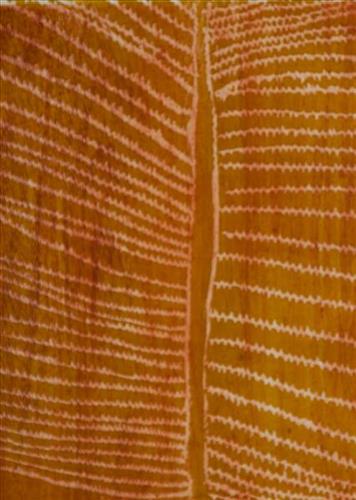
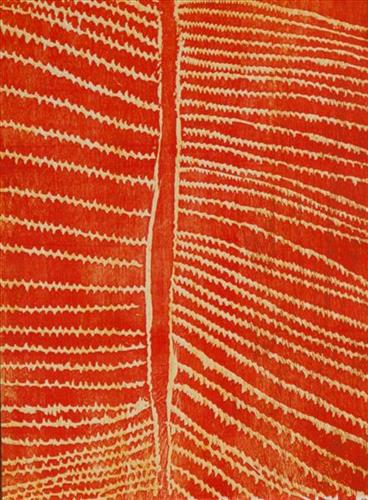
Untitled

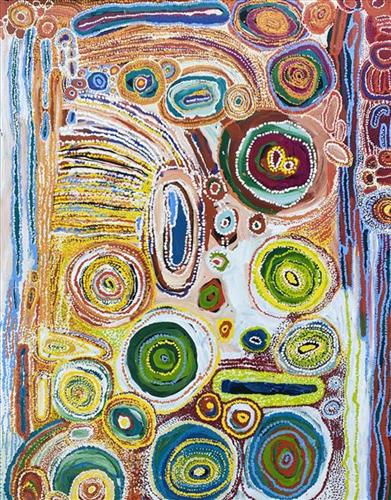
This work portrays an area known intimately to the artist, painted here in exquisite detail from memory. During the pujiman (traditional, desert dwelling) era one’s survival depended on their intimate knowledge of the location of resources; thus physical elements of Country, such as sources of kapi (water), tali (sandhills), and different varieties of warta (trees, vegetation) were carefully observed and remembered. Today, this relationship with Country remains equally strong, despite the movement of Martu out of the desert and into remote Aboriginal Communities, towns and cities.

Also visible may be traces of life cycles based around kalyu (rain, water) and waru (fire). A thousands of year old practice, fire burning continues to be carried out as both an aid for hunting and a means of land management today. As the Martu travelled and hunted they would burn tracts of land, ensuring plant and animal biodiversity and reducing the risk of unmanageable, spontaneous bush fires. The patchwork nature of regrowth is visible in many landscape works, with each of the five distinctive phases of fire burning visually described with respect to the cycle of burning and regrowth.  

Finally, metaphysical information relating to a location may also be recorded; jukurrpa (dreaming) narratives chronicle the creation of physical landmarks, and can be referenced through depictions of ceremonial sites, songlines, and markers left in the land. 

111581934981


Ngayurnangalkumili Ngurra (cannibal country)

“Ngayurnangalku (cannibal beings) fighting. They all come in here, all meet up here. Ngayurnangalku coming from this way [north], go in here. Ngayurnangalku coming from this way (east), they go in. They come from this way (west), get in there. And from the south, get in there again. Fighting all the way. All the yirrkili (boomerang) flying everywhere. All get up.”

This painting depicts several sequences in the jukurrpa (dreaming) of Kumpupirntily (Lake Disappointment) country and the lives of it’s inhabitants, the cannibal beings Ngayurnangalku. The lake is the white section in the centre of the painting, which is further quartered by the creeks that feed into it. Including Kupayiyura (Savory Creek). In these sections, other elements of the jukurrpa intersect with the fighting scenes. Top right includes the partarta (bush turkey) and walawurru (eagle hawk) jukurrpa North of the lake country. Bottom right includes a reference to Turnturnpa, an old woman who is not permitted into the lake area. This section and the others are interspersed by the imagery of the Ngayurnangalku fighting among themselves, indicated by their weapons flying around everywhere.

377813982402665


Jennifer Ingkatji – Seven Sisters Story

This is a Tjukurpa (Creation Story) about the constellations of Pleiades and Orion. The sisters are the constellation of Pleiades and the other star Orion is said to be the man Nyiru or Nyirunya. Nyiru is forever chasing the sisters known as the Kunkarunkara women as it is said he wants to marry the eldest sister. The seven sisters travel again and again from the sky to the earth to escape Nyiru’s unwanted attention. They turn into their human form to escape Nyiru, but he always finds them and they flee back to the sky. As Nyiru is chasing the sisters he tries to catch them by using magic to turn into the most tempting kampurarpra (bush tomatoes) for the sisters to eat and the most beautiful ili (fig) tree for them to camp under. However, the sisters are too clever for Nyiru and outwit him as they are knowledgeable about his magic. They go hungry and run through the night rather than be caught by Nyiru. Every now and again one of the women fall victim to his ways. It is said that he eventually captures the youngest sister, but with the help of the oldest sister, she escapes back to her sisters who are waiting for her. Eventually the sisters fly back into the sky, reforming the constellation.

222082403082


Bilin – Movement

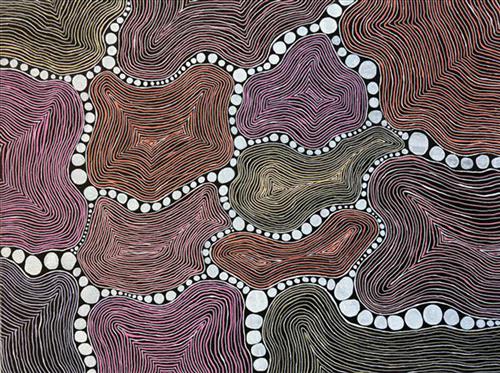
Bilin, Movement tells a story about the constant motion of life, how everything around us is always moving shifting and flowing together. The lines represent the paths we walk each day sometimes crossing sometimes separating but always connected. Just like our country nothing ever stands still. The land the wind the people we are all part of that same rhythm. Each shape and colour shows the energy of life as it moves through us. The flowing patterns hold stories of chaos and calm, reminding us that even when things feel uncertain or busy, everything still finds its way. Every movement has purpose. Every connection has meaning. The circles in the painting show those meeting place moments where paths and people come together to share, to rest and keep moving forward. The lines flowing between them show that journey, the way we are all carried along by time and change. Even though life is always moving, there is beauty and balance in that motion. When we step back, we can see how all the parts come together how everything works better than we thought it would. Bilin “movement” speaks to the strength of connection the flow of energy through Country and the understanding that everything, every story, every person, every path is part of something much greater.