Status: Stock
22514009041
Status: Stock
Bucket Hat by Lorna Shuan
22514009040
Status: Stock
Bucket Hat by Margaret Rocky
22514009039
Status: Stock
Bucket Hat by Karen Shuan
22514009038
Status: Stock
Bucket Hat by Laurence Gibson
11154009037
Status: Stock
Kaalpa (Kalypa, Canning Stock Route Well 23)
“Kaalpa (Kalypa, Canning Stock Route Well 23) is my grandfather’s Country. There’s a waterhole there, Kaalpa waterhole. It’s my two pops’ Country. They been walking around, hunting around Kaalpa. You can see a yapu (rock), warla (lake), claypans, karru (creek) and tuwa (sandhills) there. It’s on the [Canning] Stock Route, it’s Well 23. One walypala One walypala (whitefella) well, and a real kalyu (water) there, jurnu. The Seven Sisters landed there, Jukurrpa (Dreaming). That man Yurla yapu (hill, stone, rock) there.” [Yurla, who chased the Seven Sisters during the Jukurrpa remains at Kaalpa in the form of a rock])
In pujiman (traditional, desert dwelling) days, pujimanpa (desert born people) walking around all this Country. My pops told me about that place, a big flat area, parlkarra (flat country) good for hunting parnajarrpa (goanna), lunki (witchetty grub), lungkurta (blue tongue lizard), wamurla (bush tomato), jinyjiwirrilyi (wild gooseberry). Kaalpa is a busy place for emus getting a drink.
The old people were telling me “Kaalpa’s your grandfather’s Country, you gotta paint it.” I went [to Kaalpa] for the first time [in 2018] on a Martumili KJ [Kanyirninpa Jukurrpa] trip. We went out there when we were looking for the [Greater] Bilby. They took me and [my sister] Tamisha, they showed us our grandfather’s Country, Well 23. I went out there, had a good look, walked around, and went back to Wantili (Warntili, Canning Stock Route Well 25), Parnngurr, and I started painting it. Now it’s my mind, now I know what Kaalpa looks like. When I went there, I was pukurlpa (happy). It made you open up your spirit, it feels like home.”
– Corban Clause Williams
Kaalpa is a permanent water source located northeast of Kumpupirntily (Kumpupintily, Lake Disappointment). This site is a place of great cultural significance, and is also known for good hunting. Adjacent to the waterhole is a hill of the same name. The landscape around Kaalpa is parlkarra (flat country), bordered by tali (sandhills) stretching as far as Windy Corner, northeast and towards the border of Western Australia and the Northern Territory. The large and dangerous Jukurrpa (Dreamtime) mosquito and fly beings partially created the landforms in this area and continue to live underground here.
Kaalpa also features in the Minyipuru (Jakulyukulyu, Seven Sisters) Jukurrpa, a central creation narrative for Martu, Ngaanyatjarra, Pitjantjatjara and Yankunytjatjara people that is associated with the seasonal Pleiades star constellation. At Kaalpa the Minyipuru met a group of men; it was the first time either group had seen members of the opposite sex. The men tried to grab the women, but the Minyipuru chased them, hitting them with their digging sticks and leaving them lying there as they continued travelling east.
Relayed in song, dance, stories and paintings, Minyipuru serves as a creation narrative, a source of information relating to the physical properties of the land, and an embodiment of Aboriginal cultural laws. Beginning in Roebourne on the west coast of Western Australia, the story morphs in its movement eastward across the land, following the women as they walk, dance, and even fly from waterhole to waterhole. As they travel the women camp, sing, wash, dance and gather food, leaving markers in the landscape and creating landforms that remain to this day, such as groupings of rocks and trees, grinding stones and seeds. During the entirety of their journey the women are pursued by a lustful old man, Yurla, although interactions with other animals, groups of men, and spirit beings are also chronicled in the narrative.
The intersection of the Canning Stock Route with Kaalpa also made this a site of early contact with Europeans for many Martu then living a pujiman life in the desert. Following the route’s construction, Martu encountered Europeans and other Martu working as cattle drovers as they would travel up and down the Stock Route from water source to water source. Increasingly, pujimanpa followed the route to newly established ration depots, mission and pastoral stations. They were drawn to the route in search of food, by a sense of curiosity, or by loneliness. By the late 1950s and early 1960s, most of the desert family groups had left the desert. Eventually, these factors combined with an extreme and prolonged drought in the 1960s to prompt the few remaining pujimanpa to move in from the desert.
22174009035
Status: Stock
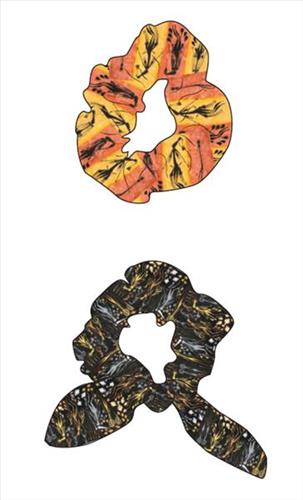
Make it Real Scrunchie Set by Gemma Unghango
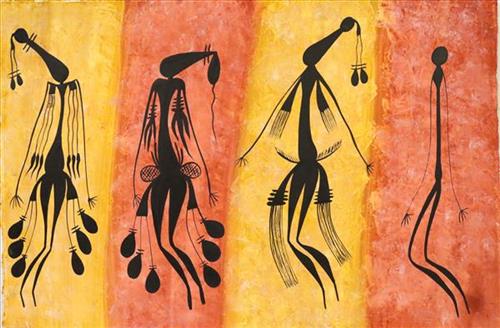
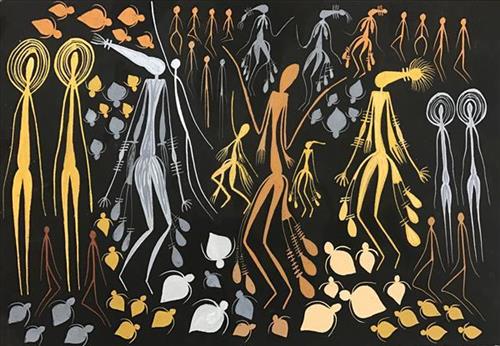
Artwork 1 (Black) : Dancing People
Dancing and ceremony, teaching the younger generation. The Kira Kiro dance with Ero Uru of the Kulari people, the Saltwater people. The small Jimi Warlay are the good spirits that look after you in the bush. The Ancestors lived in the bush, long time ago, and still walk with us on the land.
Artwork 2 (Yellow & Red) : Kira Kiro Gather to Celebrate Family.
The Kira Kiro gather in large family groups to celebrate with dancing and singing. These gatherings are also to teach the younger members of the family about hunting, bush tucker food, what are the best seasons to collect various foods. For example, the yam and bush potato are collected at the end of the wet season as the weather begins to get hot and dry.
————————————————————————————————–
Make it Real
Make it Real is a project delivered through the Aboriginal Art Centre Hub of Western Australia (AACHWA). As a not-for-profit Aboriginal organisation, our profit story ensures the artist receives the economic benefits of their shared generational stories and culture. When an artist thrives, their community also benefits.
The profits generated from this product give 90% back to the artist and 10% back to their art centre.
*The way profits are distributed can vary, and we ask consumers to be mindful of this when buying Authentic Indigenous Art or products.
The profits generated from this product give 90% back to the artist and 10% back to their art centre.
*The way profits are distributed can vary, and we ask consumers to be mindful of this when buying Authentic Indigenous Art or products.
————————————————————————————————–
22024001187
Status: Stock
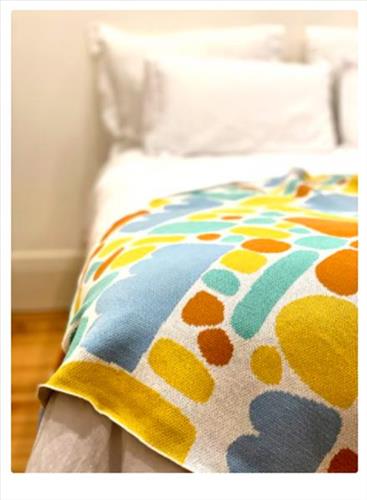
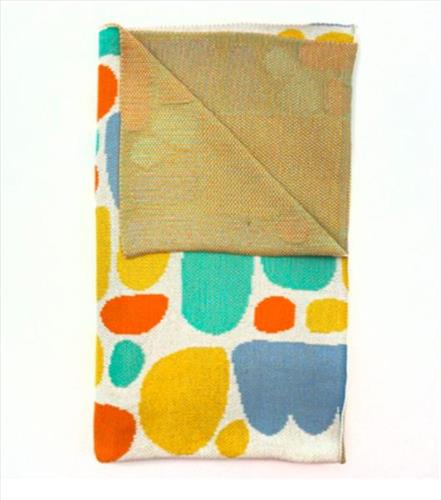
Puli Puli Baby Blanket (Teal and Yellow)
This beautiful baby blanket features Keturah Zimarn’s artwork, ‘Puli Puli Rocks’, and has been made by our ethical partners, Better World Arts.
The ancient Australian landscape with it’s eroded forms and organic shapes provides motivation for Keturah’s art. In this work Keturah depicts the natural rock formations (puli) found in and around Haasts Bluff.
221382400532
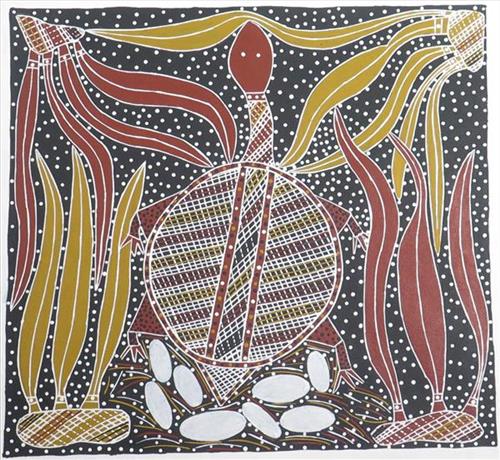
Turtle Nest
The turtle is in the billabong with it’s eggs – they are all hidden in the grasses. There are waterlilies and bubbles.
Djilpin Arts is a not for profit Aboriginal Corporation that promotes the maintenance, development and transmission of traditional cultural knowledge systems.
For two decades, Djilpin Arts has been working on country with kin and culture, across generations. Our activities are rich in spirit, bringing, healing to the community and linking traditional knowledge with modern enterprise. Our Centre features galleries, museum collection and award winning accommodation for visitors.
Meet local people and artists, learn about traditional life and culture, browse and buy artworks, stay with us and experience seasonal cultural events, tours and immersions.
All artworks are made by local artists living in the community. Artwork reflects the traditional songs and stories that have been passed down through the generations with a contemporary edge: from paintings, prints, fibre art, carvings and dijeridu together to contemporary design prducts and fine woven wire jewellery.

221382400800

Woven basket
Fibre Art is an ancient Aboriginal women’s craft that is still made today using the same techniques as their ancestors. Making fibre art is labour intensive and much care and fine needlework is required to ensure the finished object is both functional and beautiful. Fibre art from Ghunmarn Culture Centre includes dilly bags, floor mats, bush fans, woven creatures found in the landscape, plants such as yams (bush potato), baskets, place mats, and spirit figures such as mermaids and Mukuys. Natural pandanus fibre (Mukarra), is used to make much of the fibre art produced by the artists of Djilpin Arts. Women collect the pandanus by pulling from the top of the pandanus tree, then stripping and drying the leaves before they are dyed with natural bush colour collected from the Beswick surrounds.