111582396399


Bush Medicine

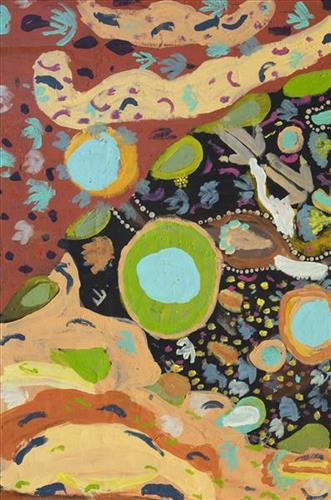
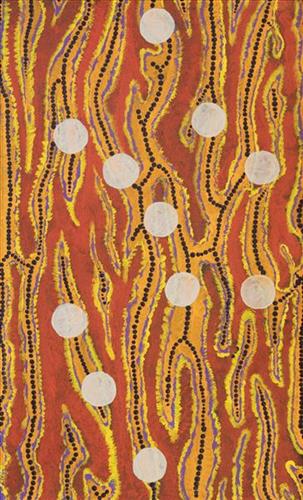
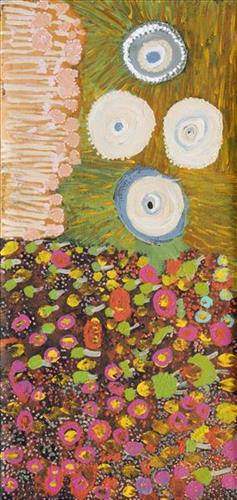
Traditional Martu knowledge of plant properties was encyclopedic, and saw plants used for purposes as diverse as food resources, carving implements, tobacco, firewood, shelter construction, and bush medicines. Depicted in this work are types of bush medicines, their habitats, and the processes used in their preparation. 

Physical ailments treated with plant based poltices, body washes, drinks, rubs and pastes included fever, congestion, headache, skin sores, aching limbs, and digestive problems. More serious health issues were often treated with a combination of bush medicine and maparn (magic healing/ healer).

Plants still prepared to make bush medicines today include warlji (desert bloodwood), kalpari (Dysphania Kalpari) and nayju (green crumbweed), which can be soaked in a water solution to make a skin wash. One of the most popular types of bush medicine still used today is wanta (red sap), collected from the mijarrpa (bloodwood) tree and brewed as a tea to ease heart pains and other body aches.

111582396395


Untitled

“The old people, they sit down and paint and tell stories of the old days, and we listen and learn.”

– Corban Clause Williams

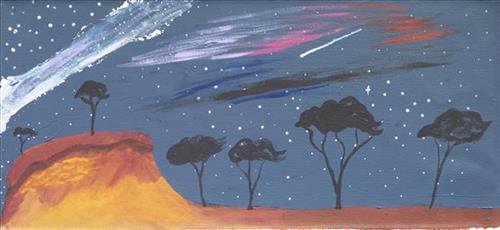
Transfer of cultural knowledge through visual arts is an important way for Martu artists to keep their culture strong. Younger Martu artists typically begin painting with their parents, grandparents and extended family, thus fostering an organic process of learning, not only about painting techniques, but also specific locations, family histories, traditional ways of life, bush tucker and Jukurrpa (Dreaming). Martu artists also often paint together where a story of mutual significance is conveyed, and in this way have produced many of the stunning, large scale collaborative works for which Martumili Artists are most well known.

111582396363


Kulyakartu

“My Country, Kulyakartu. I grew up there, from little boy to big boy grew up there.”

 – Muuki Taylor

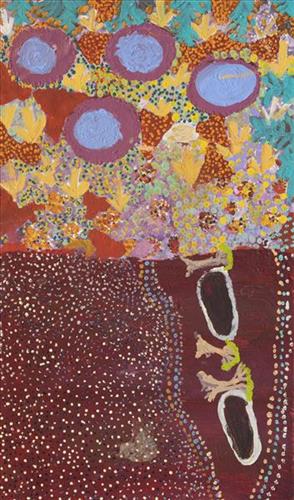
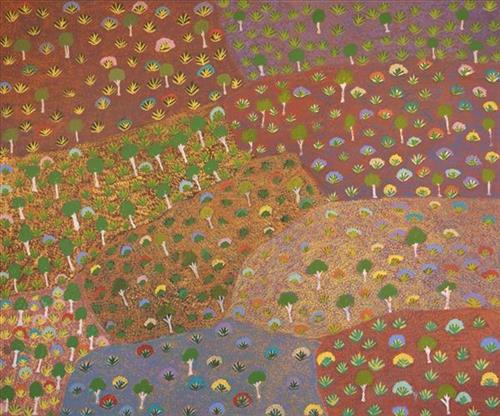
This painting depicts Kulyakartu, Muuki’s ngurra (home Country, camp). Kulyakartu is located in the far north of the Martu homelands, near the Percival Lakes region of Western Australia’s Great Sandy Desert. Muuki has extensive knowledge of the Country in this region, where he grew up living traditionally during the pujiman (traditional, desert dwelling) days with his family. Kulyakartu is mostly grass Country where there is very good hunting. In particular parnajarrpa (goanna), wild cats, and lunki (witchetty grub) are found in abundance here. There is no permanent water source in Kulyakartu, so Muuki’s family would walk here annually following the wantajarra (wet season). During the yalijarra (hot, dry season) they would head south again to more permanent water.

Muuki paints Kulyakartu in all its different seasonal stages. Often visible in his work is the patchwork nature of regrowth subsequent to the practice of waru (fire) burning that assists with hunting, regenerates growth, and encourages greater diversity in plant and animal life. This mosaic patterning is aligned with the five distinct Martu cyclical phases of burning and regrowth. First is nyurnma (freshly burnt Country) when Muuki is “making waru”. Following nyurnma are the rains and subsequent waru-waru, when young, bright green plants start to grow. Nyukura occurs between one and three years after burning, when plants have matured and are fruiting and seeding. Manguu is “when him finished”, four to six years post burning, and when spinifex has matured to the point that it can be burned once again. Finally, kunarka signifies the time when spinifex and other plant species have become old growth, and pose a risk of destructive bushfires.

111582396400


Puntawarri

“All around is sandhills and lakes on every side. You can see the grass, but the lakes are all dry. In the middle is Puntawarri waterhole. That’s the jila (snake) place, two jila. They nyupa (spouses), they darlings, man and woman. They sleeping near to Puntawarri. It’s a hole in the ground- that jila will come out of the ground and all the dust will go everywhere. All the dust going everywhere, the dust that flies up when the jila flies up out of its hole. The jila isn’t in that place anymore. It’s gone now but that jila used to stop there.” 

 – Helen Dale Samson

Puntawarri is an important cultural area located on the middle stretches of the Canning Stock Route and east of the Jigalong Mission (now Jigalong Aboriginal community). It is also the site of an abandoned community, a waterhole, creek and lake. Puntawarri’s close proximity to Jigalong Mission made it a popular site for Martu to visit during the ‘mission days’. Dale was born at Jigalong Mission, and continues to live in the community now located there today. Though she grew up in the dormitory at Jigalong, she spent her weekends and holidays in the bush, camping at sites such as Puntawarri with her extended family. Once married, she lived around Puntawarri, walking and hunting in the surrounding Country.

For many Martu, like Dale’s family, Jigalong Mission was the site where their pujiman (traditional, desert dwelling) lifestyle came to an end from the late 1940s as they transitioned to a life as stockmen and women working in cattle stations in the Pilbara region and beyond. In the wake of the extreme and prolonged drought of the 1960s, the last of the remaining pujimanpa (desert dwellers) were forced to move to missions like Jigalong, where a supply of food and water was assured. There, many Martu were reunited with family members that had already moved in from the desert.

The waterhole at Puntawarri is said to be populated by several kinds of ancestral jila, as referred to by Dale in her account. However the site is best known for its association with the Ngayurnangalku, fearsome ancestral cannibal beings. During the Jukurrpa (Dreaming) the Ngayurnangalku came together from all over the desert, first stopping near Puntawarri on their travels to Kumpupirntily (Kumpupintily, Lake Disappointment). At Kumpupirntily, they had a big meeting to debate whether or not they would continue to live as cannibals, and eventually came to the decision to stop eating people. That night, a female baby cannibal was born to the eastern Ngayurnangalku on the red sandhills at Puntawarri, where she continues to live today as the ‘big mummy’ Ngayurnangalku. Following protocol, the baby also had to be consulted by the group. She determined that the Ngayurnangalku should continue to eat people. Her decision divided the group, and from this point the group from the east continued to live as ‘bad’ cannibals at Kumpupirntily, while the group from the west became ‘good’, thereafter consuming only animals.

111582396397


Karlamilyi

“This Karlamilyi area, big land. That’s a ngurra (home Country, camp) belonging to our old people, Warnman people. We talk for our land, our jila (snake). I grew up in this Country, my Country. This land belongs to our father. In pujiman (traditional, desert dwelling) days I walked around here, used to walk up and down tuwa (sandhill) and back to the main camp belonging to Martu. 

That river running through, he called Pirnpi. Whitefella way is Rudall River. There’s a bird, karuwarlkun (kookaburra), flying and singing everywhere in the Rudall River there. The river is flowing to Lake Dora, it has five waterholes in the river system. Outside of the river are creeks and gullies, the salt lake, Lake Dora, and the sand dunes.

There’s a claypan there too, big claypan, close to Walirrlirri. Pangkartal we call him. There’s a big rain there, rain time. Fill him up water when the rain time comes. Snake living there in Pangkartal, big one. He [the snake] going to listen to the owner of the land. When we sing out to him in a Warnman way, we tell him “Stop, don’t get cheeky. We coming in [to the land].” He not cheeky, he a good one. Quiet snake.

At Nyayartakujarra (Ngayarta Kujarra, Lake Dora), [in the north east of the region,] two snakes been killed. Right here they got crook in the Dreamtime. All the men, Ngaanyatjarra and Warnman, they were singing. One young fella, he threw a spear into the snake. That snake felt something there, got killed and burned.

[West of Nyayartakujarra is] Yanytikuji, red hill over there. They working, doing the mining there now [at Yandicoogina Mine]. Next to Yanytikuji is a big claypan, Yalpalpa, main camp and a water. That’s a hunting place. Plenty of bush tucker round there; kanyjamarra (yam, bush carrot), like a carrot growing in the ground in the river bed there. You pull it out, just like a carrot! Lunki (witchetty grub), and jatarrpa, that’s like a seed, you gotta clean him up and grind it to make a flour wheat, make a damper in the waru (fire). We gonna get that seed and show you fellas. Minyarra (bush onion) there, and ngaputa (sweet, patterned green melon), they all grow in the river banks.

In the middle is Putarrluu, a yinta (permanent spring) where there are two snakes, a man and a woman snake. They are nyupa (partners), they stop here, it is their yinta. You can’t camp right at the big yinta because of the snakes. You have to get your water from the little soak. When we want to get water we talk to the snakes in Warnman, their language, and the snakes send the water to them.  

This one Wartararra area, [south of Yanytikuji,] but you can’t go through there. This one Pulikati [Hill] area, we used to go through a gap here. There is quicksand here. People don’t go there. We used to sing out for this water, from this side. The old people used to sing out to “Come on, send the water for me.” You can’t go through there, quicksand, not allowed.

Tintinmarran, bottom end of Rudall River [and southeast of Pulikati. There is a januku (waterfall) there, a big yapu (hill), two tuwa (sandhills), and jawirli (quondong) trees. All of the rivers run down through Tintinmarran before joining Rudall River. After all the kapi (water) joins the Rudall River it runs to Warnanjarra where it disappears underground and goes all the way up north to Derby.

I [Jatarr Lily Long] was born there in Karlamilyi River, that’s my Country. [I was born in] Jatarrngara, that’s the name for the place and that’s my name. That’s the living water place.

We are Warnman ladies, painting Kintyre and Karlamilyi. We can share this Country.”

 –Sisters Wurta Amy French and Jatarr Lily Long

Karlamilyi (Rudall River) is Warnman Country, located in the very heart of the Martu homelands. The Karlamilyi region is ngurra for sisters Wurta Amy French and Jatarr Lily Long. They travelled and camped extensively around this area with their family in their youth, and possess a great deal of knowledge of the region’s physical elements, resource distribution, and Jukurrpa (Dreaming) narratives.

The region is situated southwest of the Great Sandy Desert and northeast of the Little Sandy Desert. Spanning through the region is the epic Karlamilyi River, which runs north into Nyayartakujarra (Ngayarta Kujarra, Lake Dora), a large salt lake. The Broadhurst and Fingoon Ranges extend diagonally across the river’s path. The landscape is striking for its abundance of gorges and valleys carved by ice age glaciers, rugged cliffs, red tali (sand dunes), grasslands, sandstone and quartz rocky outcrops, and salt lakes. 

Across the whole region are hundreds of water sources; including waterholes, creeks, soaks, lakes, pools and rockholes. Lining the rivers are coolabah, walyji (river gum), yulbah (bats wing coral tree), and several species of acacia and hakea. Jalkuran (paperbark), kurrulyu/ mijarrpa (bloodwood) and jawirli (quandong) are found in the region’s valleys, and wikirrpa (desert oaks) and grasses in the sandplains. The area is abundant with bird species, jila, maruntu (goannas), red kangaroos and warlpaju (rock wallabies). The region is also home to remote aboriginal communities Punmu and Parnngurr.

According to two of the central Martu Jukurrpa narratives, the Karlamilyi River and its surrounds were created by the ancestral beings Jila Kujarra (Two Snakes) and the Wati Kujarra (Two Goanna Men) as they travelled across the lands.

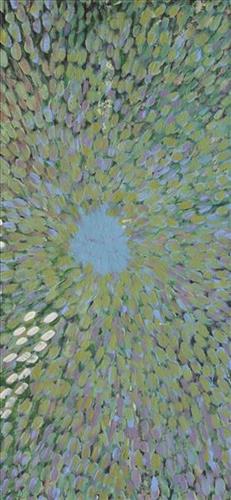
111582396391


Untitled

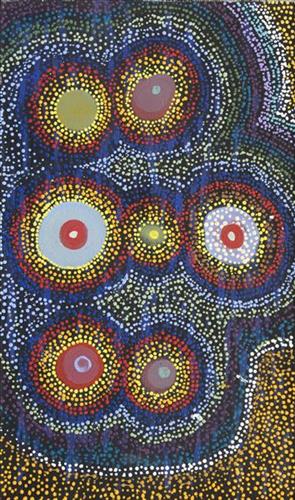
Martumili Artists work with over three hundred artists from remote Martu Aboriginal communities, including Punmu, Parnngurr, Kunawarritji, Jigalong, Irrungadji (Nullagine), and Warralong, as well as from the Parnpajinya (Newman) gallery and studio spaces. Known for their diverse, energetic, and unmediated painting styles, their works reflect the dramatic geography and scale of their homelands. Each artist, however, brings a unique approach to their craft.

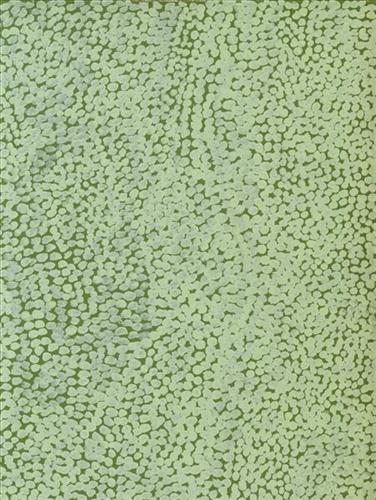
Younger Martu artists often start painting alongside their parents, grandparents, and extended family, which fosters an organic learning process. This not only involves mastering painting techniques but also understanding specific locations, family histories, traditional ways of life, bush tucker, and Jukurrpa (Dreaming). Over time, with encouragement from their peers, they develop their own distinct styles and explore unique painting techniques and subject matter. In this work the artist brings a contemporary, evolving perspective to their work.

111582396382


Untitled

Martumili Artists work with over three hundred artists from remote Martu Aboriginal communities, including Punmu, Parnngurr, Kunawarritji, Jigalong, Irrungadji (Nullagine), and Warralong, as well as from the Parnpajinya (Newman) gallery and studio spaces. Known for their diverse, energetic, and unmediated painting styles, their works reflect the dramatic geography and scale of their homelands. Each artist, however, brings a unique approach to their craft.

Younger Martu artists often start painting alongside their parents, grandparents, and extended family, which fosters an organic learning process. This not only involves mastering painting techniques but also understanding specific locations, family histories, traditional ways of life, bush tucker, and Jukurrpa (Dreaming). Over time, with encouragement from their peers, they develop their own distinct styles and explore unique painting techniques and subject matter. In this work the artist brings a contemporary, evolving perspective to their work.

111582396361


Untitled

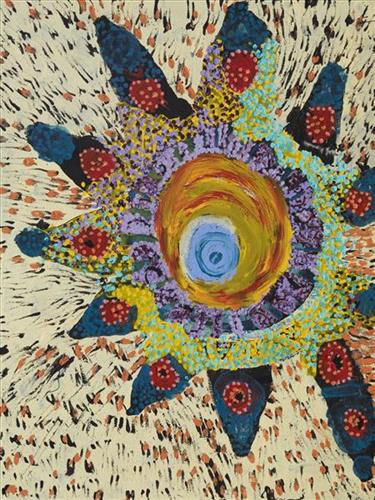
This work portrays an area known to the artist, painted here from memory. During the pujiman (traditional, desert dwelling) era one’s survival depended on their intimate knowledge of the location of resources; thus physical elements of Country, such as sources of kapi (water), tali (sandhills), and different varieties of warta (trees, vegetation) were carefully observed and remembered. Today, this relationship with Country remains equally strong, despite the movement of Martu out of the desert and into remote Aboriginal communities, towns and cities.

Also visible may be traces of life cycles based around kalyu (rain, water) and waru (fire). A thousands of year old practice, fire burning continues to be carried out as both an aid for hunting and a means of land management today. As the Martu travelled and hunted they would burn tracts of land, ensuring plant and animal biodiversity and reducing the risk of unmanageable, spontaneous bush fires. The patchwork nature of regrowth is visible in many landscape works, with each of the five distinctive phases of fire burning visually described with respect to the cycle of burning and regrowth.  

Finally, metaphysical information relating to a location may also be recorded; Jukurrpa (Dreaming) narratives chronicle the creation of physical landmarks, and can be referenced through depictions of ceremonial sites, songlines, and markers left in the land. 

111582396346


Puntawarri – Helen Dale Samson

“All around is sandhills and lakes on every side. You can see the grass, but the lakes are all dry. In the middle is Puntawarri waterhole. That’s the jila (snake) place, two jila. They nyupa (spouses), they darlings, man and woman. They sleeping near to Puntawarri. It’s a hole in the ground- that jila will come out of the ground and all the dust will go everywhere. All the dust going everywhere, the dust that flies up when the jila flies up out of its hole. The jila isn’t in that place anymore. It’s gone now but that jila used to stop there.” 

 – Helen Dale Samson

Puntawarri is an important cultural area located on the middle stretches of the Canning Stock Route and east of the Jigalong Mission (now Jigalong Aboriginal community). It is also the site of an abandoned community, a waterhole, creek and lake. Puntawarri’s close proximity to Jigalong Mission made it a popular site for Martu to visit during the ‘mission days’. Dale was born at Jigalong Mission, and continues to live in the community now located there today. Though she grew up in the dormitory at Jigalong, she spent her weekends and holidays in the bush, camping at sites such as Puntawarri with her extended family. Once married, she lived around Puntawarri, walking and hunting in the surrounding Country.

For many Martu, like Dale’s family, Jigalong Mission was the site where their pujiman (traditional, desert dwelling) lifestyle came to an end from the late 1940s as they transitioned to a life as stockmen and women working in cattle stations in the Pilbara region and beyond. In the wake of the extreme and prolonged drought of the 1960s, the last of the remaining pujimanpa (desert dwellers) were forced to move to missions like Jigalong, where a supply of food and water was assured. There, many Martu were reunited with family members that had already moved in from the desert.

The waterhole at Puntawarri is said to be populated by several kinds of ancestral jila, as referred to by Dale in her account. However the site is best known for its association with the Ngayurnangalku, fearsome ancestral cannibal beings. During the Jukurrpa (Dreaming) the Ngayurnangalku came together from all over the desert, first stopping near Puntawarri on their travels to Kumpupirntily (Kumpupintily, Lake Disappointment). At Kumpupirntily, they had a big meeting to debate whether or not they would continue to live as cannibals, and eventually came to the decision to stop eating people. That night, a female baby cannibal was born to the eastern Ngayurnangalku on the red sandhills at Puntawarri, where she continues to live today as the ‘big mummy’ Ngayurnangalku. Following protocol, the baby also had to be consulted by the group. She determined that the Ngayurnangalku should continue to eat people. Her decision divided the group, and from this point the group from the east continued to live as ‘bad’ cannibals at Kumpupirntily, while the group from the west became ‘good’, thereafter consuming only animals.

220982396470


Rita Pitjara Beasley – My Father’s Country

“This is my Father’s country.

This place is our hunting place. I always go with my daughters and their children, I show them this place and teach them about the swampy country. We hunt for goannas, bush potato, bush tomato and after the big rain the bush medicine is picked and the roots are dug up to be used.

It is important as my mother taught me this and now I teach my family.”

The community of Ampilatwatja made a conscious decision not to paint altyerr (dreaming stories). The artists paint their country where those stories sit.