111982412250


Mimih Spirit

The mimih spirit exists in a realm that runs parallel to and mirrors many facets of human life, demonstrating the deep sense of time and place understood by Aboriginal and Torres Strait Islander people. Such spirits feature importantly in relation to Aboriginal spirituality, cosmology, social and moral tales as well as ritual. As is true with the multiple mediums employed by artists of West Arnhem Land, the development of artistic style and form is in line with an awareness by the artist that the work produced is predominantly made for a broader audience. Whether shown in a national or international context these works communicate and exist in a particular space that is cross-cultural and simultaneously particular to the Arnhem region.

The mimih sits within a complex pedagogical and religious body of knowledge which links Kuninjku people to their distinctive escarpment homelands. Young Kuninjku artists, or apprentices, employ the mimih as an important exercise for the practice of the rarrk technique, as it could be achieved on a smaller surface area before being attempted in larger scale on pieces of bark. The mimih serves a purpose for those young artists first learning to carve in a social space of sharing and innovating. The initial mimih manifestation was a large form that almost mirrored the anatomy of a human and at this stage the sculptures have been likened to mokuy carvings visible in eastern Arnhem Land. Contemporaneously, mimih are depicted in a refined, slender, even emaciated form with a broad range of facial expressions giving both individual character to, and denoting the potential volatility and humour that mimih spirits are notable for in their interaction with bininj (humans). The sculptures are frequently carved from the thin trunks of softwoods such as kapok (bombax ceiba or cottonwood) kurrajong, beach hibiscus or leichardt and are painted with earth pigments for their colouring and design.

A leading figure engaging the spirit in visual storytelling was Crusoe Kuningbal, a Kuninjku man, who while traveling was familiarised with carving styles from the east of Arnhem at the mission in Milingimbi pre-dating World War II. The connection and development of art forms informed by cross cultural dialogues within northern Aboriginal language groups is notable. The mimih became a valued inclusion in performance and public ceremony by Kuninjku people like Kuningbal. At times these ceremonies were performed for extended language groups in the local region. 

Now a familiar and broadly depicted figure of iconography, it is important to acknowledge the development of this quite recent sculptural tradition. The depiction of this particular spirit being, once used as an addition to the sharing of song cycles and ceremony, has since been elevated to a prominent form and subject of contemporary sculpture. Variation in the creation of mimih acts as an indication of the individualism of each artist and their stylistic markers. Additionally significant to note is that in the space of the past thirty years the mimih has begun being produced by multiple language groups residing in the Maningrida area including the traditional owners of Maningrida, the Ndjébbana, speaking Kunibidji as well as Gurrgoni people who have strong ties to Kuninjku. 

________
*Maningrida Arts & Culture acknowledge the work of many academic and non-academic voices when writing on this topic, it is important to note Luke Taylor, who’s broad research has informed this text.

111982412249


Mimih Spirit

The mimih spirit exists in a realm that runs parallel to and mirrors many facets of human life, demonstrating the deep sense of time and place understood by Aboriginal and Torres Strait Islander people. Such spirits feature importantly in relation to Aboriginal spirituality, cosmology, social and moral tales as well as ritual. As is true with the multiple mediums employed by artists of West Arnhem Land, the development of artistic style and form is in line with an awareness by the artist that the work produced is predominantly made for a broader audience. Whether shown in a national or international context these works communicate and exist in a particular space that is cross-cultural and simultaneously particular to the Arnhem region.

The mimih sits within a complex pedagogical and religious body of knowledge which links Kuninjku people to their distinctive escarpment homelands. Young Kuninjku artists, or apprentices, employ the mimih as an important exercise for the practice of the rarrk technique, as it could be achieved on a smaller surface area before being attempted in larger scale on pieces of bark. The mimih serves a purpose for those young artists first learning to carve in a social space of sharing and innovating. The initial mimih manifestation was a large form that almost mirrored the anatomy of a human and at this stage the sculptures have been likened to mokuy carvings visible in eastern Arnhem Land. Contemporaneously, mimih are depicted in a refined, slender, even emaciated form with a broad range of facial expressions giving both individual character to, and denoting the potential volatility and humour that mimih spirits are notable for in their interaction with bininj (humans). The sculptures are frequently carved from the thin trunks of softwoods such as kapok (bombax ceiba or cottonwood) kurrajong, beach hibiscus or leichardt and are painted with earth pigments for their colouring and design.

A leading figure engaging the spirit in visual storytelling was Crusoe Kuningbal, a Kuninjku man, who while traveling was familiarised with carving styles from the east of Arnhem at the mission in Milingimbi pre-dating World War II. The connection and development of art forms informed by cross cultural dialogues within northern Aboriginal language groups is notable. The mimih became a valued inclusion in performance and public ceremony by Kuninjku people like Kuningbal. At times these ceremonies were performed for extended language groups in the local region. 

Now a familiar and broadly depicted figure of iconography, it is important to acknowledge the development of this quite recent sculptural tradition. The depiction of this particular spirit being, once used as an addition to the sharing of song cycles and ceremony, has since been elevated to a prominent form and subject of contemporary sculpture. Variation in the creation of mimih acts as an indication of the individualism of each artist and their stylistic markers. Additionally significant to note is that in the space of the past thirty years the mimih has begun being produced by multiple language groups residing in the Maningrida area including the traditional owners of Maningrida, the Ndjébbana, speaking Kunibidji as well as Gurrgoni people who have strong ties to Kuninjku. 

________
*Maningrida Arts & Culture acknowledge the work of many academic and non-academic voices when writing on this topic, it is important to note Luke Taylor, who’s broad research has informed this text.

111982412248


Ngalkodjek Spirit Pole

Transcription of text by Jack Nawilil about two ceremonial objects— Karlanj and Ngalkodjek. Transcribed by Murray Garde and Margaret Carew 2 & 5 December 2017. Notes by Margaret Carew on 5 Dec 2017


Note: The site Jack refers to as Kœnœdjangka is in the Rembarrnga language. The ‘œ’ vowel sounds like the ‘ur’ in English ‘fur’. As this vowel does not exist in neighbouring languages, it is usually converted to an ‘i’ as Kinidjangka by Kuninjku and Burarra speakers. I have used that spelling also in the English translation but retained Kœnœdjangka in the transcription of Jack’s speech. Jack’s speech involves code switching amongst Kriol, Kune, Burarra and English.


[00:00:01] This one here, like ngaye ngakurrmeng, im my draw.


This one here [ceremonial objects], I have drawn my own personal designs on them.


[00:00:09] This one Ngalkodjek.


This one (is called) Ngalkodjek. (MG- note, that this is not the subsection term Ngalkodjok, rather the stem -kodjek is formative in the verb -kodjekmang ‘to abduct’ and may refer to a secret episode in the Nakorrkko story, the father and son cultural heroes for Bininj in western Arnhem Land).


[00:00:13] Daluk, im from Elcho im bin travellng, im from Elcho, gama ngarla, jiny-bona didjan na, and didjan du.


This represents a woman, she travelled (here) from Elcho Island, she is from Elcho, she was a woman indeed, she went/travelled, this one and this one too.


[00:00:27] Didjan najawan, didjan na.


This is another one however, this one.


[00:00:30] Shemaiah: Those two are the same story?


[00:00:33] Same story this mob but I’ll bringim next week. I’ll bring another one.


[00:00:39] This one here, an-nerranga, an-guna balaji, mun-anngiya langa djolworra kantri, im from gun-anngiya, im from like im 


This one here, this is a different one and represents a food plant, what’s its name (that tucker), it is from the saltwater country, from this way, like, it’s from what’s that place


(MC comment: -anngiya is a ‘what’s its name’ word, that inflects for noun class.)


[00:01:05] In my country where that Kœnidjangka way. Didjan na.


In my country there at Kinidjangka. This one here.


[00:01:09] Yo an-guna. Yo Murray, Murray im save, marn.gi.


This one. Murray knows about this.


[00:01:19] Yo, Murray ngudda yibengkan ngayi ngarduk nani Murray. From Kœnidjangka ngamarnbom.


Murray you know this one, it’s my design Murray. I made it, the one from Kinidjangka.


[00:01:28] En nani Kœnidjangka ngamarnbom, en nani kuluban kayo kure Nakorrkko wam. Nani ngamarnbom. Ungke nane ngamarnbom that story ngarduk na. Ngakurrmeng ngaye. Ngudda yibengkan. Kanmarnebengkan Bulanj. Yoh.


This one I made it, the design from Kinidjangka, the place where flying foxes live where the Nakorrkko passed through. I made that. I’ve made that story for you, that one of mine. I have put it there. You know that. You know what I’m talking about Bulanj (to Murray Garde).


[00:01:51] Didjan, nane, dijan gama i bin travelling garra didjei, garra didjei.


This one here, she is a woman who travelled this way, coming this way (to the west from north-east Arnhem Land).


[00:02:03] Im gona garra ebrijing. From Kunidjangka i bin make it. From Kœnidjangka ngamarnbom en nani Kœnidjangka ngamarnbom. En dijan Kœnidjangka ngamarnbom. Nane now.


She has many things. I made it, the one from Kinidjangka. From Kinidjangka I made it. It is from Kinidjangka, this thing i have made. That’s it now.


[00:02:25] Ngarduk my draw nane. Like ngamarnbun, like im nomo marrek ba morning star, im different nani. ngardapa ngardapa ngarla dreaming. Mu-gurrmurra, yo a-gurrmurra a-bona. Wangarr ngarla.


This design belongs to me. Like, I made it, and it should not be confused with a morning star pole, no, it is something different. they are separate indeed, these dreamings. It (an ancestral spirit) put it there. It is my totemic emblem. It is my ancestral design of the ancestral beings, indeed.


MC note: 

mu-gurrmurra

00:02:44.460 – 00:02:45.310

it put it (object belongs to mun- vegetable noun class)

00:02:44.460 – 00:02:45.310

a-gurrmurra a-bona

00:02:45.310 – 00:02:47.928

it put it (object now belongs to an- masculine noun class). a-bona here literally means ‘it (masculine) went’ but functions as an aspectual auxilliary, showing that the action is completed. Tense suffixes construe this in the past.


Shemaiah responds: yo gun-burral

00:02:49.570 – 00:02:51.155

yes that’s true

00:02:49.570 – 00:02:51.155


[00:02:53] Dijan, dijan, im from dijei na, from Elcho. mm dijan.


This one, its origins are from this way (the east), from Elcho, mm, this one.


[00:03:00] gama


a woman


[00:03:02] Shemaiah: Ngay ngay ngay


yeah yeah yeah


[00:03:05] Dijan, im daga ia la Kœnidjangka. Balajiya. But im Mardayin. Bad ai jas putumbat eniwe yuno?


This other one is an edible plant. Food. But it is a sacred thing from the Mardayin ceremony. But I have adapted it to make it a secular version.


MC note: balajiya – note emphasis -ya final syllable.


@Shemaiah: balaji murda

00:03:09.370 – 00:03:10.530

food this one

00:03:09.370 – 00:03:10.530

murda is a contracted demonstrative (from mun-narda), ‘this one in focus’ compare arda, jirda, gurda, other noun class inflected forms. These contracted demonstrative forms are a feature of modern Burarra. 

00:03:09.370 – 00:03:10.530


[00:03:19] Dijan na. Dijan, dijan mun-anngeyo balaji gen


This one. This is also a food.


[00:03:27] Shemaiah: balaji?


Food?


[00:03:28] Yo im my country igen bad awirri-gapajinga ngarla. We digim and karrimang. We eatim na, dijan na. 


Yes, in my country, we dig it, but has a secret element to the story. We dig it and take it out. Then we eat it, this thing.


MC note:

The transitive prefix awirri- (~abirri-) reads to me as ‘you and me plus one more’, ie inclusive unit augmented. If plural/augmented we’d expect mbi-gapajinga ie third person augmented acting on singular object, where there is noun class agreement with the object. If just ‘you and me’ is intended it would be ay-gapajinga. Quite commonly unit augmented prefixes are used in generic statements such as this, where one might expect another prefix going from the speech or discourse context.

00:03:29.960 – 00:03:31.565


[00:03:42] Like ngakurrmeng namekke Murray, Bulanj, nane Ngalkodjek wam from aa kure kamdolkkang from aam, Elcho.


So, Murray, that’s what I’ve put on it (the design). This is Ngalkodjek who travelled, setting out from Elcho Island.


[00:03:58] Ngamarnbom. Nabuyika nane, ngamarnbom manme rerri. Manme ngamarnbom, mane manme kangeydi manbingkanj.


I made it. The other one, I also made that one too. I made the plant food emblem, and the name of that plant is manbingkanj.


[00:04:16] Nane, nane ngamarnbom karlanj ngamarnbom, manme rerrih. Nane na Kœnidjangka ngamarnbom. Ngaleng nani, ngaleng Elcho kamwam daluk. Dijan na.


This thing here, I made it, this object is called karlanj and it represents a plant food. This one I have made is from Kinidjangka. She is a woman who came from Elcho Island. This one now.


[00:04:34] Im from long way dijan i bin travelling, from Elcho, (kala xxx ) like yu nomo save… yuno that, daluk, blanga im business, garra dijan i bin travelling. Yo. Dijan ia im mine dijan. Nane ngarduk rowk Bulanj, namekke draw namekke recordim ngayeman ngangeykurrmehkurrmeng nane.


She was travelling a long way, from Elcho Island (…..) like, you don’t know that story (it’s secret)… you know it related to a woman, it was her ceremonial story, and she was travelling. This thing here is my (clan) design. These are all mine Bulanj (to Garde) and what I have drawn, it’s being recorded now and I’m explaining all the names relating to it.


[00:05:03] Nane Ngalkodjek daluk, nane manme karlanj en nane mak, njamed, um. Karlanj manih manbu. Mak mane manbuyika, djal manbuyika yerri.


This woman, her name is Ngalkodjek, and this is the food, the karlanj, and this whatsit, um. Karlanj, that’s it. And there is another one but it is different again.


[00:05:24] Manbu rerri kayime wanjh mani nawu.


It is similar again, this one here.


[00:05:26] Ngamarnbom.


I made them.


[00:05:28] Ungke Murray. Kaluk yibekkan yingan kumekke mankarre yimarnbun. Yo namekke. Ma, thank you.


This (recording) is for you Murray (to transcribe for the art and cultural centre). You can listen to it and document the cultural story. That’s it. Okay, thank you.

111982412247


Man-ngalinj (bush potato)

Man-ngalinj is a root vegetable often described as ‘bush potato’. It’s duwa, the artist’s moiety. It has a bulbous root and a long thin vine with small flowers that grows across the ground or up the trunks of nearby trees. Large crops can be found near the artist’s outstation, Bolkdjam. Man-ngalinj are harvested after the Wet season in the early Dry

111982412246


Gomarla (Egret bird)

The artist has carved the ‘Gomarla’, which in the Burarra word for Egret. This bird is native to the country of Yilan, which is the coastal region North West of Maningrida Community. 

People use feathers from gomarla to make ceremonial regalia for Yirrichinga. Many Yirrichinga groups own manikay ‘song’ for gomarla.

Gomarla mun-baparrurr Gopungorra. Jin-gubatbatcha jin-banga jiny-yorkiya. Gomarla waykin makukuya mu-guyinda.

The egret belongs to the Gopungorra clan. It always eats grasshoppers. The egret is high in a nest (builds its nest in the tree).

111582305345


Fortescue River near Newman

“When Martu paint, it’s like a map. Martu draw story on the ground and on the canvas, and all the circle and line there are the hunting areas and different waters and tracks where people used to walk, and [some you] can’t cross, like boundaries. So nowadays you see a colourful painting and wonder what it is, but that’s how Martu tell story long ago. It’s not just a lovely painting, it’s a story and a songline and a history and everything that goes with it.” 

– Ngalangka Nola Taylor and Joshua Booth

This work portrays an area of Country that can be interpreted in multiple ways. Firstly, the image may be read as an aerial representation of a particular location known to the artist- either land that they or their family travelled, from the pujiman (traditional, desert dwelling) era to now. During the pujiman period, Martu would traverse very large distances annually in small family groups, moving seasonally from water source to water source, and hunting and gathering bush tucker as they went. At this time, one’s survival depended on their intimate knowledge of the location of resources; thus physical elements of Country, such as sources of kapi (water), tali (sandhills), different varieties of warta (trees, vegetation), ngarrini (camps), and jina (tracks) are typically recorded with the use of a use of a system of iconographic forms universally shared across the desert. 

An additional layer of meaning in the work relates to more intangible concepts; life cycles based around kalyu (rain, water) and waru (fire) are also often evident. A thousands of year old practice, fire burning continues to be carried out as both an aid for hunting and a means of land management today. As the Martu travelled and hunted they would burn tracts of land, ensuring plant and animal biodiversity and reducing the risk of unmanageable, spontaneous bush fires. The patchwork nature of regrowth is evident in many landscape works, with each of the five distinctive phases of fire burning visually described with respect to the cycle of burning and regrowth.  

Finally, metaphysical information relating to a location may also be recorded; Jukurrpa (Dreaming) narratives chronicle the creation of physical landmarks, and can be referenced through depictions of ceremonial sites, songlines, and markers left in the land. Very often, however, information relating to Jukurrpa is censored by omission, or alternatively painted over with dotted patterns.

111582396131


Untitled

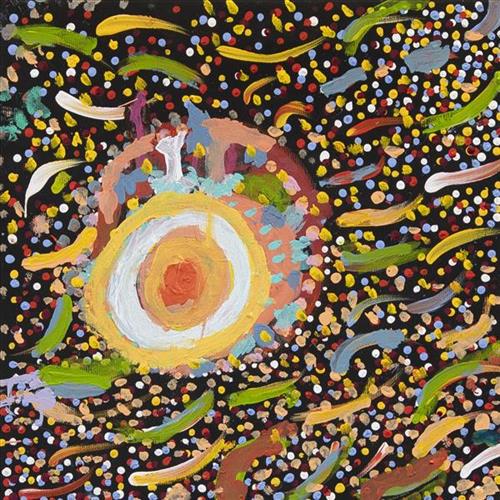
Martumili Artists work with over three hundred artists from remote Martu Aboriginal communities, including Punmu, Parnngurr, Kunawarritji, Jigalong, Irrungadji (Nullagine), and Warralong, as well as from the Parnpajinya (Newman) gallery and studio spaces. Known for their diverse, energetic, and unmediated painting styles, their works reflect the dramatic geography and scale of their homelands. Each artist, however, brings a unique approach to their craft.

Younger Martu artists often start painting alongside their parents, grandparents, and extended family, which fosters an organic learning process. This not only involves mastering painting techniques but also understanding specific locations, family histories, traditional ways of life, bush tucker, and Jukurrpa (Dreaming). Over time, with encouragement from their peers, they develop their own distinct styles and explore unique painting techniques and subject matter. In this work the artist brings a contemporary, evolving perspective to their work.

111582397511


Pimurlu – Jatarr Lily Long

“Pimurlu is a special women’s place not far from Parnngurr community. There is a rockhole here; it is a little kapi (water) up in the rocks that you have to reach down for. Dreamtime [designs] in the stone everywhere here, Dreamtime properly here. We never put them there, old people never put them there, Dreamtime put them there. This is special Warnman culture, left there in Warnman lands. All the Minyipuru (Jakulyukulyu, Seven Sisters) grannies were dancing there, beautiful!”

–  Jatarr Lily Long

Pimurlu is a rockhole and important women’s site located between Parnngurr Aboriginal community and Karlamilyi River (Rudall River). This site lies within Jatarr’s ngurra (home Country, camp), the area which she knew intimately and travelled extensively with her family in her youth. During the pujiman (traditional, desert dwelling) Pimurlu was an important Warnman campsite. Surrounding Pimurlu rockhole is a hilly, rocky area featuring circular walka (sacred designs) left by the Minyipuru in the Jukurrpa (Dreaming). These same designs are painted on women’s bodies and faces for important ceremonial dancing today. 

Minyipuru is a central Jukurrpa narrative for Martu, Ngaanyatjarra, Pitjantjatjara and Yankunytjatjara people that is associated with the seasonal Pleiades star constellation. Relayed in song, dance, stories and paintings, Minyipuru serves as a creation narrative, a source of information relating to the physical properties of the land, and an embodiment of Aboriginal cultural laws. Beginning in Roebourne on the west coast of Western Australia, the story morphs in its movement eastward across the land, following the women as they walk, dance, and even fly from waterhole to waterhole. As they travel the women camp, sing, wash, dance and gather food, leaving markers in the landscape and creating landforms that remain to this day, such as groupings of rocks and trees, grinding stones and seeds. During the entirety of their journey the women are pursued by a lustful old man, Yurla, although interactions with other animals, groups of men, and spirit beings are also chronicled in the narrative.

111582406118


Sandy Hill

“When Martu paint, it’s like a map. Martu draw story on the ground and on the canvas, and all the circle and line there are the hunting areas and different waters and tracks where people used to walk, and [some you] can’t cross, like boundaries. So nowadays you see a colourful painting and wonder what it is, but that’s how Martu tell story long ago. It’s not just a lovely painting, it’s a story and a songline and a history and everything that goes with it.” 

– Ngalangka Nola Taylor and Joshua Booth

This work portrays an area of Country that can be interpreted in multiple ways. Firstly, the image may be read as an aerial representation of a particular location known to the artist- either land that they or their family travelled, from the pujiman (traditional, desert dwelling) era to now. During the pujiman period, Martu would traverse very large distances annually in small family groups, moving seasonally from water source to water source, and hunting and gathering bush tucker as they went. At this time, one’s survival depended on their intimate knowledge of the location of resources; thus physical elements of Country, such as sources of kapi (water), tali (sandhills), different varieties of warta (trees, vegetation), ngarrini (camps), and jina (tracks) are typically recorded with the use of a use of a system of iconographic forms universally shared across the desert. 

An additional layer of meaning in the work relates to more intangible concepts; life cycles based around kalyu (rain, water) and waru (fire) are also often evident. A thousands of year old practice, fire burning continues to be carried out as both an aid for hunting and a means of land management today. As the Martu travelled and hunted they would burn tracts of land, ensuring plant and animal biodiversity and reducing the risk of unmanageable, spontaneous bush fires. The patchwork nature of regrowth is evident in many landscape works, with each of the five distinctive phases of fire burning visually described with respect to the cycle of burning and regrowth.  

Finally, metaphysical information relating to a location may also be recorded; Jukurrpa (Dreaming) narratives chronicle the creation of physical landmarks, and can be referenced through depictions of ceremonial sites, songlines, and markers left in the land. Very often, however, information relating to Jukurrpa is censored by omission, or alternatively painted over with dotted patterns.

111582406114


Untitled

Martumili Artists work with over three hundred artists from remote Martu Aboriginal communities, including Punmu, Parnngurr, Kunawarritji, Jigalong, Irrungadji (Nullagine), and Warralong, as well as from the Parnpajinya (Newman) gallery and studio spaces. Known for their diverse, energetic, and unmediated painting styles, their works reflect the dramatic geography and scale of their homelands. Each artist, however, brings a unique approach to their craft.

Younger Martu artists often start painting alongside their parents, grandparents, and extended family, which fosters an organic learning process. This not only involves mastering painting techniques but also understanding specific locations, family histories, traditional ways of life, bush tucker, and Jukurrpa (Dreaming). Over time, with encouragement from their peers, they develop their own distinct styles and explore unique painting techniques and subject matter. In this work the artist brings a contemporary, evolving perspective to their work.