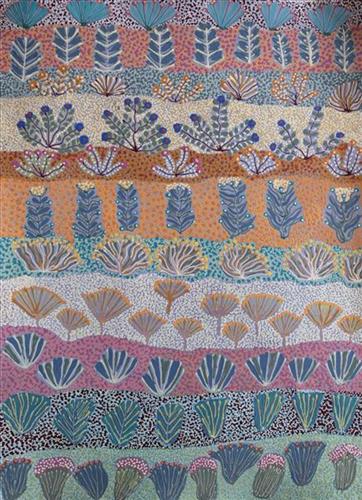
Julieanne Ngwarraye Morton – Alpeyt Alpeyt (Flowers Blooming)
Walking across my land to look for bush flowers and goanna. I bring home to make medicine for my family and cook the goanna for dinner. Goanna is my favourite to eat.
Walking across my land to look for bush flowers and goanna. I bring home to make medicine for my family and cook the goanna for dinner. Goanna is my favourite to eat.
Jarrka is the Burarra word for a species of goanna (Varanus gouldii) which are associated with a site called Ngarla Ji-bama in East Central Arnhem Land. This place is associated with a complex of other sites including: M-bucha, Ji-gurremangunyja and Mu-garlmbarl. The Ancestral being, Jarrka, travelled a long way across Arnhem Land. Many different clans have custodianship over its design and songs associated with it. On the final stage of his journey, Jarrka travelled from Miwirnbi to the south before entering the ground at Ngarla Ji-bama. The depiction of Jarrka therefore implies the artist’s ceremonial and kinship affiliations to clan and country outside of his own clan estates and thus identifies himself and his own clan in the context of a regional kinship network.
It is well known that Aboriginal art often depicts images of sacred totems or dreamings of Aboriginal culture. However, the world of the non-sacred also provides a rich source of subject matter for Aboriginal art. Much of the rock art of western Arnhem Land for example features secular topics such as common food animals and plants, depicted because of their economic importance but also merely because of their existence in the environment.
Text by Christiane Keller
We hunt the Nawarlah (Brown River Stingray) during the wet season. There is a plant with a yellow flower that tells us that it is the right time. We know it will be fat.
It is well known that Aboriginal art often depicts images of sacred totems or dreamings of Aboriginal culture. However, the world of the non-sacred also provides a rich source of subject matter for Aboriginal art. Much of the rock art of western Arnhem Land for example features secular topics such as common food animals and plants, depicted because of their economic importance but also merely because of their existence in the environment.
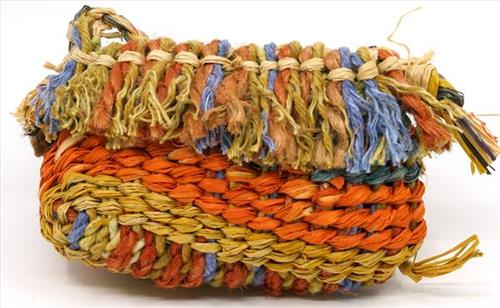
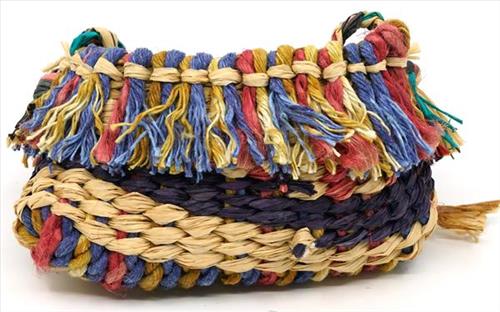
Coil basketry is a well-established fibre art form in the Maningrida region, especially for women from the Kuninjku, Rembarrnga, Ndjebbana and Nakkara language groups.
Artists make coiled baskets of many shapes and sizes, ranging from small round baskets to large oval baby baskets, and made mostly from pandanus fibre that is dyed with natural pigments. Bundles of fibre are formed into coils which are covered and stitched together with strands of fibre threaded onto a needle. Artists combine colours and patterns to obtain intricate new graphic patterns.
These techniques are believed to have been introduced to Arnhem Land by Greta Matthews, a missionary on Goulburn Island in the 1920s. She had probably learnt coil basketry from Aboriginal people in the south-east of Australia, possibly the Murray River people such as the Yorta Yorta or the coastal Ngarrindjeri.
The coiling technique spread quickly from Goulburn Island to people on mainland Arnhem Land.
Coil basketry is a well-established fibre art form in the Maningrida region, especially for women from the Kuninjku, Rembarrnga, Ndjebbana and Nakkara language groups.
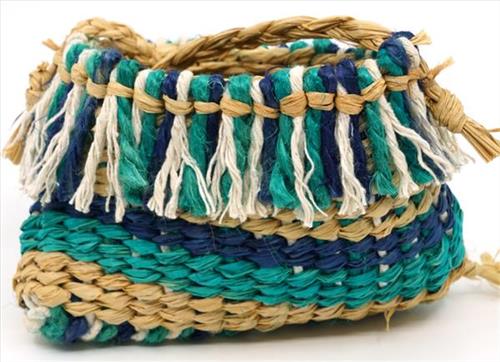
Artists make coiled baskets of many shapes and sizes, ranging from small round baskets to large oval baby baskets, and made mostly from pandanus fibre that is dyed with natural pigments. Bundles of fibre are formed into coils which are covered and stitched together with strands of fibre threaded onto a needle. Artists combine colours and patterns to obtain intricate new graphic patterns.
These techniques are believed to have been introduced to Arnhem Land by Greta Matthews, a missionary on Goulburn Island in the 1920s. She had probably learnt coil basketry from Aboriginal people in the south-east of Australia, possibly the Murray River people such as the Yorta Yorta or the coastal Ngarrindjeri.
The coiling technique spread quickly from Goulburn Island to people on mainland Arnhem Land.