Fallen Seeds
We have many fallen seeds from our plants that give new growth to our wild flowers.


We have many fallen seeds from our plants that give new growth to our wild flowers.


There are many Salt flats in the Pilbara.This painting depicts the water flowing underneath with the salt forming on top in ripples to show the movement of the ocean.


Thama (fire) and jinda (charcoal): When you get the marruwa (snakewood) and make fire, you see it burning, burning, burning. After the fire burns the wood becomes black, jinda (charcoal). And then the ash comes. Marruwa is the best stick to burn because it burns so hot.This is fire burning with ashes after.


Women collecting Watiyawarnu (Acacia tenuissima). Back at camp after collecting the seeds they make large windbreaks for shelter and winnow the seed in the late afternoon. Immature watiyawarnu seed is ground into a paste and can be used to treat upset stomachs. There is an important ceremony for this Tjukurrpa.

“When Martu paint, it’s like a map. Martu draw story on the ground and on the canvas, and all the circle and line there are the hunting areas and different waters and tracks where people used to walk, and [some you] can’t cross, like boundaries. So nowadays you see a colourful painting and wonder what it is, but that’s how Martu tell story long ago. It’s not just a lovely painting, it’s a story and a songline and a history and everything that goes with it.”
– Ngalangka Nola Taylor and Joshua Booth
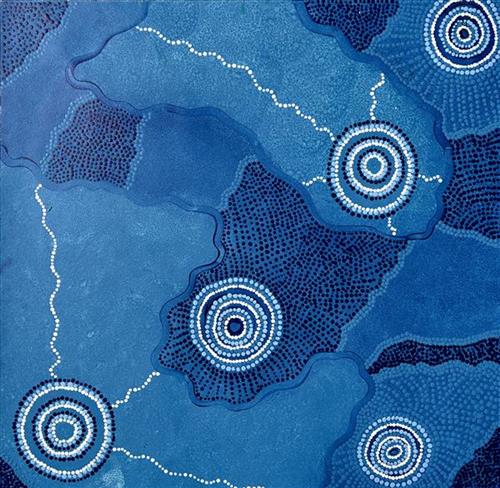
This work portrays an area of Country that can be interpreted in multiple ways. Firstly, the image may be read as an aerial representation of a particular location known to the artist- either land that they or their family travelled, from the pujiman (traditional, desert dwelling) era to now. During the pujiman period, Martu would traverse very large distances annually in small family groups, moving seasonally from water source to water source, and hunting and gathering bush tucker as they went. At this time, one’s survival depended on their intimate knowledge of the location of resources; thus physical elements of Country, such as sources of kapi (water), tali (sandhills), different varieties of warta (trees, vegetation), ngarrini (camps), and jina (tracks) are typically recorded with the use of a use of a system of iconographic forms universally shared across the desert.
An additional layer of meaning in the work relates to more intangible concepts; life cycles based around kalyu (rain, water) and waru (fire) are also often evident. A thousands of year old practice, fire burning continues to be carried out as both an aid for hunting and a means of land management today. As the Martu travelled and hunted they would burn tracts of land, ensuring plant and animal biodiversity and reducing the risk of unmanageable, spontaneous bush fires. The patchwork nature of regrowth is evident in many landscape works, with each of the five distinctive phases of fire burning visually described with respect to the cycle of burning and regrowth.
Finally, metaphysical information relating to a location may also be recorded; Jukurrpa (Dreaming) narratives chronicle the creation of physical landmarks, and can be referenced through depictions of ceremonial sites, songlines, and markers left in the land. Very often, however, information relating to Jukurrpa is censored by omission, or alternatively painted over with dotted patterns.


Walking across my land to look for bush flowers and goanna. I bring home to make medicine for my family and cook the goanna for dinner. Goanna is my favourite to eat.


This shows the layered landscape of Alyawarr, Central Australia. Knowing your country is an important part of living in a remote community like Ampilatwatja.
Knowing when and where to go hunting and gathering, knowing where there is ‘soakage’ (where you can dig for water), travelling with family for ceremonies, and maintaining a connection with the land.
“This is my country, my view of country.”
The community of Ampilatwatja made a conscious decision not to paint altyerr (dreaming stories). The artists paint their country where those stories sit.

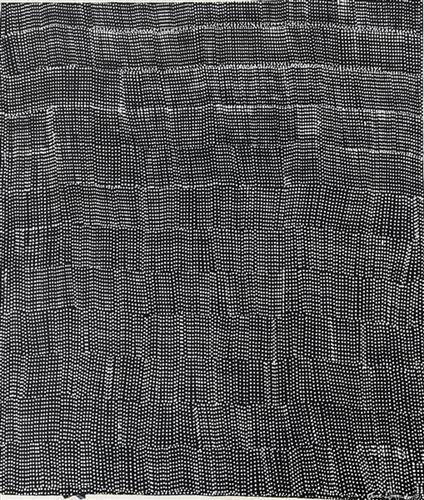
The old people talk about the Milky Way, there’s different stories, Mayalarri Seven Sisters and the Jarnkurna emu. In the Milky Way, you can see a Jarnkurna emu. When the Milky Way turns up in the cold season, it means it’s time for nesting and they lay their eggs. The man Emu sits on the eggs and raise the chicks until they are independent and then he runs away from them.
There is a large petroglyph of the Jarnkurna Emu at the Murujuga, Burrup
Minkala, the Great Spirit, lifted the Mayalarri into the sparkling night sky. then came the Marrga, singing the Burndud (sacred song). Their voices were so powerful that two of the Mayalarri were drawn down from the sky, into the sea near Murujuga. They were the Bunggaliyarra.
Dimensions: 80cm x 70cm

Dimensions: 70 x 69cm

