377815582405498


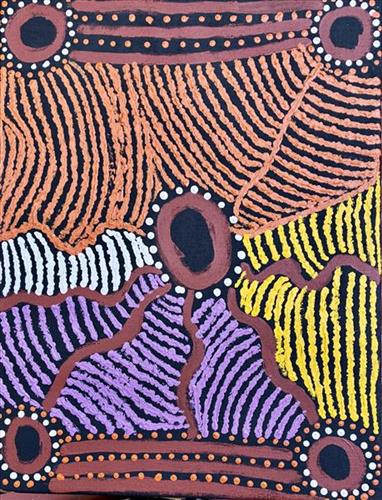
Shoreline

“At night, the sky is filled with the Milky Way and stars. When we go camping, I lie down and watch the stars, the moon, and shooting stars crossing the sky. During the wet season, I see the brolga walking and dancing on the saltmarsh. Along the shore, we must be careful — the sawfish swims in the shallow water, swinging its head side to side. When the tide comes in, the water and life move together, from the mangroves to the creeks and back out to sea.”
 – Tracey Mulardy

This artwork invites the viewer into the world of salt-water Country — the sea animals, the tides, the reefs, the mangroves, the hunting, the gathering, and the guardianship of coast and sea. The artist portrays fish, turtles, rays, dolphins, dugongs, sharks, crustaceans and shellfish, weaving together the patterns of sea-grass, coral, tidal flats, beach and reef.

It tells of families fishing off the beach, children diving in shallow waves, spear hunting, crabbing and catching prawns. It also speaks of wildlife protection — respectful harvesting, ensuring sea animals remain healthy, sea-ranger work and cultural practice.

With flowing patterns, deep blues and turquoise, shell shapes, wave forms and animal tracks, the work echoes the movement of water, tides and life beneath the waves. The artist invites us to listen to the tide, recognise the connection between land, sea, animal and people, and remember that to harvest is also to care — leaving Country strong for those who come next.


Dimensions: 46 x 61cm

377815582405465


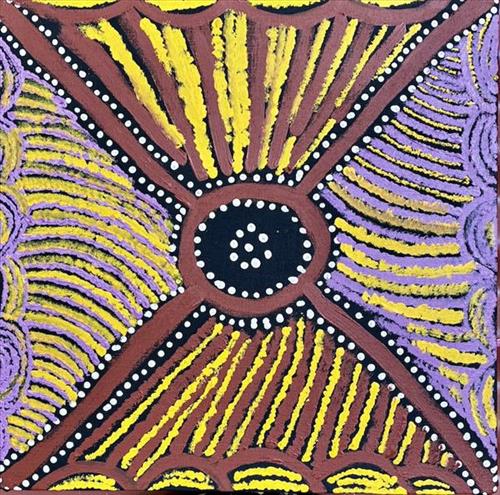
My Ngurra (Country), Jupurr

“My ngurra (home), Juwaliny — my language. My Country Jukurrpa, Yirnpa, Yimiri, Yulpu, Kupankurlu, Lyinjalung, and Lungkarung. Big one warla — that’s the area where the old people belong, ngurra. They been come here and pass away. We come here, Bidyadanga — mummy, daddy, all here. I came from the desert — I sat down in Jigalong, Punmu, Parnngurr, 33 (Kunawarritji), Newman, and I came back here (Bidyadanga).”
 – Yikartu Bumba

This painting shows the artist’s Country in the Percival Lakes region. Yikartu’s daughter, Bali Bumba, was born in this area when they lived a traditional pujiman (desert-born) life. The painting includes lyinji (claypan), jurnu (waterhole), kurru (river), and a big warla (lake).

This artwork depicts Country in and around the Great Sandy Desert — an immense area stretching from the edges of the Kimberley near Bidyadanga and Eighty Mile Beach, east through Walyarta (Mandora Marsh) and Percival Lakes, and down toward Kulyakartu, Kunawarritji (Well 33) and the Canning Stock Route. It is a vast landscape of dunes, claypans, salt lakes and waterholes.

For many families connected to Bidyadanga, this is ancestral land and holds places and significant sites where the old people lived pujiman (traditional desert-dwelling) lives before travelling to the coast.

The Great Sandy Desert is not empty — it is full of life, memory and movement. Soft sandhills rise and fall like waves, spinifex shimmers in the wind, flowers bloom after rain, and jila (living waterholes) lie hidden beneath the surface. People hunted goanna, bush turkey and small animals, dug for water, gathered bush foods, and camped beside claypans. Families walked long distances between soaks, teaching others how to read the land, follow tracks and travel safely.

In painting, the desert becomes a map of belonging — circles showing water and camps, lines following walking tracks and dunes, and soft patterns recalling plants, sand ridges and the glow of sunsets across wide skies. Colours shift between deep reds, ochres, warm sand tones and the greens that come after rain.


Dimensions: 36 x 76cm

377815582405463


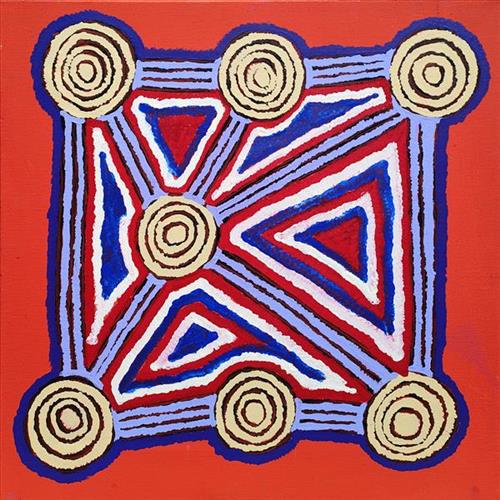
Mangala Country

“I paint Mangala because I love going there. I feel at peace and connected to the old people when I paint this Country. I like painting the flowers, the wet season and the waterholes.

My son is learning to paint. He feels real good and happy when he is painting about Country. I have three little ones and one big son. We went out to Mangala Country and camped with the family — with Jadai mob. The kids love going there. They feel at home, feel safe and at peace.”
 – Marika Jadai

This artwork honours Mangala Country and the families who carry its stories — walking, camping, hunting and gathering across desert edges, river systems and claypans. It remembers old people moving between soaks and sandhills, and later travelling to La Grange Mission (now Bidyadanga), keeping language, law and family strong.

Patterns trace tracks of animals and people; dots and lines follow water after rain; maps, camps, soaks and sandhills. The work also reflects the way caring for Country continues today — through ranger work and community leadership that bring together cultural knowledge and science to look after land and water.


Dimensions: 61 x 91cm

377815582405462


Bush Desert and Wildflowers at Kulyakartu

“Kulyakartu is my ancestor ngurra (home) through my grandmother and my great-great-grandfather and grandmother. Going out on Country with Nola and Muuki and hearing their stories of Kulyakartu touched my heart — listening to them talk about travelling through Kulyakartu with their mum and dad.

It was an experience for me to see the Country for the first time and to listen to their stories about travelling through the Great Sandy Desert. When I paint about Kulyakartu, it’s like an image in my mind from when I went there. That’s what I paint — the colours and the surrounding sand dunes around Kulyakartu.

I went on a chopper with Muuki, and now I picture the landscape from the air.”
 – Jenny Butt

This artwork shares the story of Kulyakartu, a vast and peaceful area north-east of the community, on the edge of Nyangumarta and Martu Country. Kulyakartu is a place of wide open skies, long claypans, sandhills and soft grasses that come alive after rain.

Families remember camping there, visiting waterholes, looking for goanna and bush foods, watching birds, and travelling with old people who knew every dune, track and soak. The painting celebrates the beauty and calm of Kulyakartu, often shown through soft lines and dots that follow the movement of water and sand. It honours the knowledge of where to find water, how to move across Country, and the deep belonging felt when returning to ancestral places.

Through this work, the artist invites viewers to feel that stillness and connection — the strength of Country, memory and family.


Dimensions: 61 x 91cm

220982409822


Dakota Ngwarraye Petrick – Artna Alpeyt (Bush Flowers)

These bush flowers grow seasonly in Alyawarr country, some of which are also used in bush medicine remedies.

My twin sister Lotoya and I have just started painting, our grandmother Elizabeth Ngwarraye Bonney has been teaching us, she tells us all about the bush Flowers and bush medicine.

The artists of Ampilatwatja made a conscious decision not to paint altyerr (dreaming stories). The artists paint their country where those stories sit.


Dimensions: 61 x 61 cm Acrylic on Linen

116182410036


Three houses in Hermannsburg

‘Three houses in Hermannsburg, family houses at Sandhill Camp. That’s like our family area at Hermannsburg. The families are sitting down outside watching tourist cars coming to Alice Springs.’


Dimensions: 560 x 560 mm

114182412947


Rosie – Winboll Rockhole


Rosie paints the land that birthed her: the sacred Winboll Rockhole, a place cradled on the far western side of Mantamaru (Jameson) a place where ancient waters sleep beneath the earth and stories from time immemorial breathe through the stones.

Rosie brings to life the rhythm of her birthplace, a land where sunlight dances upon the rocks and whispers of ancestors float on the wind. Her work is a glimpse into the heart of Winboll Rockhole, a land woven with mystery.


Dimensions: 38 x 38cm

114182412943


Rosie – Winboll Rockhole

Rosie paints the land that birthed her: the sacred Winboll Rockhole, a place cradled on the far western side of Mantamaru (Jameson) a place where ancient waters sleep beneath the earth and stories from time immemorial breathe through the stones.

Rosie brings to life the rhythm of her birthplace, a land where sunlight dances upon the rocks and whispers of ancestors float on the wind. Her work is a glimpse into the heart of Winboll Rockhole, a land woven with mystery.


Dimensions: 38 x 38cm

114182413392


Kungkarrangkalpa (Seven Sisters)

‘Kungkarrangkalpa’ (The Seven Sisters or Pleaides) is significant Tjukurrpa (dreamtime). Its origins you may be familiar with in astronomy and its connection to ‘Wati Nyiru’ (Magic Man or Orion).  The roots of this dreaming stems across indigenous groups around the world. The Australian Aboriginal songline is one part to the whole dreaming which can be traced all around the world. The ladies of the Ngaanyatjarra Lands depict their significant chapter and understanding of the journey of the sisters. The different versions of this story depend on where you live and the significance’s of local Tjukurrpa places.

Nyiru fell in love with the sisters but he was of the wrong skin group to marry, but he still pursued them on their journey. The sisters travel across the land to escape Nyiru’s unwanted attentions, but he is persistent and always finds them. There are significant land forms which can be sited today that evidence this dreaming. As Nyiru is chasing the sisters he tries to catch them by using magic to turn into the most tempting kampurarrpa (bush tomato) and the most beautiful Yirli (wild fig tree), for them to eat and camp under. However, the sisters are knowledgeable of his magic and too clever for Nyiru who they outwit again and again. They go hungry and run through the night rather than be caught by him. As the journey continues, Nyiru gets so frustrated at the wit of the sisters that he uses his magic to make the oldest sister sick to try and get closer to her. The other sisters rescue the big sister and nurse her back to health. It is said he also captures the youngest sister, but with the help of the oldest sister, she escapes back to her sisters who are waiting for her. Eventually, the sisters fly into the sky to escape Nyiru, forming the constellation. Nyiru felt lonely, longing for the sisters who were so far away. Nyiru used his magic to go to the sky, forever in pursuit.

Kakalyalya (white cockatoo)


Dimensions: 61 x 61cm

114182418271


Kungkarrangkalpa (Seven Sisters)

‘Kungkarrangkalpa’ (The Seven Sisters or Pleaides) is significant Tjukurrpa (dreamtime). Its origins you may be familiar with in astronomy and its connection to ‘Wati Nyiru’ (Magic Man or Orion).  The roots of this dreaming stems across indigenous groups around the world. The Australian Aboriginal songline is one part to the whole dreaming which can be traced all around the world. The ladies of the Ngaanyatjarra Lands depict their significant chapter and understanding of the journey of the sisters. The different versions of this story depend on where you live and the significance’s of local Tjukurrpa places.

Nyiru fell in love with the sisters but he was of the wrong skin group to marry, but he still pursued them on their journey. The sisters travel across the land to escape Nyiru’s unwanted attentions, but he is persistent and always finds them. There are significant land forms which can be sited today that evidence this dreaming. As Nyiru is chasing the sisters he tries to catch them by using magic to turn into the most tempting kampurarrpa (bush tomato) and the most beautiful Yirli (wild fig tree), for them to eat and camp under. However, the sisters are knowledgeable of his magic and too clever for Nyiru who they outwit again and again. They go hungry and run through the night rather than be caught by him. As the journey continues, Nyiru gets so frustrated at the wit of the sisters that he uses his magic to make the oldest sister sick to try and get closer to her. The other sisters rescue the big sister and nurse her back to health. It is said he also captures the youngest sister, but with the help of the oldest sister, she escapes back to her sisters who are waiting for her. Eventually, the sisters fly into the sky to escape Nyiru, forming the constellation. Nyiru felt lonely, longing for the sisters who were so far away. Nyiru used his magic to go to the sky, forever in pursuit.


Dimensions: 61 x 61cm