111982424664


Wak Wak

This painting depicts a sacred site at ‘Kurrurldul’, an outstation south of Maningrida.

The ‘rarrk’, or abstract crosshatching, on this work represents the design for the crow totem ancestor called ‘Djimarr’. Today this being exists in the form of a rock, which is permanently submerged at the bottom of Kurrurldul Creek. The ‘Djimarr’ rock in the stream at Kurrurldul is said to move around and call out in a soft hooting tone at night. Both the stone itself and the area around it are considered sacred.

The imagery represents the rock mentioned above at the bottom of Kurrurldul creek, which is the final transmutation of the dreaming ancestor ‘Djimarr’. Finally, the pattern used here is also the crow design used in the sacred ‘Mardayin’ ceremony, which is a large regional patri-moiety ceremony now rarely conducted in central and eastern Arnhem Land.

111982424628


Gomarla (Egret bird)

The artist has carved the ‘Gomarla’, which in the Burarra word for Egret. This bird is native to the country of Yilan, which is the coastal region North West of Maningrida Community. 

People use feathers from gomarla to make ceremonial regalia for Yirrichinga. Many Yirrichinga groups own manikay ‘song’ for gomarla.

Gomarla mun-baparrurr Gopungorra. Jin-gubatbatcha jin-banga jiny-yorkiya. Gomarla waykin makukuya mu-guyinda.

The egret belongs to the Gopungorra clan. It always eats grasshoppers. The egret is high in a nest (builds its nest in the tree).

111982424627


Burlupurr – dillybag

Burlupurr, or dilly bag, is usually a large woven collecting basket. These large bags are often made from the vine ‘Malasia scandens’, a strong pliable plant which grows along the floor and into the canopy of monsoon vine thickets. The bags are used to collect any kind of large numbers of heavy foods such as fish caught in conical fish traps or large collections of yams.

They can also be made from Pandanus spiralis, a plant which grows in many areas of Arnhem Land. These dilly bags are a tightly woven collecting basket, very finely made. These dilly bags are often used to collect sugarbag, the native honey. 

Common colours used to dye pandanus used for weaving burlupurr include:

– barra gu-jirra: the soft, white and fleshy end of the pandanus leaf imparts green to the fibre.

–  mun-gumurduk/ gala (Pogonolobus reticulatus): a bright yellow root that is crushed and put in a billycan with the fibre and boiled. It creates yellow when boiled once and deep orange hues when boiled multiple times.

– ngalpur (Haemodorum brevicaule): a bright red root which yields a range of purply red to brown colours.

– Baluk: ashes of certain plants are added to the boiling billycan with the fibre and dye plants to alter the colour that is imparted to the fibre. The fruiting body of gulpiny (Banksia denanta) is burnt and the ashes added to other day plants to make the colour pink. 

As well as being of practical use, dilly bags are also of religious significance to Arnhem Land people. Dilly bags are said to be totemic objects and associated with particular sites in the landscape.

111982424625


Burlupurr – dillybag

Burlupurr, or dilly bag, is usually a large woven collecting basket. These large bags are often made from the vine ‘Malasia scandens’, a strong pliable plant which grows along the floor and into the canopy of monsoon vine thickets. The bags are used to collect any kind of large numbers of heavy foods such as fish caught in conical fish traps or large collections of yams.

They can also be made from Pandanus spiralis, a plant which grows in many areas of Arnhem Land. These dilly bags are a tightly woven collecting basket, very finely made. These dilly bags are often used to collect sugarbag, the native honey. 

Common colours used to dye pandanus used for weaving burlupurr include:

– barra gu-jirra: the soft, white and fleshy end of the pandanus leaf imparts green to the fibre.

–  mun-gumurduk/ gala (Pogonolobus reticulatus): a bright yellow root that is crushed and put in a billycan with the fibre and boiled. It creates yellow when boiled once and deep orange hues when boiled multiple times.

– ngalpur (Haemodorum brevicaule): a bright red root which yields a range of purply red to brown colours.

– Baluk: ashes of certain plants are added to the boiling billycan with the fibre and dye plants to alter the colour that is imparted to the fibre. The fruiting body of gulpiny (Banksia denanta) is burnt and the ashes added to other day plants to make the colour pink. 

As well as being of practical use, dilly bags are also of religious significance to Arnhem Land people. Dilly bags are said to be totemic objects and associated with particular sites in the landscape.

111982424624


Burlupurr – dillybag

Burlupurr, or dilly bag, is usually a large woven collecting basket. These large bags are often made from the vine ‘Malasia scandens’, a strong pliable plant which grows along the floor and into the canopy of monsoon vine thickets. The bags are used to collect any kind of large numbers of heavy foods such as fish caught in conical fish traps or large collections of yams.

They can also be made from Pandanus spiralis, a plant which grows in many areas of Arnhem Land. These dilly bags are a tightly woven collecting basket, very finely made. These dilly bags are often used to collect sugarbag, the native honey. 

Common colours used to dye pandanus used for weaving burlupurr include:

– barra gu-jirra: the soft, white and fleshy end of the pandanus leaf imparts green to the fibre.

–  mun-gumurduk/ gala (Pogonolobus reticulatus): a bright yellow root that is crushed and put in a billycan with the fibre and boiled. It creates yellow when boiled once and deep orange hues when boiled multiple times.

– ngalpur (Haemodorum brevicaule): a bright red root which yields a range of purply red to brown colours.

– Baluk: ashes of certain plants are added to the boiling billycan with the fibre and dye plants to alter the colour that is imparted to the fibre. The fruiting body of gulpiny (Banksia denanta) is burnt and the ashes added to other day plants to make the colour pink. 

As well as being of practical use, dilly bags are also of religious significance to Arnhem Land people. Dilly bags are said to be totemic objects and associated with particular sites in the landscape.

111982424623


Burlupurr – dillybag

Burlupurr, or dilly bag, is usually a large woven collecting basket. These large bags are often made from the vine ‘Malasia scandens’, a strong pliable plant which grows along the floor and into the canopy of monsoon vine thickets. The bags are used to collect any kind of large numbers of heavy foods such as fish caught in conical fish traps or large collections of yams.

They can also be made from Pandanus spiralis, a plant which grows in many areas of Arnhem Land. These dilly bags are a tightly woven collecting basket, very finely made. These dilly bags are often used to collect sugarbag, the native honey. 

Common colours used to dye pandanus used for weaving burlupurr include:

– barra gu-jirra: the soft, white and fleshy end of the pandanus leaf imparts green to the fibre.

–  mun-gumurduk/ gala (Pogonolobus reticulatus): a bright yellow root that is crushed and put in a billycan with the fibre and boiled. It creates yellow when boiled once and deep orange hues when boiled multiple times.

– ngalpur (Haemodorum brevicaule): a bright red root which yields a range of purply red to brown colours.

– Baluk: ashes of certain plants are added to the boiling billycan with the fibre and dye plants to alter the colour that is imparted to the fibre. The fruiting body of gulpiny (Banksia denanta) is burnt and the ashes added to other day plants to make the colour pink. 

As well as being of practical use, dilly bags are also of religious significance to Arnhem Land people. Dilly bags are said to be totemic objects and associated with particular sites in the landscape.

111982424622


Burlupurr – dillybag

Burlupurr, or dilly bag, is usually a large woven collecting basket. These large bags are often made from the vine ‘Malasia scandens’, a strong pliable plant which grows along the floor and into the canopy of monsoon vine thickets. The bags are used to collect any kind of large numbers of heavy foods such as fish caught in conical fish traps or large collections of yams.

They can also be made from Pandanus spiralis, a plant which grows in many areas of Arnhem Land. These dilly bags are a tightly woven collecting basket, very finely made. These dilly bags are often used to collect sugarbag, the native honey. 

Common colours used to dye pandanus used for weaving burlupurr include:

– barra gu-jirra: the soft, white and fleshy end of the pandanus leaf imparts green to the fibre.

–  mun-gumurduk/ gala (Pogonolobus reticulatus): a bright yellow root that is crushed and put in a billycan with the fibre and boiled. It creates yellow when boiled once and deep orange hues when boiled multiple times.

– ngalpur (Haemodorum brevicaule): a bright red root which yields a range of purply red to brown colours.

– Baluk: ashes of certain plants are added to the boiling billycan with the fibre and dye plants to alter the colour that is imparted to the fibre. The fruiting body of gulpiny (Banksia denanta) is burnt and the ashes added to other day plants to make the colour pink. 

As well as being of practical use, dilly bags are also of religious significance to Arnhem Land people. Dilly bags are said to be totemic objects and associated with particular sites in the landscape.

111982424621


Mun-dirra (fish fence)

Mun-dirra, in Burarra language, means “fish fence”. Mun-dirra were traditionally made by men using coastal sedge grass called gurdagarra and were designed to fence in schools of fish in ocean shallows or riverbeds. They were used in conjunction with conical traps, called an-gujechiya, which are woven with mirlarl, a hardy jungle vine, and burdaga, the sinewy inner bark from Kurrajong trees. 

Fish traps and fish fences have been used throughout west and central Arnhem Land by various language groups; in Kuninjku, people call them kunkarlewabe (fish fence) and mandjabu (fish trap).

Artist Doreen Jinggarrabarra explains, “In the old days, they didn’t have any casting nets, [so] they made a fish trap and a long fence net, [put] them side to side, and put the fish trap in the middle. Then the fish came and went in the fish trap.”

To make a fish trap (an-gujechiya), jungle vine (mirlarl) is soaked in water for one night to make it soft. Then, the structural form of the fishtrap would be worked on, with hibiscus (bardainy) rings fashioned inside to keep the fish trap’s shape. Kurrajong string (burdaga) would be made to attach the inner rings and to tie the conical end of the fish trap closed. This fish trap is used in both saltwater and freshwater.

 The fish fences (mun-dirra) would be set up across rivers and creeks, with the fish trap (an-gujechiya) placed in the middle of the two fences. Sticks, rocks, mud and grass would be used to hold the fences in position and funnel the fish into the trap. This ingenious system could catch fish like saltwater barramundi (rajarra), freshwater barramundi (janambal), small black freshwater catfish (buliya), bonefish (an-guwirrpiya), and sand bass (dalakan).

Doreen remembers seeing the traps in riverbeds around Maningrida when she was young: “The older ladies and the older men [would] usually go down, say about seven or eight o’clock, to go and check the trap. Maybe seven fish can go in, crabs and catfish,” she recalls.

Today, people generally use fishing lines and casting nets for fishing, but the woven traps and fences continue to be made as works of art. Women are now considered the knowledge holders, and are leaders in the development of sophisticated examples of woven design and material culture.

 *Maningrida Arts & Culture acknowledges the work of many academic and non-academic voices when writing on this topic. It is important to note Anna Freeland and Myles Russell-Cook, whose writing have informed this text.
111982424620


Wamba (Bull Shark)

Works in fibre from the Maningrida region are widely recognised as some of the finest in Australia. Artists confidently push the boundaries of fibre craft and cultural expression, adapting traditional techniques and forms to produce strikingly inventive and aesthetically exquisite artworks.

In 2003, Kuninjku artist Marina Murdilnga brought a revolutionary new form of pandanus weaving to Maningrida Arts & Culture: a flat yawkyawk made from knotted pandanus on a jungle-vine frame, painted with natural pigments. She next explored using dyed pandanus and feathers in this way. Murdilnga’s innovation inspired many other weavers, who are producing an array of beautifully resolved flat figurative works (stingray, butterflies, spiderwebs) and spiritual figures and Ancestral beings. Alongside Murdilnga, leading artists of this form of fibre art are Anniebell Marnngamarnnga, Frewa Bardaluna and Rembarrnga artists Vera Cameron and Maisie Cameron. Lulu Larandjbi has woven interpretations of the rock pools at Kobumi where Ngalyod (the Rainbow Serpent) entered and died.

Commonly used fibres include the leaves of pandanus (Pandanus spiralis), and palms (Livistonus), mírlírl (burney or jungle vine, Malaisia scandens), and the inner bark of kurrajong and stringybark eucalyptus trees. Weaving is physically hard work, now done only by women. They colour the pandanus using natural dyes made from the roots, leaves or flowers of plants within the weaver’s clan estate. The same dye bath is often used to dye a number of batches of fibre, with variations in the colours depending on the time spent in the dye bath and the potency of the bath. The women skilfully use salt and wood ash as mordants and colour enhancers.


22134009446


Status: Stock


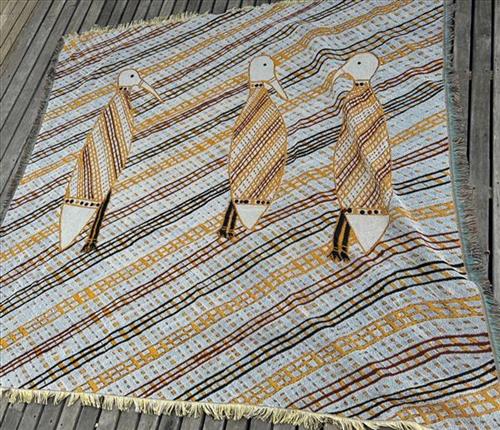
Throw Rug by Eric Malibirr

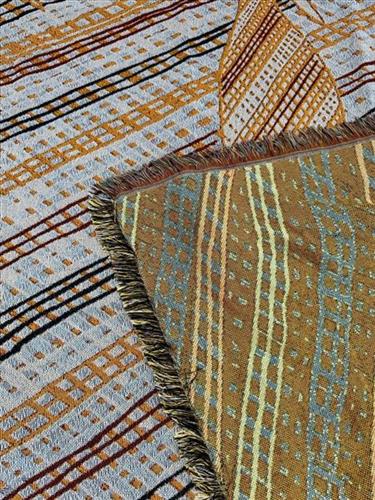
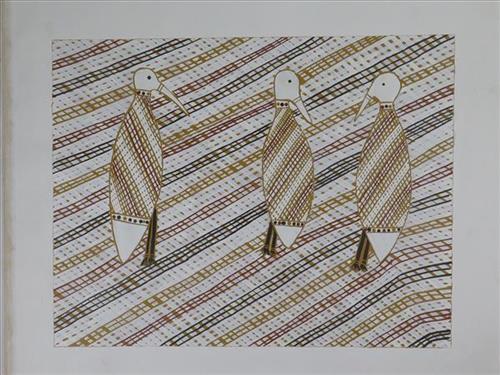
Eric’s beautiful rarrk painting has been carefully translated into this functional woven throw rug for the home.