22023974587


Status: Stock


Puli Puli Gift Wrapping Paper

Gift Wrapping Paper 4 individual pieces 50 x 68 cm

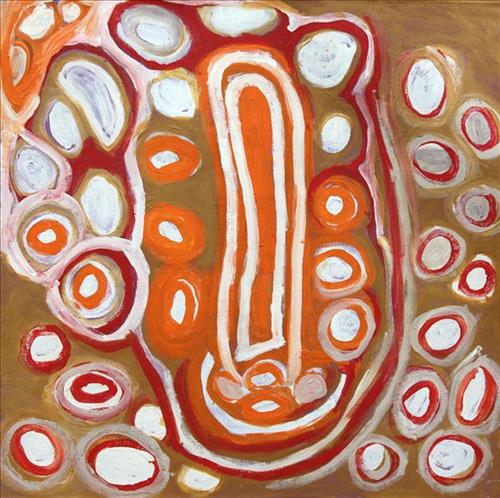
Keturah depicts the puli puli (rocks) at two different sites: the landscapes at Haasts Bluff and also Karrkurrutintja (Lake McDonald). Keturah depicts her childhood memories of both places.
“The sand hills I paint are my mother’s story and the rocks I paint are my own story. My paintings are about my story and my mother’s. When I look at my paintings I feel happy. My Grandmother used to say to me when I was younger: “One day you will paint.”

22023974307


Status: Stock


Puli Puli Medium Lacquerware Box (4.5×7.5×9.5cm)

Keturah depicts the puli puli (rocks) at two different sites: the landscapes at Haasts Bluff and also Karrkurrutintja (Lake McDonald). Keturah depicts her childhood memories of both places.
“The sand hills I paint are my mother’s story and the rocks I paint are my own story. My paintings are about my story and my mother’s. When I look at my paintings I feel happy. My Grandmother used to say to me when I was younger: “One day you will paint.”

22023974306


Status: Stock


Puli Puli Small Lacquerware Box (4x6x8 cm) – Brown

Keturah depicts the puli puli (rocks) at two different sites: the landscapes at Haasts Bluff and also Karrkurrutintja (Lake McDonald). Keturah depicts her childhood memories of both places.
“The sand hills I paint are my mother’s story and the rocks I paint are my own story. My paintings are about my story and my mother’s. When I look at my paintings I feel happy. My Grandmother used to say to me when I was younger: “One day you will paint.”

22023974289


Status: Stock


Puli Puli Wool Table Runner

Keturah Zimran depicts in her artworks the landscape in and around Haasts Bluff as well as combining it with her childhood memories of her mother’s country of Lake Macdonald in Western Australia.

These table runners, chainstitched by Kashmiri artisans in India as part of a fair trade project with Better World Arts, show Keturah’s understanding of the landscape and its bold qualities.

22023974314


Status: Stock


Waterhole Gift Card

The artwork by Alice Nampitjinpa featured on the cushion is about a rockhole at Taalalpi West of Kintore, the artist’s country.

22023974310


Status: Stock


Puli Puli Christmas Ball (Brown)

Keturah depicts the puli puli (rocks) at two different sites: the landscapes at Haasts Bluff and also Karrkurrutintja (Lake McDonald). Keturah depicts her childhood memories of both places.
“The sand hills I paint are my mother’s story and the rocks I paint are my own story. My paintings are about my story and my mother’s. When I look at my paintings I feel happy. My Grandmother used to say to me when I was younger: “One day you will paint.”

22023974303


Status: Stock


Puli Puli Rock Pill Box (Yellow)

Keturah depicts the puli puli (rocks) at two different sites: the landscapes at Haasts Bluff and also Karrkurrutintja (Lake McDonald). Keturah depicts her childhood memories of both places.
“The sand hills I paint are my mother’s story and the rocks I paint are my own story. My paintings are about my story and my mother’s. When I look at my paintings I feel happy. My Grandmother used to say to me when I was younger: “One day you will paint.”

11151031522


Luurnkurangu

Luurnkurangu is a soak located between Nyarruri (Canning Stock Route Well 32) and Warla-warla (Canning Stock Route Well 31), and south west of Kunawarritji Aboriginal community. This site is ngurra (home Country, camp) for Nungabar (Nyangapa) (dec.), and forms part of the area which she knew intimately and travelled extensively with her family in her youth. 

During the pujiman (traditional, desert dwelling) period, Martu would traverse very large distances annually in small family groups, moving seasonally from water source to water source, and hunting and gathering bush tucker as they went. At this time knowledge of water sources was critical for survival, and today Martu Country is still defined in terms of the location and type of water. Each of the hundreds of claypans, rockholes, waterholes, soaks and springs found in the Martu desert homelands is known by name, location, quality and seasonal availability through real life experience and the recounting of Jukurrpa (Dreaming) narratives. 

Soaks, or soakwaters, derive their name from the manner in which their waters generally seep into the sand from below stores, sometimes as part of an ephemeral river or creek. Soaks were an especially important source of water during the pujiman era, being the most dependable water source in times of drought. Water was obtained from soaks by scooping away the sand with a piti (timber bowls used for carrying food and water) until clear water gathered at the base of the hole, sometimes at a depth of several metres.

11152117948


Untitled

This is Nungabar’s Country- her ‘ngurra’ (home Country, camp). People identify with their ngurra in terms of specific rights and responsibilities, and the possession of intimate knowledge of the physical and cultural properties of one’s Country. Painting ngurra, and in so doing sharing the Jukurrpa (Dreaming) stories and physical characteristics of that place, has today become an important means of cultural maintenance. Nungabar’s ngurra encompasses her birthplace, near Lipuru well (Libral Well, Canning Stock Route Well 37) and the Country that became Wells 33 through to 38 along the Canning Stock Route, where her family walked in the pujiman (traditional, desert-dwelling) era. From an early age Nungabar and her family had encounters with the white men who drove cattle along the route. As a young woman, together with her close friend Nora Wompi, Nungabar followed the drovers north to Balgo Mission, where she settled and raised a family.

Portrayed in this work are features of Nungabar’s family’s ngurra, such as the striking salt lakes, permanent red tali (sandhills), warta (trees, vegetation), and the individually named water sources they camped at. Rock holes, waterholes, soaks and springs were all extremely important sites for Martu people during the pujiman period, and are generally depicted with circular forms. 

The encyclopaedic knowledge of the location, quality and seasonal availability of the hundreds of water bodies found in one’s Country sustained Martu as they travelled across their Country, hunting and gathering, visiting family, and fulfilling ceremonial obligations. They would traverse very large distances annually, visiting specific areas in the dry and wet season depending on the availability of water and the corresponding cycles of plant and animal life on which hunting and gathering bush tucker was reliant. As they travelled and hunted they would also burn areas of Country, generating a greater diversity of plant and animal life.

111576341538


Kunawarritji (Canning Stock Route Well 33)

Kunawarritji is an important site in the Great Sandy Desert where multiple stories and histories intersect. Originally a spring water and major Martu pujiman (traditional, desert dwelling) camping site, at the turn of the 20th century Kunawarritji was converted into a well along the Canning Stock Route. Each year throughout the 1930-50s, the well became a site of contact between the drovers, their cattle, and desert families like Nungabar’s (dec.). Nungabar was born near Lipuru (Libral Well, Canning Stock Route Well 37), north east of Kunawarritji. She grew up in the Country between these sites, and from an early age she and her family had encounters with drovers along the Canning Stock Route.

Long before colonial history entered this Country, however, other stories dominated this site. Primarily, Kunawarritji features in the Minyipuru (Jakulyukulyu, Seven Sisters) Jukurrpa (Dreaming). Minyipuru is a central Jukurrpa narrative for Martu, Ngaanyatjarra, Pitjantjatjara and Yankunytjatjara people that is associated with the seasonal Pleiades star constellation. Beginning in Roebourne on the west coast of Western Australia, the story morphs in its movement eastward across the land, following a group of women as they walk, dance, and even fly from waterhole to waterhole. As they travelled the women left markers in the landscape and create landforms that remain to this day. During the entirety of their journey the women are pursued by a lustful old man, Yurla, although interactions with other animals, groups of men, and spirit beings are also chronicled in the narrative.

The Minyipuru travelled to Kunawarritji from Nyipily (Nyipil, Nibil, Canning Stock Route Well 34), and transformed themselves into a distinctive group of trees that remain in the area between these two sites. From Kunawarritji Yurla followed the sisters to Pangkapirni, where he finally caught one of the women. 

Today, Kunawarritji is a site of return, a place where people came back to continue their life in the desert with the formation of Kunawarritji Aboriginal community in the early 1980s. The community’s cultural significance endures, with the population swelling up to 1000 during cultural business. In her late years Nungabar relocated to her homelands at Kunawarritji, though she continued to travel regularly between Kunawarritji, Balgo and Mulan. Nungabar was a custodian of a great deal of cultural knowledge about the Kunawarritji area, much of which is referred to in her extensive body of work.