115682398346


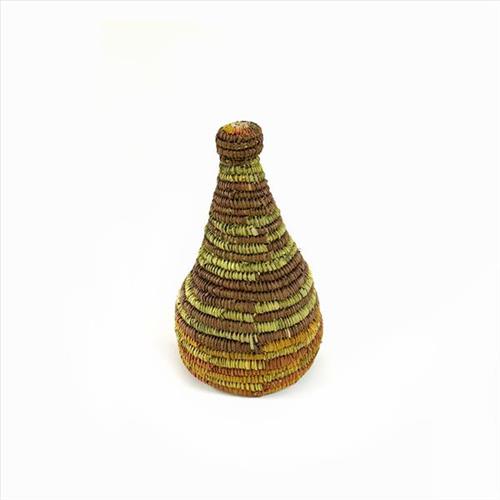
Bottles

Robyn Djunginy began weaving bottle sculptures in 1983, after the Curator Djon Mundine, suggested to Djunginy that she may like to encase an empty gin bottle in Pandanus fibre ‘Chianti-style’ for an exhibition he was organising. Using a local twining technique, the artist began producing multiple woven bottles of various sizes. The sculptural qualities and the high workmanship of these objects have led them to be become recognised as key contemporary Aboriginal fibre works.

A decade after making her first bottle artworks, Djunginy began producing two-dimensional renderings of the woven sculptures on canvas.

Robyn has been the only artist from this area to produce and paint bottles, but has passed the bottle story on to her daughters.

Robyn has been the only artist from this area to produce and paint bottles, but has passed the bottle story on to her daughters.

This bottle was woven by Robyn’s daughter, Janice Djupuduwuy.


Dimensions: 33 x 19cm

377815582418477


Kulyakartu

“I paint about Kulyukartu. It’s my grandmother’s Country. I love painting about that Country. I went on a trip doing fire burning, cleaning the waterholes, and walking around looking where my grandmothers carved the rocks and things. I went with my mum Emily, and SJ (Nuriah Jadai). You turn before 80 Mile Beach and just go straight.

I feel good when I’m there — it feels like home when I paint it. I learnt to paint from my grandfather (Wokka Taylor, dec.). When we went to 33 (Kunawarritji, Well 33) and back to Punmu, we were just watching them. He told me to get a brush, and then he told me to start painting. I think him and Dunjan (Thelma Judson) were painting a big one, and I came to help him. He told me, ‘One day you should go to Kulyukartu,’ and so I went there.”
 – Kiarah Mandijalu-Jadai

This artwork shares the story of Kulyakartu, a vast and peaceful area north-east of the community, on the edge of Nyangumarta and Martu Country. Kulyakartu is a place of wide open skies, long claypans, sandhills and soft grasses that come alive after rain.

Families remember camping there, visiting waterholes, looking for goanna and bush foods, watching birds, and travelling with old people who knew every dune, track and soak. The painting celebrates the beauty and calm of Kulyakartu, often shown through soft lines and dots that follow the movement of water and sand. It honours the knowledge of where to find water, how to move across Country, and the deep belonging felt when returning to ancestral places.

Through this work, the artist invites viewers to feel that stillness and connection — the strength of Country, memory and family.


Dimensions: 46 x 61cm

220982426009


Shardia Kemarre Holmes – Alpeyt Alpeyt (Flowers Blooming)

Shardia is the daughter of Julieanne Ngwarraye Morton, grandaughter of Lilly Kemarre Morton both senior artists of Ampilatwatja, Lilly was part of the Utopian Batik movement in the 1980’s and is a respected elder of the community. Her Grandfather was Banjo Pitjara Morton.

Shardia depicts her country with great joy, a style influenced by her family but with her own distinct fresh palette.

Bush flowers grow seasonally in Alyawarre country, some of which are also used in bush medicine remedies. The artists of Ampilatwatja made a conscious decision not to paint altyerr (dreaming stories). The artists paint their country where those stories sit.


220982428831


Louise Pula Luck – Artna Alpeyt (Bush Flowers)

These bush flowers grow seasonly in Alyawarr country, some of which are also used in bush medicine remedies.

When I go out hunting, I like to see all the bush flowers that are flowering and then when I come back, I paint them.

The artists of Ampilatwatja made a conscious decision not to paint altyerr (dreaming stories). The artists paint their country where those stories sit.

107582430668


Solomon

A variety of rays are found around our island home, from the shallow waters of the shoreline to the reefs and deeper waters. This ray has been created by stitching reclaimed fishing net, rope and twine. Reclaimed fishing nets (also known as ghost nets) are derelict fishing nets that drift aimlessly at sea indiscriminately fishing, killing turtles, other creatures and tangling boat propellers. We are recycling these nets, incorporating other flotsam and making products for enjoyment and use

107582430667


Joey

This fish has been created by stitching reclaimed fishing net, rope and twine. Reclaimed fishing nets (also known as ghost nets) are derelict fishing nets that drift aimlessly at sea indiscriminately fishing, killing turtles, other creatures and tangling boat propellers. We are recycling these nets, incorporating other flotsam and making products for enjoyment and use. By purchasing this product, you are helping indigenous communities who collect this net and other groups who make items to develop economic opportunities. We hope this product brings you great joy and helps spread the ghost net message.

107582430665


Sarah

This fish has been created by stitching reclaimed fishing net, rope and twine. Reclaimed fishing nets (also known as ghost nets) are derelict fishing nets that drift aimlessly at sea indiscriminately fishing, killing turtles, other creatures and tangling boat propellers. We are recycling these nets, incorporating other flotsam and making products for enjoyment and use. By purchasing this product, you are helping indigenous communities who collect this net and other groups who make items to develop economic opportunities. We hope this product brings you great joy and helps spread the ghost net message.

107582430663


Spot blo Awa

Through my artwork, I have learnt to embrace my totems and culture to showcase and share my identity. These pieces represent the various seasons and ever-changing weather patterns. Traditional knowledge passed down through the generations taught us to look at plants and animals to understand the changes in seasons. For instance, seeing a flock of frigate birds flying high in the sky indicates that good weather is coming. While seeing them fly low in the sky signals that bad, windy weather is expected. We work closely with the local children to pass knowledge during school time. Children are taught about gardening, language and cultural identity. In these modern times, we are faced daily with plastic and marine debris in ways we can no longer ignore. We also educate the children about the importance of recycling and reusing these materials, instead of discarding them.

107582430662


Fever of Rays

Through my artwork, I have learnt to embrace my totems and culture to showcase and share my identity. These pieces represent the various seasons and ever-changing weather patterns. Traditional knowledge passed down through the generations taught us to look at plants and animals to understand the changes in seasons. For instance, seeing a flock of frigate birds flying high in the sky indicates that good weather is coming. While seeing them fly low in the sky signals that bad, windy weather is expected. We work closely with the local children to pass knowledge during school time. Children are taught about gardening, language and cultural identity. In these modern times, we are faced daily with plastic and marine debris in ways we can no longer ignore. We also educate the children about the importance of recycling and reusing these materials, instead of discarding them.

107582430661


Barramundi

Through my artwork, I have learnt to embrace my totems and culture to showcase and share my identity. These pieces represent the various seasons and ever-changing weather patterns. Traditional knowledge passed down through the generations taught us to look at plants and animals to understand the changes in seasons. For instance, seeing a flock of frigate birds flying high in the sky indicates that good weather is coming. While seeing them fly low in the sky signals that bad, windy weather is expected. We work closely with the local children to pass knowledge during school time. Children are taught about gardening, language and cultural identity. In these modern times, we are faced daily with plastic and marine debris in ways we can no longer ignore. We also educate the children about the importance of recycling and reusing these materials, instead of discarding them.