111982439709


Mimih Spirit

The mimih spirit exists in a realm that runs parallel to and mirrors many facets of human life, demonstrating the deep sense of time and place understood by Aboriginal and Torres Strait Islander people. Such spirits feature importantly in relation to Aboriginal spirituality, cosmology, social and moral tales as well as ritual. As is true with the multiple mediums employed by artists of West Arnhem Land, the development of artistic style and form is in line with an awareness by the artist that the work produced is predominantly made for a broader audience. Whether shown in a national or international context these works communicate and exist in a particular space that is cross-cultural and simultaneously particular to the Arnhem region.

The mimih sits within a complex pedagogical and religious body of knowledge which links Kuninjku people to their distinctive escarpment homelands. Young Kuninjku artists, or apprentices, employ the mimih as an important exercise for the practice of the rarrk technique, as it could be achieved on a smaller surface area before being attempted in larger scale on pieces of bark. The mimih serves a purpose for those young artists first learning to carve in a social space of sharing and innovating. The initial mimih manifestation was a large form that almost mirrored the anatomy of a human and at this stage the sculptures have been likened to mokuy carvings visible in eastern Arnhem Land. Contemporaneously, mimih are depicted in a refined, slender, even emaciated form with a broad range of facial expressions giving both individual character to, and denoting the potential volatility and humour that mimih spirits are notable for in their interaction with bininj (humans). The sculptures are frequently carved from the thin trunks of softwoods such as kapok (bombax ceiba or cottonwood) kurrajong, beach hibiscus or leichardt and are painted with earth pigments for their colouring and design.

A leading figure engaging the spirit in visual storytelling was Crusoe Kuningbal, a Kuninjku man, who while traveling was familiarised with carving styles from the east of Arnhem at the mission in Milingimbi pre-dating World War II. The connection and development of art forms informed by cross cultural dialogues within northern Aboriginal language groups is notable. The mimih became a valued inclusion in performance and public ceremony by Kuninjku people like Kuningbal. At times these ceremonies were performed for extended language groups in the local region. 

Now a familiar and broadly depicted figure of iconography, it is important to acknowledge the development of this quite recent sculptural tradition. The depiction of this particular spirit being, once used as an addition to the sharing of song cycles and ceremony, has since been elevated to a prominent form and subject of contemporary sculpture. Variation in the creation of mimih acts as an indication of the individualism of each artist and their stylistic markers. Additionally significant to note is that in the space of the past thirty years the mimih has begun being produced by multiple language groups residing in the Maningrida area including the traditional owners of Maningrida, the Ndjébbana, speaking Kunibidji as well as Gurrgoni people who have strong ties to Kuninjku. 

________
*Maningrida Arts & Culture acknowledge the work of many academic and non-academic voices when writing on this topic, it is important to note Luke Taylor, who’s broad research has informed this text.
220982350225


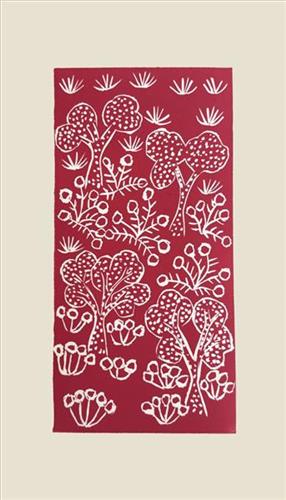
Alana Ngwarraye Holmes – Wild Flowers

Out in the plain after the rain the wild flowers grow and bloom, I see these flowers on my mother’s country.

The plant has pretty flowers, we take them home and show them to the children.  They are a beautiful purple, yellow and pink colour.


Dimensions: 15 x 30 cm Lino Print – Wild Flower Pink SH300gsm

220982351880


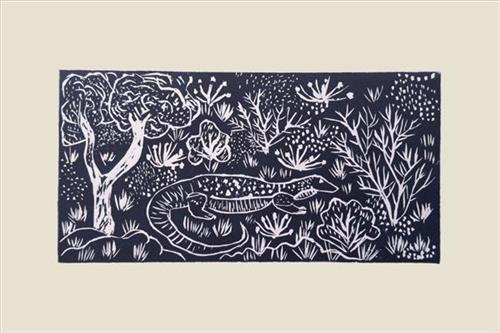
Elizabeth Ngwarraye Bonney – Sand Goanna

When the goannas run into the hole we block the front and find it through the top of the ground.  We use the digging stick to hold it and we then find and grab the tail and pull it out and then hit it on the head to kill it.  We take back to camp, clean them and cook it in the hot coals.


Dimensions: 15 x 30 cm LinoPrint-NightCharcoalBlak

111582397057


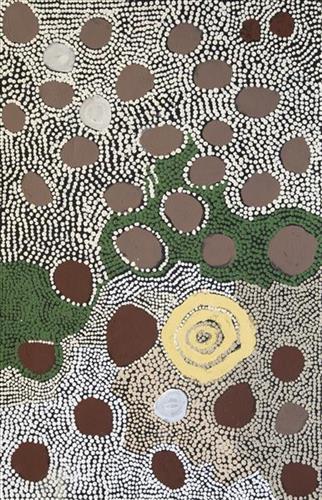
Untitled

“When Martu paint, it’s like a map. Martu draw story on the ground and on the canvas, and all the circle and line there are the hunting areas and different waters and tracks where people used to walk, and [some you] can’t cross, like boundaries. So nowadays you see a colourful painting and wonder what it is, but that’s how Martu tell story long ago. It’s not just a lovely painting, it’s a story and a songline and a history and everything that goes with it.” 

– Ngalangka Nola Taylor and Joshua Booth

This work portrays an area of Country that can be interpreted in multiple ways. Firstly, the image may be read as an aerial representation of a particular location known to the artist- either land that they or their family travelled, from the pujiman (traditional, desert dwelling) era to now. During the pujiman period, Martu would traverse very large distances annually in small family groups, moving seasonally from water source to water source, and hunting and gathering bush tucker as they went. At this time, one’s survival depended on their intimate knowledge of the location of resources; thus physical elements of Country, such as sources of kapi (water), tali (sandhills), different varieties of warta (trees, vegetation), ngarrini (camps), and jina (tracks) are typically recorded with the use of a use of a system of iconographic forms universally shared across the desert. 

An additional layer of meaning in the work relates to more intangible concepts; life cycles based around kalyu (rain, water) and waru (fire) are also often evident. A thousands of year old practice, fire burning continues to be carried out as both an aid for hunting and a means of land management today. As the Martu travelled and hunted they would burn tracts of land, ensuring plant and animal biodiversity and reducing the risk of unmanageable, spontaneous bush fires. The patchwork nature of regrowth is evident in many landscape works, with each of the five distinctive phases of fire burning visually described with respect to the cycle of burning and regrowth.  

Finally, metaphysical information relating to a location may also be recorded; Jukurrpa (Dreaming) narratives chronicle the creation of physical landmarks, and can be referenced through depictions of ceremonial sites, songlines, and markers left in the land. Very often, however, information relating to Jukurrpa is censored by omission, or alternatively painted over with dotted patterns.

220982416548


Rosie Kemarre Morton – Atyenh Aknyey Amper (My Father’s Country) and Bush Medicine

Rosie has painted her Father’s country, where she can always find bush tucker and bush medicine. She is very happy when out bush hunting and gathering, as it brings back memories of her childhood when she used to live traditionally off of the land with her family.


Rosie uses these hunting trips as her inspiration for her artworks, each one reflecting the layered landscape and various colours as she has seen them. They are always changing, with the light of day and the seasons of the year.


Rosie enjoys and understands the importance of painting bush medicine plants. They help in the healing of her people and it keeps the tradition and knowledge strong. These particular plants are very plentiful after rain and can be used for numerous conditions, such as skin irritations, flu, coughs and infections.


Rosie’s dreaming is the Araluta or kangaroo plant. This bush is a rich source of food for the kangaroos and keeps them fat and healthy and good for hunting.

The community of Ampilatwatja made a conscious decision not to paint altyerr (dreaming stories). The artists paint their country where those stories sit.

220982417431


Rita Pitjara Beasley – Apwert Angketyarr (Hill Country)

This place is our hunting place. I always go with my daughters and their children, I show them this place and teach them about the swampy country. We hunt for goannas, bush potato, bush tomato and after the big rain the bush medicine is picked and the roots are dug up to be used.

It is important as my mother taught me this and now I teach my family.”


Dimensions: 15 x 30 cm Lino Print S/H250gsm

220982417389


Elizabeth Ngwarraye Bonney – Arlewatyerr (Sand Goanna)

When the arlewatyerr (goannas) run into the hole we block the front and find it through the top of the ground.  We use the digging stick to hold it and we then find and grab the tail and pull it out and then hit it on the head to kill it. 

We take back to camp, clean them and cook it in the hot coals. 

I like to hunt for sand goanna. This is a good food to catch and cook for me and my family


Dimensions: 15 x 30 cm Lino Print S/H250gsm

220982417576


Kathleen Nanima Rambler -Terekerre (White Cockatoo)

When I go bush driving, I see these terekerre (white cockatoos). Mostly around dams, and especially when it is hot. I don’t see these around my community very much.


Dimensions: 15 x 23 cm Lino Print S/H250gsm

220982417571


Kathleen Nanima Rambler -Terekerre (White Cockatoo)

When I go bush driving, I see these terekerre (white cockatoos). Mostly around dams, and especially when it is hot. I don’t see these around my community very much.


Dimensions: 15 x 23 cm Lino Print S/H250gsm

220982417548


Nancy Pitjara Frank – Artna Areyawarr Kwen Apwert – (Bush Medicine Under Rocks)

When I go looking for bush medicine I look around the ground and under the rocks. That is where I will find it