Bush onion
Dimensions: 410 x 560 mm

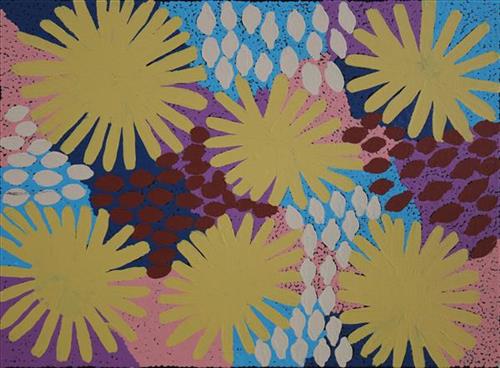
Dimensions: 410 x 560 mm

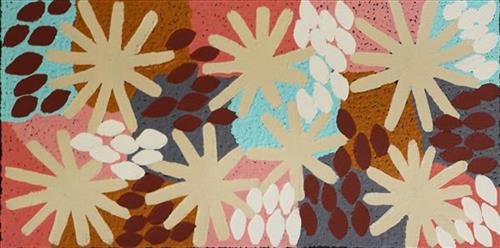
Women collecting Watiyawarnu (Acacia tenuissima). Back at camp after collecting the seeds they make large windbreaks for shelter and winnow the seed in the late afternoon. Immature watiyawarnu seed is ground into a paste and can be used to treat upset stomachs. There is an important ceremony for this Tjukurrpa.

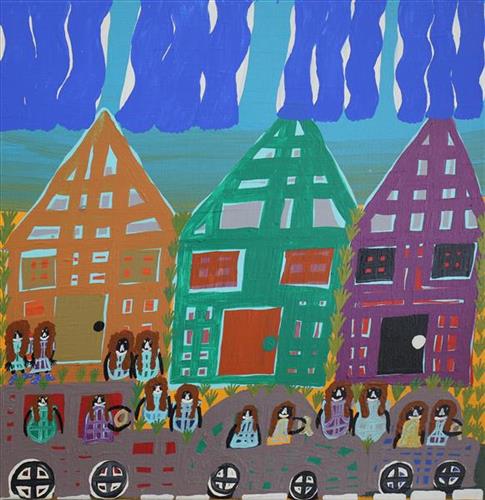
‘Three houses in Hermannsburg, family houses at Sandhill Camp. That’s like our family area at Hermannsburg. The families are sitting down outside watching tourist cars coming to Alice Springs.’

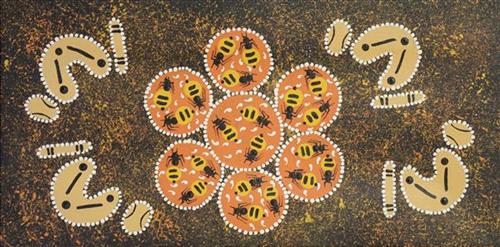
Women planning their dig for Honey Ants. Honey Ants hang from the ceiling of chambers their family dig out of the earth. The tunnels into the chambers are long and complex. That means the Honey Ants have to be tracked, and then the women use informed guesswork based on experience to decide where to dig. The process can take hours of very hard work, but the ladies are always completely rewarded when they find those delicious ants whose abdomens are full of sweet honey.

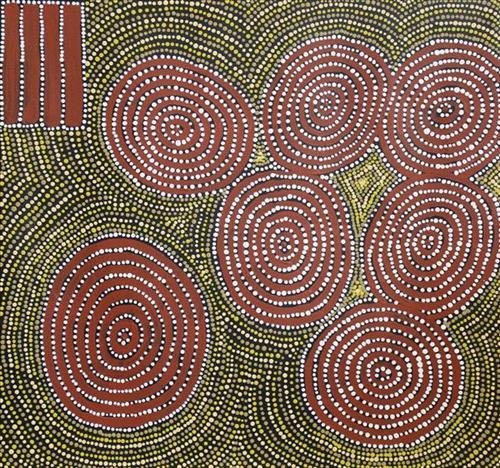
‘This painting is about the way women hunt Wardapi – that sand goanna. He digs holes in the dunes, makes his nest deep inside. Many of the holes all join up. Women hunt Wardapi in the dunes by digging out the holes. Sometimes cover one, and Wardapi runs out other one. Need to hunt him together. Find all the holes. Dig them at the same time. Someone going to get him that way.’
The Wardapi Jukurrpa [Varanus Gouldii Goanna] belongs to the Spencer Sisters. It comes from Yarripilangku [aka Yinyiripalangu], south-west of Yuendumu. A group of Warlpiri Karnta [women] are sitting down in a circle when a Japangardi Wati [man] from Puturlu [Mt Theo], called Wamaru came upon them. He wants to take one of them, named Yurlkurinyi, of Nungarrayi skin, which is the wrong skin for him. He takes the Nungarrayi woman up a hill, where they make love. In response, the earth on top of the hill turns to Ngunjungunju [white ochre], and yellow and red ochre. The yellow is for Karnta and the red for Wati. The ochre is used by Warlpiri people for love magic and ceremonial decoration. The Wati turns all the Karnta and himself into Wardapi, aka Varanus Gouldii goannas. This Jukurrpa belongs to the Napaljarri/Japaljarri and Nungarrayi /Jungarrayi subsections, and the Japanangka/Napanangka, Japangardi/Napangardi subsections of Puturlu. The women are often represented by ‘U’ shapes. Concentric circles may illustrate Wardapi holes, or their droppings left behind them, and Wardapi tracks are usually represented by ‘W’ shapes and wavy lines.

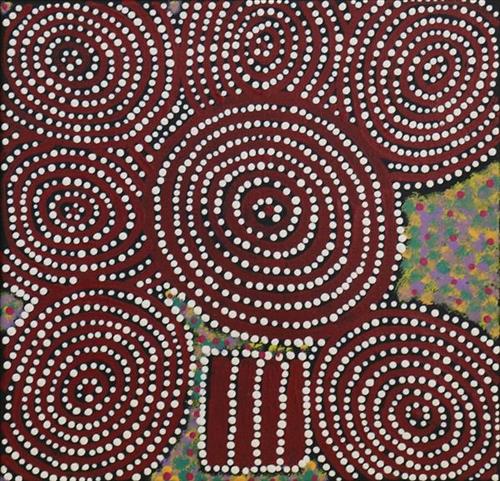
‘This painting is about the way women hunt Wardapi – that sand goanna. He digs holes in the dunes, makes his nest deep inside. Many of the holes all join up. Women hunt Wardapi in the dunes by digging out the holes. Sometimes cover one, and Wardapi runs out other one. Need to hunt him together. Find all the holes. Dig them at the same time. Someone going to get him that way.’
The Wardapi Jukurrpa [Varanus Gouldii Goanna] belongs to the Spencer Sisters. It comes from Yarripilangku [aka Yinyiripalangu], south-west of Yuendumu. A group of Warlpiri Karnta [women] are sitting down in a circle when a Japangardi Wati [man] from Puturlu [Mt Theo], called Wamaru came upon them. He wants to take one of them, named Yurlkurinyi, of Nungarrayi skin, which is the wrong skin for him. He takes the Nungarrayi woman up a hill, where they make love. In response, the earth on top of the hill turns to Ngunjungunju [white ochre], and yellow and red ochre. The yellow is for Karnta and the red for Wati. The ochre is used by Warlpiri people for love magic and ceremonial decoration. The Wati turns all the Karnta and himself into Wardapi, aka Varanus Gouldii goannas. This Jukurrpa belongs to the Napaljarri/Japaljarri and Nungarrayi /Jungarrayi subsections, and the Japanangka/Napanangka, Japangardi/Napangardi subsections of Puturlu. The women are often represented by ‘U’ shapes. Concentric circles may illustrate Wardapi holes, or their droppings left behind them, and Wardapi tracks are usually represented by ‘W’ shapes and wavy lines.

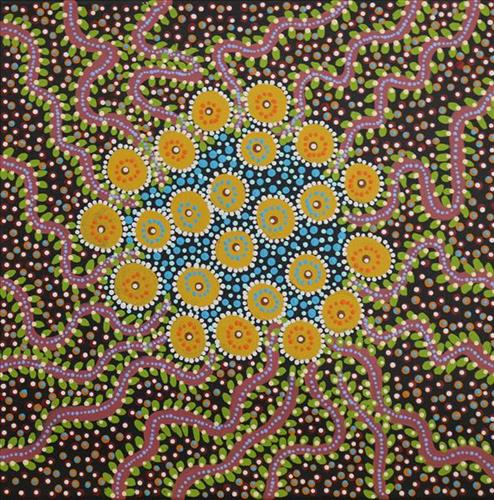
‘When I paint Bush Flower, my painting means all the seasons as they change, and the landscape views, about the Country, and about the place, where the bush tucker and bush medicine can be found. It’s about people going hunting, and about people telling their stories about that’s the time where to find new bush tucker, everything growing. It is like a map and a calendar, and history, genealogy, Everything! I see it like a very BIG picture. In my mind making lots of pictures sharing these stories with others so they can understand. It’s not just a leaf that I’m doing. The painting is the big picture in my mind, spreading everything out before me like a landscape view, and the seasons, and the calendar, and the history, and genealogy, and stories… It’s everything to me. All of what I know. That’s what I’m painting when I paint bush flowers.’

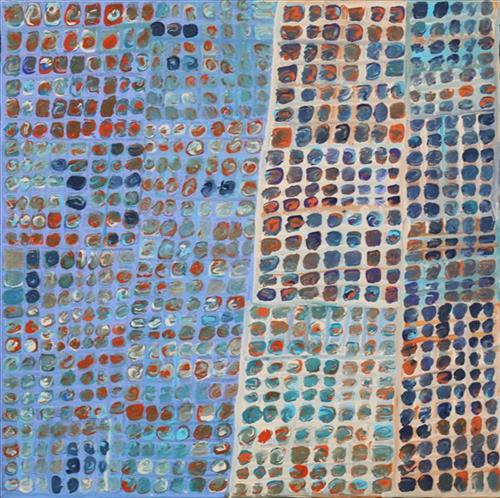
‘This is Petermann Range near Kaltukatjara – that’s Docker River [Community]. Puta Puta, Tjunti, Muliati. This is my father’s Country’.
Carbiene’s father was Snowy McDonald. He, like many other Pintupi-Pitjantjatjara people eventually moved east and north to refuges such as the Lutheran Mission at Ernabella, and Areyonga, during difficult drought times about 60-70 years ago. Some even ended up in Papunya once it opened as a Government Reserve in the early 1960s, as was the case of Carbiene’s father.
The shapes Carbiene paints represent an abstracted form of a series of important waterholes through the Petermann Ranges. Some of these sacred places now also have small Family Outstations or Homelands established nearby. For example, Tjunti is the name of a family outstation named for a soakage where the Hull River cuts through the Petermann Ranges. This is where Lasseter took refuge during his ill-fated expedition in search of gold. The cave he was found in near Tjunti is called Kuḻpi Tjuntinya (now commonly called Lasseter’s Cave in English).
The Petermann Ranges have now been designated an area of Conservation significance and the government work closely with local families in managing the area.
Carbiene is a Papunya Tjupi artist, having joined Papunya Tjupi Art Centre in 2018 and launching his career along with a cohort of emerging young male artists. Papunya is 250km West of Alice Springs, and when Carbiene visits Alice Springs he paints with Tangentyere Artists. Tangentyere Artists and Papunya Tjupi have a good working relationship, with several artists from each art centre coming from the same families. Tangentyere Artists’ figurative painter Betty Conway is Carbiene’s Aunty and Carbiene stops at Betty’s when in town.

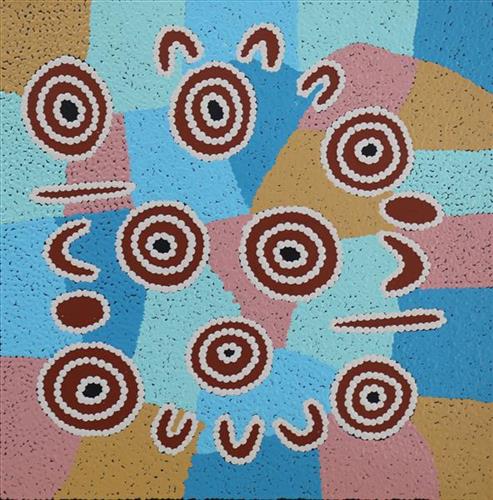
‘This painting is about the way women hunt Wardapi – that sand goanna. He digs holes in the dunes, makes his nest deep inside. Many of the holes all join up. Women hunt Wardapi in the dunes by digging out the holes. Sometimes cover one, and Wardapi runs out other one. Need to hunt him together. Find all the holes. Dig them at the same time. Someone going to get him that way.’
The Wardapi Jukurrpa [Varanus Gouldii Goanna] belongs to the Spencer Sisters. It comes from Yarripilangku [aka Yinyiripalangu], south-west of Yuendumu. A group of Warlpiri Karnta [women] are sitting down in a circle when a Japangardi Wati [man] from Puturlu [Mt Theo], called Wamaru came upon them. He wants to take one of them, named Yurlkurinyi, of Nungarrayi skin, which is the wrong skin for him. He takes the Nungarrayi woman up a hill, where they make love. In response, the earth on top of the hill turns to Ngunjungunju [white ochre], and yellow and red ochre. The yellow is for Karnta and the red for Wati. The ochre is used by Warlpiri people for love magic and ceremonial decoration. The Wati turns all the Karnta and himself into Wardapi, aka Varanus Gouldii goannas. This Jukurrpa belongs to the Napaljarri/Japaljarri and Nungarrayi /Jungarrayi subsections, and the Japanangka/Napanangka, Japangardi/Napangardi subsections of Puturlu. The women are often represented by ‘U’ shapes. Concentric circles may illustrate Wardapi holes, or their droppings left behind them, and Wardapi tracks are usually represented by ‘W’ shapes and wavy lines.

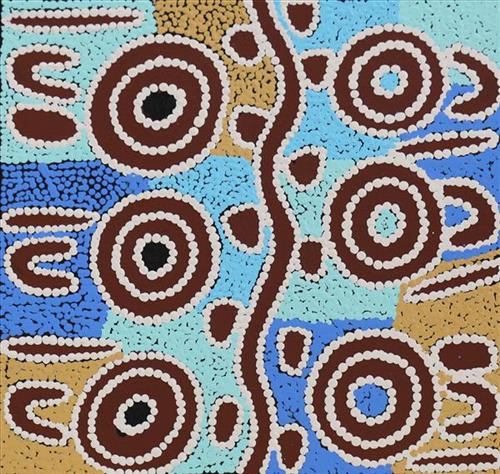
‘This painting is about the way women hunt Wardapi – that sand goanna. He digs holes in the dunes, makes his nest deep inside. Many of the holes all join up. Women hunt Wardapi in the dunes by digging out the holes. Sometimes cover one, and Wardapi runs out other one. Need to hunt him together. Find all the holes. Dig them at the same time. Someone going to get him that way.’
The Wardapi Jukurrpa [Varanus Gouldii Goanna] belongs to the Spencer Sisters. It comes from Yarripilangku [aka Yinyiripalangu], south-west of Yuendumu. A group of Warlpiri Karnta [women] are sitting down in a circle when a Japangardi Wati [man] from Puturlu [Mt Theo], called Wamaru came upon them. He wants to take one of them, named Yurlkurinyi, of Nungarrayi skin, which is the wrong skin for him. He takes the Nungarrayi woman up a hill, where they make love. In response, the earth on top of the hill turns to Ngunjungunju [white ochre], and yellow and red ochre. The yellow is for Karnta and the red for Wati. The ochre is used by Warlpiri people for love magic and ceremonial decoration. The Wati turns all the Karnta and himself into Wardapi, aka Varanus Gouldii goannas. This Jukurrpa belongs to the Napaljarri/Japaljarri and Nungarrayi /Jungarrayi subsections, and the Japanangka/Napanangka, Japangardi/Napangardi subsections of Puturlu. The women are often represented by ‘U’ shapes. Concentric circles may illustrate Wardapi holes, or their droppings left behind them, and Wardapi tracks are usually represented by ‘W’ shapes and wavy lines.