111582441171


Mungili Waterholes and Rockholes

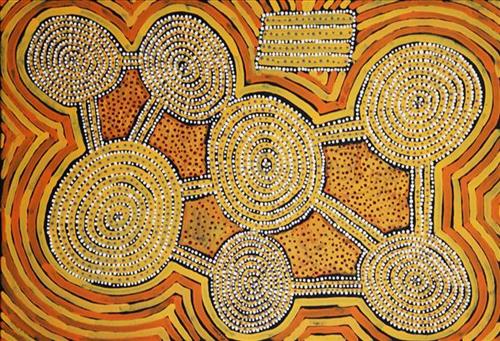
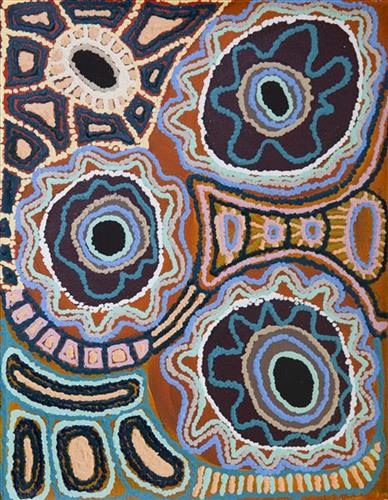
“No one goes there and sees that landscape. Only two, Mr and Mrs [refers to footsteps in painting]. They was walking to see if the water was in there. Walking on the creek sand, they see the colours and walk down to the water hole and dig where the waters been left. Dig the creek sand where there is still water. Little huts where they sit; move when it dries out. Leave remembrance behind. When the water fills up again; come back.

When the creek sand is still moist you can see the colours. You can see many colours – lovely colours come out. I do that in my mind [when painting], go and think about the rock colours there.

Different plants, water runs, and different plants are growing, different seeds. When it rains, all year round, when its overflowing. It’s all connected. The orange sand connects to one waterhole full of water, then flowing through the creek sand. This side down [pointing to one rock hole]; and it’s a bit up [pointing to another rock hole].

I was swimming there. Yeah, we go visit them a long time [ago]. We drink it, rainwater from the rain. Big waterhole. It’s a fresh water, when the rain comes, fills it up. One for swimming and another rock hole for drinking. 3 rock holes; another is special.”

– Marlene Anderson

In this work Marlene depicts a waterhole and rock hole located in Mungili, the small outstation community located just off the Eagle Highway in Western Australia, approximately 430 kilometres northeast of Wiluna and 250 kilometres north of Warburton. Marlene grew up in Mungili, and as such it forms a significant part of her ‘ngurra’ (home Country, camp). Typically Marlene depicts this site with a central large circular form that represents the main waterhole, surrounded by smaller circular forms representing satellite water bodies.

During the pujiman (traditional, desert dwelling) period, knowledge of water sources was critical for survival, and today Martu Country is still defined in terms of the location and type of water. Each of the hundreds of claypans, rockholes, waterholes, soaks and springs found in the Martu desert homelands is known through real life experience and the recounting of Jukurrpa (Dreaming) narratives by name, location, quality and seasonal availability. This encyclopedic knowledge extends even to the nature and movement of arterial waterways, and sustained Martu as they travelled across their Country, hunting and gathering, visiting family, and fulfilling ceremonial obligations. They would traverse very large distances annually, visiting specific areas in the dry and wet season depending on the availability of water and the corresponding cycles of plant and animal life on which hunting and gathering bush tucker was reliant.
111582441170


Punmu

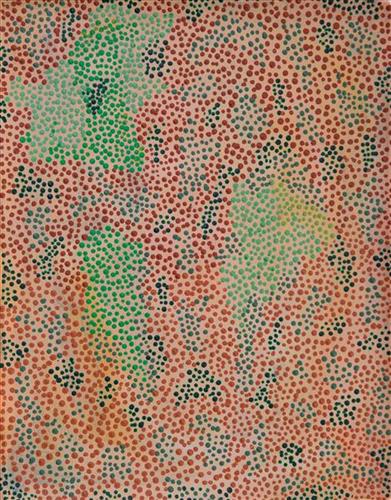
“Punmu, I went there when I was a young girl, a teenager with my mother and father before my mother passed. Big mob of people was there. No building, just little cubby houses [bough shelters]. Long time I been there. 

These here are the waterholes around Punmu; Rawa spring- Rawa means ‘long time’, Tuu-tuu, Jila-jila, Wirlarra and Yilyara. That is my ngurra (home Country, camp). We grew up in Punmu around all these water holes. I still live here with my grandkids, [we share the] same stories for all these places.” 

 – Marianne Burton


Punmu refers to a region and an Aboriginal community within its vicinity, located 670km North-East of Newman. Created during the return to Country movement of the 1980s, with the recognition of Martu land rights and native title, the community was named after a nearby Jukurrpa (Dreaming) story. As described by Marianne, Punmu is her ngurra; she grew up in this region with her parents. 

Punmu community sits on the edge of a large salt lake known as Nyayartakujarra, or Lake Dora. The lake runs south into Karlamilyi River (Rudall River). Surrounding Punmu are numerous fresh water soaks and the red tali (sandhills) typical of the area. The most frequently visited yinta (permanent springs) around Punmu include Wirlarra, Rawa, Yilyara, Jila-jila and Tuu-tuu.

The Country around Punmu features in several Jukurrpa stories. Of particular importance is the story of the Jila Kujarra (Two Snakes), one of the key Jukurrpa narratives for the Martu. Though the story belongs to Warnman people, it is shared across the Western Desert with several other language groups. The narrative centres on the travels of two snakes as they are pursued by the Niminjarra, spiritual ancestors of the Warnman people. 

Before transforming themselves into snakes, the Jila Kujarra were young brothers. As snakes, they began travelling home to their mother, but were intercepted by the Niminjarra, who tracked the Jila Kujarra to Paji, east of Nyayartakujarra (Lake Dora). Though the Jila Kujarra eluded their pursuers here by escaping under the lake at Paji, they were soon after speared and injured by two Pukurti (initiates with bundled hair) at Nyayartakujarra, who returned with the Niminjarra to cook the snakes at the site of Kumpupirntily (Kumpupintily, Lake Disappointment). As the Niminjarra cut down the length of the Jila Kujarra, the snake’s bladders were pierced, causing an explosion of scalding hot urine in which the Niminjarra all perished and became black rocks at the site. The spirits of the Jila Kujarra returned to their mother at Nyayartakujarra, where the mother and her sons entered the ground below Nyayartakujarra and remain to this day.

111582441105


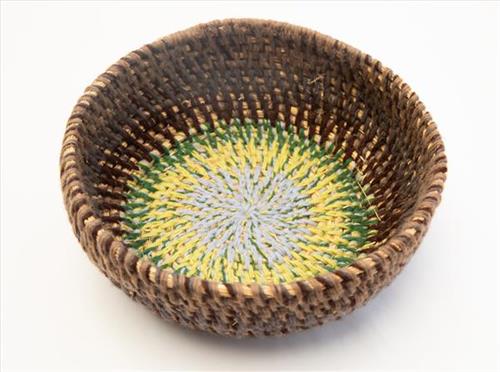
Basket

Weaving is a skill that has been practiced by Martu for thousands of years in the making of utilitarian and ceremonial items, such as yakapiri (bark sandals) and manguri (head pads for balancing carved carrying dishes). However, coiled basket weaving as an artform is a relatively newly adopted practice for the Martu, a skill passed on from Central Desert artists in the 1990’s. Leading Martu fibre arts practitioner Nola Taylor says that basket weaving was so popular amongst Martu women that it “spread across the desert like a waru (fire)”.

Each basket is built up through wrapping fine bundles of grass in brightly coloured wool and then stitching each round on to the previous one. The baskets are primarily made from puntayarra and minarri (Amphipogon Caricinus) grass, usually collected incidentally during trips to visit family, attend ceremonies, maintain Country, and hunt and gather bush tucker. Martu artists have developed a distinctive style of basketry and individual artists continue to develop new designs and incorporate novel materials, including steel, wire and wood, into their work. 

116182426667


Wardapi Jukurrpa

‘This painting is about the way women hunt Wardapi – that sand goanna. He digs holes in the dunes, makes his nest deep inside. Many of the holes all join up. Women hunt Wardapi in the dunes by digging out the holes. Sometimes cover one, and Wardapi runs out other one. Need to hunt him together. Find all the holes. Dig them at the same time. Someone going to get him that way.’

The Wardapi Jukurrpa [Varanus Gouldii Goanna] belongs to the Spencer Sisters. It comes from Yarripilangku [aka Yinyiripalangu], south-west of Yuendumu. A group of Warlpiri Karnta [women] are sitting down in a circle when a Japangardi Wati [man] from Puturlu [Mt Theo], called Wamaru came upon them. He wants to take one of them, named Yurlkurinyi, of Nungarrayi skin, which is the wrong skin for him. He takes the Nungarrayi woman up a hill, where they make love. In response, the earth on top of the hill turns to Ngunjungunju [white ochre], and yellow and red ochre. The yellow is for Karnta and the red for Wati. The ochre is used by Warlpiri people for love magic and ceremonial decoration. The Wati turns all the Karnta and himself into Wardapi, aka Varanus Gouldii goannas. This Jukurrpa belongs to the Napaljarri/Japaljarri and Nungarrayi /Jungarrayi subsections, and the Japanangka/Napanangka, Japangardi/Napangardi subsections of Puturlu. The women are often represented by ‘U’ shapes. Concentric circles may illustrate Wardapi holes, or their droppings left behind them, and Wardapi tracks are usually represented by ‘W’ shapes and wavy lines.

220982439169


Diane Kemarre Ross – Atyenh Amper (My Country)

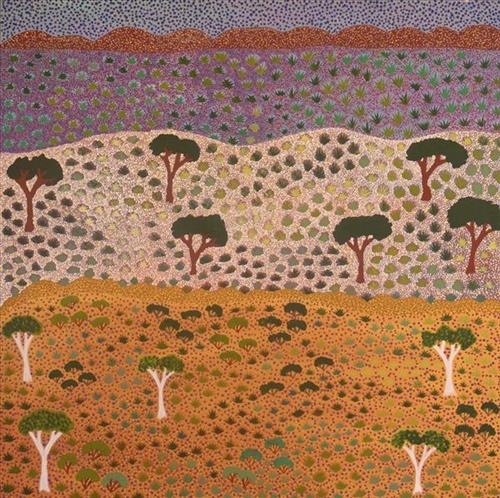
This is my country, it’s the country around Irrultja. This is where we like to go after big rain. After big rain there, we can go swimming. There is always good hunting on my country. It is good for me to paint my country and it makes me feel good.

The artists of Ampilatwatja made a conscious decision not to paint altyerr (dreaming stories). The artists paint their country where those stories sit.


221382439859


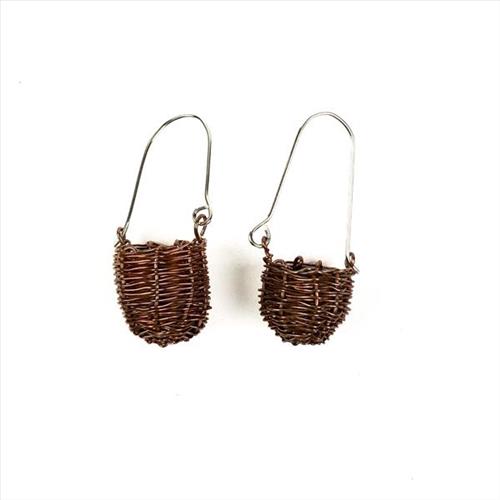
Handwoven Dillybag Earrings, Copper/Silver

Wagilak Yapa Watj (Wagilak Sisters) range –
exclusive jewellery from Indigenous women of Beswick. Developed in studio workshops with jeweller Kate Sale and weaver Fiona Gavino, traditional fibre artists are translating their skills into a series of fine woven wire earrings and pendants. Hand woven in sliver, gold and copper, traditional forms are transformed as delicate interpretations of string and dilly bags, baskets and mats.

Featuring sterling silver, 9ct gold and copper (all nickel-free work).

221382439858


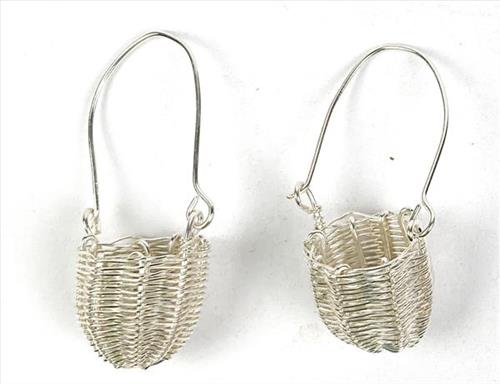
Handwoven Dillybag Earrings, Silver 925

Wagilak Yapa Watj (Wagilak Sisters) range –
exclusive jewellery from Indigenous women of Beswick. Developed in studio workshops with jeweller Kate Sale and weaver Fiona Gavino, traditional fibre artists are translating their skills into a series of fine woven wire earrings and pendants. Hand woven in sliver, gold and copper, traditional forms are transformed as delicate interpretations of string and dilly bags, baskets and mats.

Featuring sterling silver, 9ct gold and copper (all nickel-free work).

221382439852


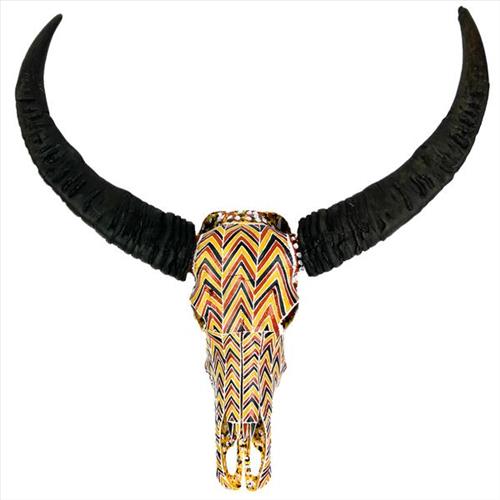
Buffalo Skull

Djilpin Arts is a not for profit Aboriginal Corporation that promotes the maintenance, development and transmission of traditional cultural knowledge systems.

For two decades, Djilpin Arts has been working on country with kin and culture, across generations. Our activities are rich in spirit, bringing, healing to the community and linking traditional knowledge with modern enterprise. Our Centre features galleries, museum collection and award winning accommodation for visitors.

Meet local people and artists, learn about traditional life and culture, browse and buy artworks, stay with us and experience seasonal cultural events, tours and immersions.

All artworks are made by local artists living in the community. Artwork reflects the traditional songs and stories that have been passed down through the generations with a contemporary edge: from paintings, prints, fibre art, carvings and dijeridu together to contemporary design prducts and fine woven wire jewellery.

221382439830


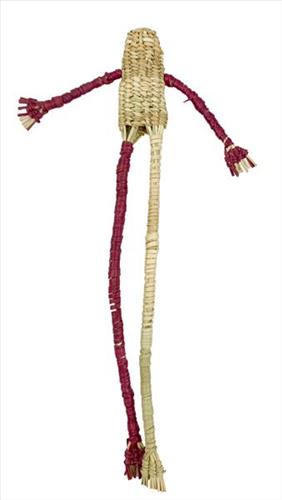
Mukuy Spirit Figure

These finely crafted woven figures represent Mukuy Spirit creatures. The Mukuy belong in Yirritja country called Galanbirni. At night you might hear them playing the Didjeridu. The Mukuy travel around a lot and are often found in sacred places. They are mysterious, sometimes playful and sometimes cheeky characters, often referred to as Devil Devil. Mukuy figures tell the stories of country, culture and spiritual beliefs.