114182409231

Published by on


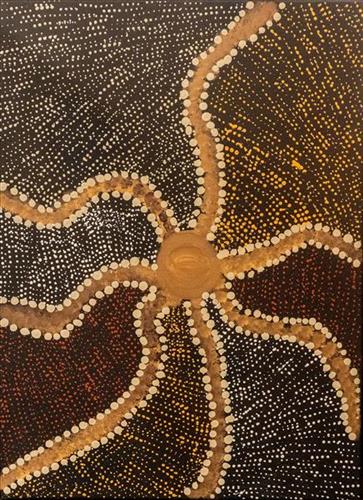
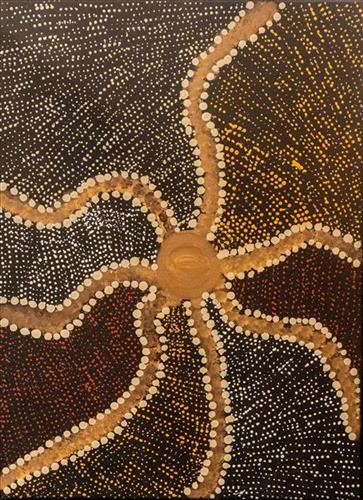
The boy who turned into wind (pirriya) at Walu rockhole

This story is about a young boy who had no parents and was neglected.

There were two men (the boy’s uncles) and one young boy camping at Walu Rockhole, an important water site in the Gibson Desert, northwest of the tri-state border between Western Australia, the Northern Territory and South Australia. 

The men went hunting and the boy stayed behind waiting. The men returned with an emu and pulled out its heart. The boy was holding the heart and blood spilt out onto the rocks. He ran away with the heart and turned into a big whirlwind. The big whirlwind. came up and swept the families away. Today you can still see the emu’s blood trail where it stained the rocks.

Walu rock hole is a special place north of Papulankutja (Blackstone) where traditionally Yarnangu families would gather when water was available in the holes found in a flat rocky area.

Categories: Papulankutja Artists

Name: Janet Nuyunkanya Lane


Language: Ngaanyatjarra


Community: Papulankutja (Blackstone)


Biography:

Janet has been creating paintings for Papulankutja Artists since its inception in 2003.  'These old people would paint and I would watch them and paint. I paint my own design, my own style.' She has also painted with Ninuku Arts centre that supports artists living in Pipalyatjara and Kalka in the APY Lands to the east of Papulankutja (Blackstone). 

Janet has one daughter and a granddaughter. She is also a tjanpi (grass) weaver and contributed to the following major projects.

In 2005 Papulankutja Tjanpi weavers won first prize in the National Aboriginal & Torres Strait Islander Art Award with their collaborative Tjanpi Grass Toyota sculpture. It was acquired by the Museum and Art Gallery NT as part of their permanent collection. This was the first time a contemporary fibre art piece took the major prize in the history of this prestigious award.

Songlines Exhibition - More recently she created a female sculptural figure – one of the Seven Sisters of the Tjukurrpa (ancestral creation stories) - for the extraordinary multi-faceted National Museum of Australia (NMA) Songlines exhibition that was on display at the NMA in Canberra from September 2017 to February 2018. The sculptures can see online as actual objects and have also been digitised as characters for a video.

The Tjanpi Desert Weavers created these sculptures with artists from Papulankutja, in the Blackstone Ranges between the Western and Great Victoria deserts. During a two-week camp at Kuru Ala, a remote Seven Sisters site in Western Australia, 14 tjanpi weavers wove the sisters into life. They then moved to a campsite just outside Papulankutja to finish the tjanpi sisters. Each figure was made by two artists. For many of the figures, a senior artist paired with a younger emerging artist so that the act of creation was also one of passing on skills to a future generation of tjanpi artists.


© the artist / art centre