Biography:
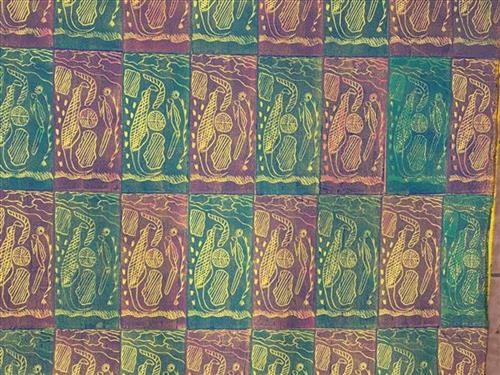
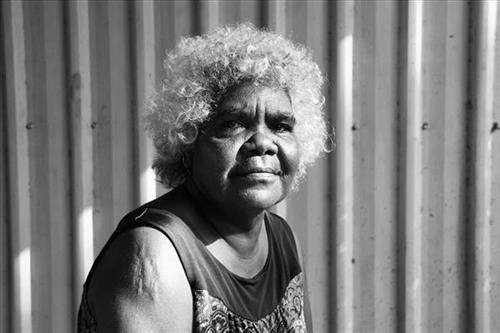
Janet Kalidjan Marawarr is a senior Kuninjku artist from Maningrida in central Arnhem Land, with a textile practice spanning almost 40 years at Bábbarra Women’s Centre. She comes from a strong family line of Kuninjku artists; her grandfather and her late husband’s father were pioneers of the Kuninjku dolobbo (bark painting) movement. Marawarr works across bark painting, lino printing, and screen-printed textiles, carrying the stories between media using colour, motifs and rarrk (cross hatching) to express her djang (ancestral creation stories).
Janet began printing at Bábbarra as a young woman, learning through observation. Her , draws on knowledge passed down through her family and elders, while also engaging with new materials and processes. As Janet explains:
“… I tell the same stories from bark painting to lino and screen. I can’t change anything, no.. The stories it’s all the same, we’re painting the same stories every single time. Bininj [Indigenous People] we are smart, we know already inside our brain and our heart what we can paint. Singing, painting, dancing, ceremony, it’s all tied together, it’s now and it’s our future.”[i]
Janet’s work has been shown nationally and internationally. In 2019, she travelled to Paris to launch the touring exhibition Jarracharra (Dry Season Wind) of which her textile designs were prominent. In 2022, her textiles were included in Aboriginal Screen-Printed Textiles from Australia’s Top End at the Fowler Museum, UCLA, Los Angeles. In 2021, Janet travelled to Aotearoa/New Zealand as part of a Māori Leadership and Global Trade Summit at Parliament House, where she met with Māori leaders and social enterprises working across business, governance, and culture.
In January 2023, Janet was invited by the Australian Consul-General in Kolkata to visit India as a guest of honour. During her visit to West Bengal and Odisha, she shared knowledge with women’s textile collectives including the Bridging Culture and Art Foundation’s Kantha studio in Tushkhali, Sadaf India Studio, and the Navajeevan Co-operative Society.
Beyond her art practice, Janet is a certified translator and a Director of Bawinanga Aboriginal Corporation, as well as a member of its Arts and Culture Sub-Committee. She is also a Director of Nja–Merleya Aboriginal Corporation. Janet continues to play an important role at Bábbarra Women’s Centre, supporting the passing on of knowledge across generations through her art and leadership.
[i] Janet Marawarr in conversation with Ingrid Johanson in essay, Daluk. Ngarribekkan.., in publication Manburrba ‘Our story of printed cloth from Babbarra women’s Centre, CDU Press, 2023