111982425290

Published by on


Ngalbenbe (Sun)

Kune and Rembarrnga religion and cosmology includes beliefs about how the universe began, how it was created and how it continues. Many stories are oracular and multi layered, and it continues to guide and inform group thought, behavior and defines existence, knowledge, values, reason and of course language.The symbolism in the Ngalbenbe story touches on all these areas. Ngalbenbe is the sun, beyond this yellow dwarf star is another entity a larger star, the mother of Ngalbenbe. Each morning Ngalbenbe rises and travels through the sky and sets each night. She tells her mother, “I am tired, can I rest for just one day and you will rise? “No, I am too powerful, I can not shine, if I rise everything will die.” At the Ngalbenbe Django site Kajaltmerra there are two kun-bad (rocks) a large one and a smaller one representing the sun and her mother. In this installation that re-tells the story, Yarinkura has made a Wallabi (butterfly fish trap, carved djeng (fish) a kun-rak (campfire) all elements of the Djarngo.
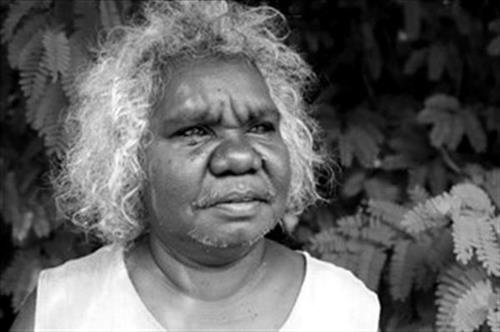
Name: Lena Yarinkura


Language: Kune


Community: Maningrida


Biography:

“No one taught me to use pandanus to make my animals. I have been teaching myself I create new ways all the time.  They are only my ideas…I pass my ideas on to my children and my grandchildren. It is important that I teach them, because one day I will be gone, and they will take my place.”

- Lena Yarinkura, 2012

 Lena Yarinkura is renowned for her ambitious and highly distinctive pandanus and paperbark fibre sculptures. Yarinkura diverged from the more conventional fibre work of her contemporaries to become one of the first Arnhem Land women to work with fibre in a sculptural way.

 Yarinkura has developed her method using pandanus in much the same process as a dilly bag or fish trap might be made: beginning by creating a closed end, much like the base of a dilly bag. When making her noted Yawkyawk spirit form,  Yarinkura works up and out to gently expand the woven structure to fashion a bulbous torso before narrowing the weave at the torso’s base or hips to create a flat two layered section representing the tail fins.  The ochre pigment applied to the textured weave of the pandanus fibre, suggest the scales of the water spirits and the shimmering quality to their skin.

 Yarinkura ‘embraces divergence and invention, and allows for intuition and spontaneity in her process’.[1]   

 [1] Diane Moon, ‘Lena Yarinkura: “weaving, it can make you happy”’, in Diane Moon (ed.), Floating Life: Contemporary Aboriginal Fibre Art, Queensland Art Gallery, Brisbane, 2009, p.134.”


© the artist / art centre