111582429312

Published by on


Community Life

“They wanted to come back to their home land, their ngurra (home Country, camp). They went and started up Punmu first. And from Punmu they started up Parngurrr, and then they started up Kunawarritji. And every community they started, first building it was the school, school was the first building.” 

– Curtis Taylor

The traditional lands of the Martu people encompass the Great Sandy Desert and Rudall River regions of Western Australia, and include speakers of Manyjilyjarra, Warnman, Kartujarra, Putijarra and Martu Wangka languages. Since the 1980’s Return to Country movement, many Martu have chosen to live in remote Aboriginal Communities, including Punmu, Parnngurr, Kunawarritji, Jigalong, Irrungadji (Nullagine), and Warralong. Here, Martu are able to live a life where connections to Country can be best maintained. 

Sites for modern day Aboriginal communities were designated for their close proximity to good spring water, their significance as historical and cultural sites, and for their relevance to particular family groups. Most communities contain an office, community store, school, health clinic, art shed, mechanics workshop, sports field, and areas for gathering during ceremonial events. Kuulkaja (community schools) were in many instances one of the first spaces to be established when the communities were formed. They are recognised as being at the heart of each community, and play an important role in keeping culture, Country and language strong.

Life in community is unique; the distance between communities and major centres means few outside visitors pass through, travel between communities and towns is via long 4WD journeys or on the mail plane, fresh fruits and vegetables are relatively scarce, and up until recently telephone communication was limited to a few fixed landlines and community phone booths. Whilst these communities are continually being modernised, Country remains central to community life, both physically and culturally.
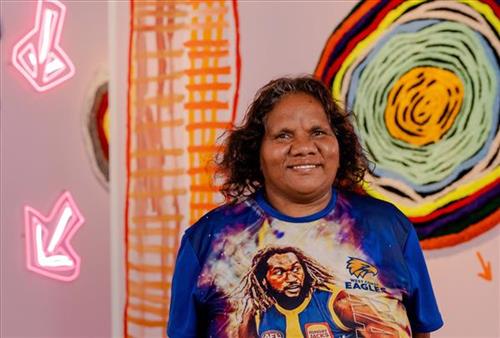
Name: Judith Anya Samson


Language: Putijarra


Community: Parnpajinya


Biography:

"My name is Anya Judith Samson. My skin [group] is Milangka and I speak Martu Wangka. I was born in Hedland, Port Hedland seaside, but I moved to Jigalong community with my nanna [Dadda Samson (dec.)] and my pop. Then we moved to desert, to Puntawarri, [Canning Stock Route] Well 17. I was still a young girl, still crawling in the desert. It was nice there. Some other families lived there with us. We had some farm, some vegetables. We went schooling in Puntawarri at the school, learning ‘two way’ [refers to teaching in both Martu Wangka and English, with a focus on local cultural and ecological knowledge]. We used to go and get some parnajarrpa (goanna) and turkey. We had a Toyota truck. We been go hunting at the desert. Some people there still, but they gotta build some new houses and then we going back to [live in] Puntawarri.

My nanna’s sister had a house here in Newman, so we used to come and visit. I did high school here in Newman. Now I move between Jigalong and Newman. My nanna [was] living in Jigalong, so I still go visit there.

I started to do painting here at Martumili when I was a young girl. I been help my nanna painting, we were painting Puntawarri one. My nanna was teach me to paint [but] I do my own style now- me, Anya. I paint the Canning Stock Route, [and Canning Stock Route] Well 17 at Puntawarri. My favourite thing is going out to Country, and go back to Jigalong and Puntawarri, and to do some painting about Country. Painting helps me be strong. My family and my culture is feeling proud. I feel happy when I paint- pukurlpa. Happy! 

I also like playing softball. We play for Jigalong, Western Desert. I also like to dance and listen to music. I work with Martumili now. I come to work and wash all the paint, put all the tubs in the colour and wash all the brushes. I help sell the paintings, and photograph and catalogue them. I went to America, Fremantle, the Gold Coast, Sydney,  and Alice Springs with Martumili. I like to work at Martumili - happy, pukurlpa. I also work for KJ (Kanyirninpa Jukurrpa ranger group) mob in Jigalong too."

- Judith Anya Samson


Born in Port Hedland, Anya has spent most of her life between Jigalong and Parnpajinya (Newman). After losing her parents at a young age, she was raised by her grandparents, Dadda Samson (dec.) and Yanjimi (Peter) Rowlands (dec.), both highly regarded Martumili artists. Anya learned to paint from her grandmother, Dadda, and together they frequently travelled to her Country around Puntawarri and the Rabbit Proof Fence areas.

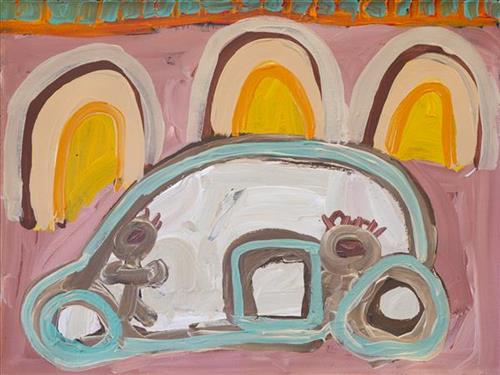
Today, Anya is recognized as a leading figure among the younger generation of Martumili Artists. She is celebrated for her vibrant and unrestrained colour palettes, bold, expressive style, and the use of geometric walka (iconographic forms that depict people, animals, tracks, geographic formations, and water sources). Her paintings often portray the Country of her ancestors, including Puntawarri, Jigalong, and the Rabbit Proof Fence.

Anya’s work has been acquired by the Art Gallery of Western Australia, the Art Gallery of Queensland (GOMA), and the National Museum of Australia. In 2025, she held her first solo exhibition, Anya’s Puntawarri World! at DADAA Inc, Fremantle, WA.


© the artist / art centre