377810582402361


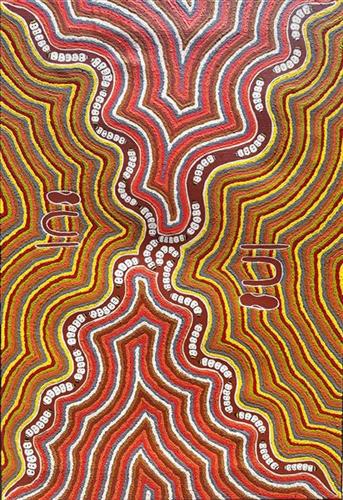
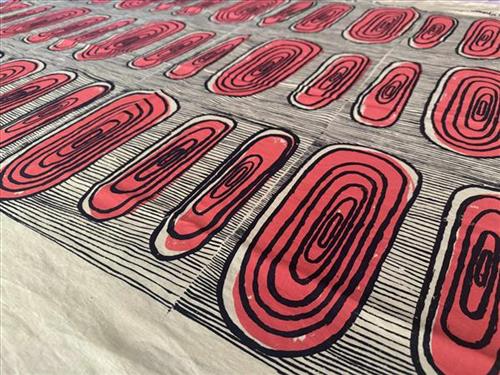
Kunwardde dja Kunronj (Rocks and Billabong)

Abigail has depicted the waterholes or Kunwardde dja Kunronj (Sacred Rocks and Billabong) that lie on the plains near Mankorlod, the country for which she is a traditional owner.

The waterholes remain wet throughout the year, even during dry season. This site is connected to the artist’s djang (dreaming), the ngalng (freshwater yabbie) and stone country. Mankorlod homeland is a three-hour drive from Maningrida in the kunwardde (stone country).

377810582402362


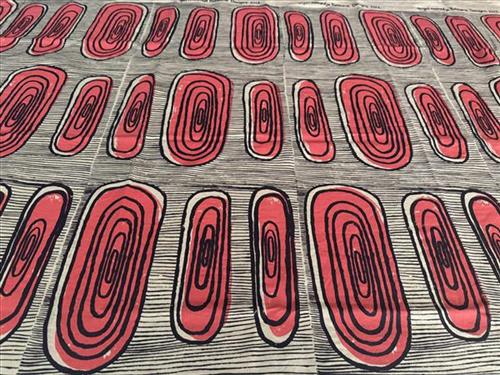
Kunwardde dja Kunronj (Rocks and Billabong)

Abigail has depicted the waterholes or Kunwardde dja Kunronj (Sacred Rocks and Billabong) that lie on the plains near Mankorlod, the country for which she is a traditional owner.

The waterholes remain wet throughout the year, even during dry season. This site is connected to the artist’s djang (dreaming), the ngalng (freshwater yabbie) and stone country. Mankorlod homeland is a three-hour drive from Maningrida in the kunwardde (stone country).

377810582402360


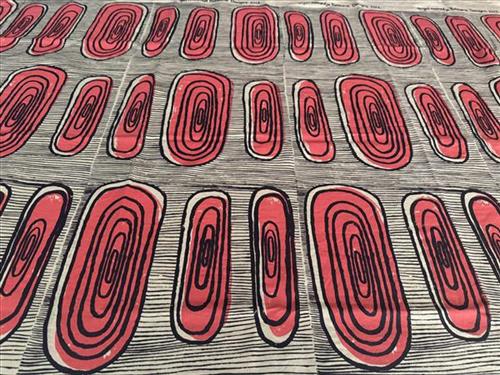
Kunwardde dja Kunronj (Rocks and Billabong)

Abigail has depicted the waterholes or Kunwardde dja Kunronj (Sacred Rocks and Billabong) that lie on the plains near Mankorlod, the country for which she is a traditional owner.

The waterholes remain wet throughout the year, even during dry season. This site is connected to the artist’s djang (dreaming), the ngalng (freshwater yabbie) and stone country. Mankorlod homeland is a three-hour drive from Maningrida in the kunwardde (stone country).
114182402508


Wati Kutjarra

This is the story of two powerful magicians who came to the Ngaanyatjarra Lands from far away to the west;

‘These two men are always together, always camping together. They do all sorts of tricks when they travel across the lands as they stop from place to place. When they reached ‘Wirtapi Wara’ (Long Black or Blackstone Range) they argued about which way to go around. One went around the south side and the other the north side.

At a distance it seemed they didn’t recognise each other or perhaps they were just pretending not to recognise each other! It is also said that at Papulankutja they tricked each other by changing their appearance at the same time so they had no chance to recognise each other. The name Papulankutja comes from the Ngaanyatjarra word meaning, ‘to stare without recognising each other’.

‘They usually took the form of goanna but they could turn into other animals as well. Finally, when they got to Kaltukatjara (Docker River) they had become so arrogant that without realising they walked straight into some local men’s business even though they were warned by the local women. The goanna men led themselves blindly to their fate”.

114182402507


Salt lake

Salt lakes,salt pans or clay pans are a fundamental part of the balance between groundwater (water occurring naturally underground) and surface water, like rivers and streams. There are many salt lakes in the Ngaanyatjarra Lands.

114182402505


Kungkarrangkalpa (Seven Sisters)

‘Kungkarrangkalpa’ (The Seven Sisters or Pleaides) is significant Tjukurrpa (dreamtime). Its origins you may be familiar with in astronomy and its connection to ‘Wati Nyiru’ (Magic Man or Orion).  The roots of this dreaming stems across indigenous groups around the world. The Australian Aboriginal songline is one part to the whole dreaming which can be traced all around the world. The ladies of the Ngaanyatjarra Lands depict their significant chapter and understanding of the journey of the sisters. The different versions of this story depend on where you live and the significance’s of local Tjukurrpa places.

Nyiru fell in love with the sisters but he was of the wrong skin group to marry, but he still pursued them on their journey. The sisters travel across the land to escape Nyiru’s unwanted attentions, but he is persistent and always finds them. There are significant land forms which can be sited today that evidence this dreaming. As Nyiru is chasing the sisters he tries to catch them by using magic to turn into the most tempting kampurarrpa (bush tomato) and the most beautiful Yirli (wild fig tree), for them to eat and camp under. However, the sisters are knowledgeable of his magic and too clever for Nyiru who they outwit again and again. They go hungry and run through the night rather than be caught by him. As the journey continues, Nyiru gets so frustrated at the wit of the sisters that he uses his magic to make the oldest sister sick to try and get closer to her. The other sisters rescue the big sister and nurse her back to health. It is said he also captures the youngest sister, but with the help of the oldest sister, she escapes back to her sisters who are waiting for her. Eventually, the sisters fly into the sky to escape Nyiru, forming the constellation. Nyiru felt lonely, longing for the sisters who were so far away. Nyiru used his magic to go to the sky, forever in pursuit.

114182402504


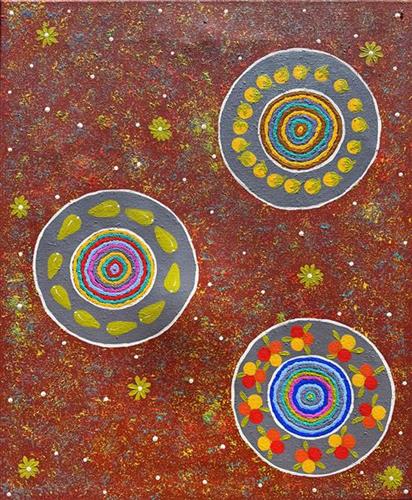
Women collecting bush foods

The Anangu people travelled vast desert landscapes, following the seasons for food and shelter, deeply attuned to the rhythms of the land. This resilience and wisdom embedded in traditional bush foods that sustained them across generations.

Maku (Witchety Grubs), with their creamy, nutty flavour, represent survival and the resourcefulness to draw nourishment from deep within tree roots. Kampurarrpa (Desert Raisins), small and tangy, add brightness and essential nutrients to desert diets, thriving under intense sun.

Ipalu (Bush Banana), a climbing vine with crisp, slender fruits, offers fibre and hydration—a refreshing staple in arid climates. Ili (Bush Figs), with their mild sweetness, grow from rugged trees, offering a delicate treat in the harsh terrain.

Through vibrant colours and intricate designs, these bush foods embody the spirit of Ngaanyatjarra culture, each a testament to the land’s gifts and the knowledge passed through generations.

114182402501


Women collecting bush foods

The Anangu people travelled vast desert landscapes, following the seasons for food and shelter, deeply attuned to the rhythms of the land. This resilience and wisdom embedded in traditional bush foods that sustained them across generations.

Maku (Witchety Grubs), with their creamy, nutty flavour, represent survival and the resourcefulness to draw nourishment from deep within tree roots. Kampurarrpa (Desert Raisins), small and tangy, add brightness and essential nutrients to desert diets, thriving under intense sun.

Ipalu (Bush Banana), a climbing vine with crisp, slender fruits, offers fibre and hydration—a refreshing staple in arid climates. Ili (Bush Figs), with their mild sweetness, grow from rugged trees, offering a delicate treat in the harsh terrain.

Through vibrant colours and intricate designs, these bush foods embody the spirit of Ngaanyatjarra culture, each a testament to the land’s gifts and the knowledge passed through generations.

111982402500


Birlmu or Namarnkorl (Barramundi)

It is well known that Aboriginal art often depicts images of sacred totems or dreamings of Aboriginal culture. However, the world of the non-sacred also provides a rich source of subject matter for Aboriginal art. Much of the rock art of western Arnhem Land for example features secular topics such as common food animals and plants, depicted because of their economic importance but also merely because of their existence in the environment. The artist has painted ‘birlmu’ or ‘namarnkorl’ (Barramundi [Lates calcarifer]). During the dry season the barramundi is an important food source for inland Aboriginal people. These fish are caught throughout the artist’s clan estate, either in fishtraps woven from pandanus or sedge grass, or else hunted with spears and fishing lines in billabongs and streams where they shelter from the sun under fallen logs or amongst the leaves of water plants.