220982317708


My Grandmothers Country – Denise Ngwarraye Bonney

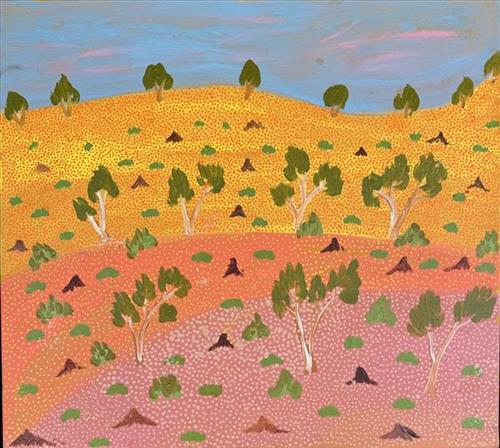
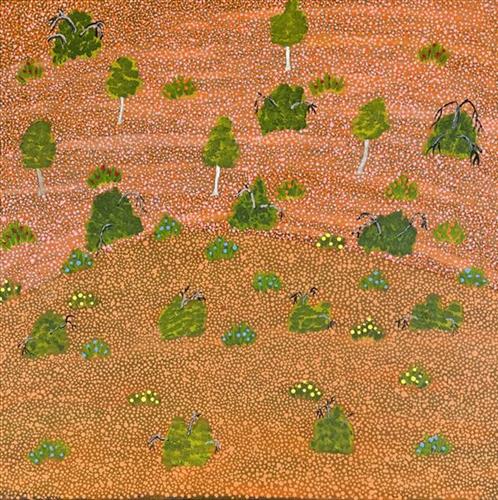
The community of Ampilatwatja made a conscious decision not to paint ‘altyerr’ dreaming stories. The artists paint their country where those stories belong.

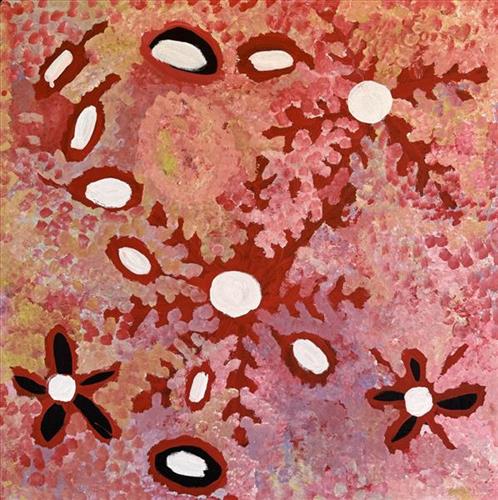
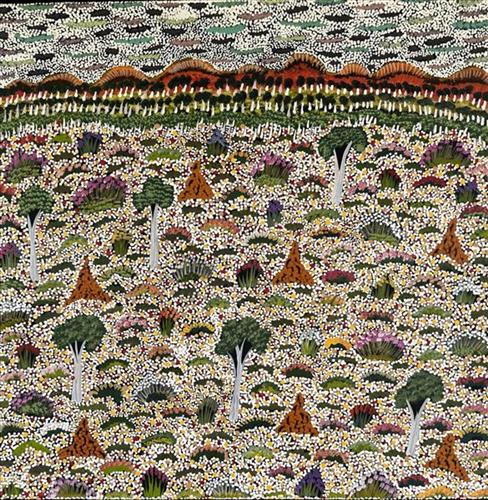
Denise paints ‘Tijamburra’, her Grandmothers country.

“This is my Mothers Mothers country, out near Canteen Creek, we go hunting  for wild onions, goannas, echidnas and sugar bag honey in the trees. I like to hunt in my country, there is water all year round even if it look dry, we follow the bird tracks to know where to dig and then we find water.


This painting is after rain, many grasses are out, but the riverbed is still sandy.”

220982317707


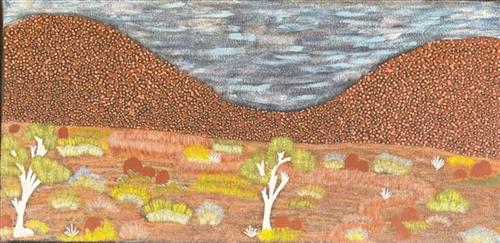
Great Grandmothers Country – Gunderson Kemarre Lewis

I paint my Great Grandmothers country around Canteen Creek.  Long time ago she hunted around this soakage in this country.   When I paint, I paint that country, the soakage the bushflowers the sandhills and the distant mountains.  I hunt this country now.

220982317706


My Fathers Country

“This is my Father’s country.

This country provides many bush foods for my people.

Painting my country helps to keep the country very strong for current and future generations of Alyawarr people.”

220982317705


View of Country – Alec Pula Lewis

The community of Ampilatwatja made a conscious decision not to paint ‘altyerr’ dreaming stories, the artists paint their country where those stories sit.


Alec was born at McDonald Downs Station.  He grew up there with his family living traditionally on the land.  Alec did not attend school, he moved between different communities with his family. 


Knowing your country is an important part of living in a remote community like Ampilatwatja. Knowing when and where to go hunting and gathering, knowing where there is ‘soakage’ (where you can dig for water), travelling with family for ceremonies, and maintaining a connection with the land.

“This is my country, my view of country.”

220982318060


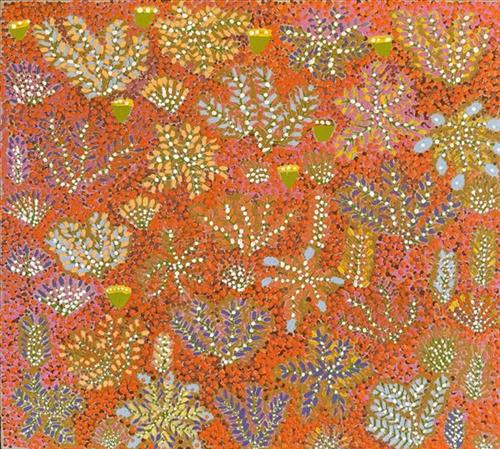
Bush Medicine Plants

“Bush medicine plants are used for healing on the body and for drinking. We make this by grinding the plants with a rock, we use the juice and the fibre of the plant.

We collect bush medicine plants when we are out hunting. Different kinds of plants grow during different seasons.

There are lots of different medicines, we know what their stories are, we learnt them from our parents and we teach these stories to our children.”

Bush medicine knowledge is still strong in Ampilatwatja, it continues to be passed down to the younger generations and is widely used.


When the women go hunting they often gather bush medicine. The plants depicted here are found in the country around Ampilatwatja, they are used for soothing skin infections and to make a drink to help with colds and coughs.


Painting bush medicine stories is important because it helps to maintain a strong knowledge and culture for the community.

220982317963


Bush Tucker – Maisie Petyarre Bundey;-

Maisie paints the bush tucker found in her country, the area that surrounds Boundary Bore in the Utopia homelands. She paints bush plums, bush bananas, bush potatoes and bush medicine plants. The main motif which recurs often in Maisie artworks is a full coolamon. When she paints she always speaks of gathering and hunting on her country ‘long way from here, long time ago’, filling up coolamons with ‘bush potato, bush banana, goanna and porcupine.’ Maisie always says her family are ‘happy ones, healthy ones.’
 

111982318276


An-gujechiya (Fish Trap)

To make fish traps and fish net fences artists firstly get vine (mirlarl) from the jungle and they put it in water for one night to make it soft. Next they start weaving it; they make rings for the inside to keep the fish trap’s shape. Artists work for three or four weeks on the fish trap. They also make string from kurrajong (burdaga) to attach the hibiscus (bardainy) rings and to tie the conical end of the fish trap. This fish trap is used in saltwater and freshwater. People also use fish net fences called mun-dirra. A long time ago they would put the mun-dirra across rivers and creeks. In the middle they would place the an-gujechiya. They also used small things like sticks, rocks, mud and grass to block the fish from going through. People would then catch fish like saltwater barramundi rajarra, freshwater barramundi (janambal), small black freshwater catfish (buliya), bonefish (an-guwirrpiya), and sand bass (dalakan) in these fish traps.

111982318273


Burlupurr – large dillybag

Burlupurr, or dilly bag, is a large woven collecting basket. These large bags are often made from the vine ‘Malasia scandens’, a strong pliable plant which grows along the floor and into the canopy of monsoon vine thickets. The bags are used to collect any kind of large numbers of heavy foods such as fish caught in conical fish traps or large collections of yams.

They can also be made from Pandanus spiralis, a plant which grows in many areas of Arnhem Land. These dilly bags are a tightly woven collecting basket, very finely made. These dilly bags are often used to collect sugarbag, the native honey 

As well as being of practical use, dilly bags are also of religious significance to Arnhem Land people. Dilly bags are said to be totemic objects and associated with particular sites in the landscape.

111982318268


Burlupurr – large dillybag

Burlupurr, or dilly bag, is a large woven collecting basket. These large bags are often made from the vine ‘Malasia scandens’, a strong pliable plant which grows along the floor and into the canopy of monsoon vine thickets. The bags are used to collect any kind of large numbers of heavy foods such as fish caught in conical fish traps or large collections of yams.

They can also be made from Pandanus spiralis, a plant which grows in many areas of Arnhem Land. These dilly bags are a tightly woven collecting basket, very finely made. These dilly bags are often used to collect sugarbag, the native honey 

As well as being of practical use, dilly bags are also of religious significance to Arnhem Land people. Dilly bags are said to be totemic objects and associated with particular sites in the landscape.

111982318266


An-gujechiya (Fish Trap)

To make fish traps and fish net fences artists firstly get vine (mirlarl) from the jungle and they put it in water for one night to make it soft. Next they start weaving it; they make rings for the inside to keep the fish trap’s shape. Artists work for three or four weeks on the fish trap. They also make string from kurrajong (burdaga) to attach the hibiscus (bardainy) rings and to tie the conical end of the fish trap. This fish trap is used in saltwater and freshwater. People also use fish net fences called mun-dirra. A long time ago they would put the mun-dirra across rivers and creeks. In the middle they would place the an-gujechiya. They also used small things like sticks, rocks, mud and grass to block the fish from going through. People would then catch fish like saltwater barramundi rajarra, freshwater barramundi (janambal), small black freshwater catfish (buliya), bonefish (an-guwirrpiya), and sand bass (dalakan) in these fish traps.